Mars: The Protrusion and the Ring
How a fast, expanded Mars set Deimos and Phobos free from a volcano on its tapered protrusion
Phobos and Deimos circle Mars on near-circular orbits of small inclination above its equatorial plane; Phobos lies inside the corotation radius and Deimos outside it. The surface of Deimos is smooth and rounded, while Phobos is scored by systems of long, parallel grooves. Both bodies are light and porous. Although Mars lost most of its water, a large reservoir of liquid water lies today 11.5–20 km beneath its crust.
In this paper we propose a single explanation: Mars raised a pressure-driven, tapered planetary protrusion on its equator, and both moons left from a volcano standing near its tip. The young Mars was 1.5 times its present radius, its mean density was 1,166 kg m, and it turned once in seven to nine hours; a homogeneous body of that density cannot turn faster than once in 5.27 hours. The spin pushed material to the equator; where most mass gathered, the protrusion rose, fed and supported by pressure from within, and tapered outward to a narrow tip. Its tip lagged behind the spin, and when the protrusion later drew inward it lay down westward. On the topography it runs from a base in Valles Marineris to a tip beside Pavonis Mons, 2,996 km on today’s surface, and the Tharsis rise along it is two to three times steeper on the west than on the east. The gravity field points to the same place: the long axis of the Martian equator lies at 255E, on the protrusion, and the figure of Mars is still offset toward it: Mars still carries the protrusion. As the protrusion returned, its interior drained back east along its axis, through Noctis Labyrinthus and Valles Marineris, over a spill point and north through the chaos to Chryse.
The measured length is the hypotenuse of a right triangle, stretched along the raised equator of the young Mars. On the standing protrusion the vent of Pavonis stood 4,450 km above the equator, where gravity had fallen to about a quarter of its surface value and the outward push of the spin cancelled it: a body there weighed nothing, and moved at the speed of an orbit. Under these conditions an ordinary volcano — a shallow reservoir about 5 km down and an overpressure of 10–50 MPa, the values of Vulcanian explosions on the Earth — set two bodies free. Deimos left first, when the day was 7.3 hours, on a long orbit that crossed the ring. Phobos left second, when Mars had slowed to 8.3 hours and the corotation line had reached the vent, directly onto a circle at the line.
A round ring of condensed steam, which Mars had built from its own volatiles, stood beyond the line in the equatorial plane. It rounded both orbits and flattened their tilt from about 10, the tilt of the vent relative to the centre of the protrusion’s base. It held Deimos long, ground it to its present size and carried it outward, and the tide of the young Mars, 8–20 times stronger than today’s, carried it beyond the final place of the line. The ring could give Phobos nothing, for Phobos already moved at its speed; its gaseous inner edge, as thin as the Earth’s air at about 115 km, exerted on Phobos a weak headwind that balanced the push of the tide, held it at the line and led it outward with the line as Mars slowed. When the ring dried, from the outside in, Phobos stood near 19,000 km and the day was about 22 hours; the line passed it, and it has been falling since — slowly for three billion years, fast in the last few hundred million.
Mars lost about 87% of its spin. It was slowed not by its moons, which carry a millionth of its spin, but by water and gas that left through the corotation line: 6–11% of its mass, a fifth to a third of the water of a young Mars rich in water. The water that never left stayed sealed beneath the crust.
Part I tells this sequence, each stage with the questions a reader will ask and their answers. Part II sets out the evidence: the pit of Pavonis, the two faces of the moons, their orbits, and the water. Part III gives detailed, falsifiable predictions — among them the composition of the samples of Phobos that the Martian Moons eXploration mission (MMX) is to return in 2031.
Keywords: Mars; Phobos; Deimos; Tharsis; Pavonis Mons; rotational fission; circumplanetary ring; corotation radius; tidal evolution; MMX
One protrusion, one volcano, one ring. A fast, expanded, water-rich Mars raised a tapered protrusion that now lies westward as the Tharsis rise. From Pavonis, high on the standing protrusion, where a body weighs nothing, an ordinary volcano set Deimos free on a long orbit and, when Mars had slowed, Phobos on a circle at the corotation line. A round ring of condensed steam rounded both orbits; it ground Deimos and carried it out, and its gaseous inner edge led Phobos outward with the line until it dried. Since then Phobos has been falling.
What the account requires — stated once here, set out in detail in Part O:
A fast, expanded young Mars: hot, rich in volatiles and not yet sorted into layers, 1.5 times today’s radius, turning in 7.3–8.3 hours; and the later loss of about 87% of its spin, carried out of the system by 6–11% of its mass in water and gas through the corotation line (§B, E.2, O).
A tapered protrusion grown on the equator of a fast-spinning Mars, fed and supported by pressure from within, which stood until the moons had left and put the vent of Pavonis 4,450 km above the young equator (§C, D).
An ordinary volcano at Pavonis: a shallow reservoir about 5 km down, a vent about as wide as the plug, and an overpressure of 10–50 MPa or less (§D.4–D.5).
A ring from the line outward, round and equatorial, whose gaseous inner edge stayed dense enough to hold Phobos until Mars had slowed to a day of about 22 hours (§F).
A soft young Mars, dissipating tidal energy () 8 to 20 times more than today while Deimos climbed (§G).
An explanation of the dark, primitive-looking spectra of both moons in terms of Martian material altered by water and by long exposure in space.
Methodological Framework
Every number belongs to the young Mars at the time of the two releases unless the row says “today”. The young Mars is treated as homogeneous, as an unsorted, volatile-rich planet would be.
| Quantity | Value | Role |
|---|---|---|
| The planet | ||
| Mass of Mars | kg; km s | Fixed throughout |
| Mean radius | young 5,084 km (); today 3,389.5 km | Expanded, hot and volatile-rich (§B.2) |
| Mean density | young 1,166 kg m; today 3,933 | Follows from mass and radius |
| Day | 7.3 h at Deimos’s release; 8.3 h at Phobos’s; today 24.62 h | Mars slows between the two releases (§E.2) |
| Fastest possible day of a homogeneous young Mars | 5.27 h (axisymmetric limit); 5.77 h (onset of a triaxial figure) | Why the day is 7.3–8.3 h and not 5 h (§B.3) |
| Flattening | 0.24 at 7.3 h; 0.18 at 8.3 h | Less spin, less flattening (§B.4) |
| Equatorial radius | 5,561 km at 7.3 h; 5,431 km at 8.3 h | The protrusion starts from the raised equator; east–west lengths 1.60–1.64 times today’s |
| Gravity at the mean surface | 1.66 m s (today 3.73) | |
| Corotation line | 9,083 km at 7.3 h; 9,870 km at 8.3 h; today 20,428 km | Turning with Mars is an orbit there |
| The protrusion | ||
| Where it lies today | base 294.7E 12.5S, in Valles Marineris; tip 243.9E 5.4S | Read on the MOLA topography (§C.3) |
| Length lying down | 2,996 km on today’s Mars; 4,800–4,920 km on the young Mars (8.3–7.3 h) | From the eastern point of the base to the tip; stretched with the equator (§C.6) |
| Half-width of the base, | 1,340 km today; 1,280–1,450 km on the young Mars | Measured on MOLA, north–south; centre of the base near 272E, 10S (§C.6) |
| Height of the standing protrusion, | 2,680 km with today’s measurements; 4,580 km (8.3 h) to 4,740 km (7.3 h) on the young Mars | The length is the hypotenuse, not the height (§C.6) |
| Pavonis on the standing protrusion | 4,450–4,610 km above the equator, 48.9 along the protrusion and 7.4 off its axis; vent 9,880–10,170 km from the centre | The exit point (§D) |
| Gravity at the vent | 0.41–0.44 m s, 25–27% of the surface value | Inverse square of the distance |
| Net weight at the vent | (7.3 h) to (8.3 h) m s | Gravity minus the outward effect of the spin: a body there weighs nothing |
| Sideways speed at the vent | 2.43 km s (7.3 h); 2.08 km s (8.3 h) | Against an orbital speed there of 2.05–2.08 km s |
| The volcano and the bodies | ||
| Overpressure at the vent | 10–50 MPa | Ordinary volcanic values; no deep chamber, no long conduit (§D.4–D.5) |
| Exit speed it gives | 110–250 m s | Pushed along the plug’s own length |
| Phobos at release | today: 22.9 km across, kg | Left second (§E.3) |
| Deimos at release | a little smaller than Phobos then: about 20.7 km, kg | Left first; ground to 12.4 km (§E.1, F) |
| The ring and the tide | ||
| Ring | From the corotation line outward, in the equatorial plane; clumps beyond 13,000 km (Roche limit for ice) | Built from steam before the releases (§F) |
| Tidal friction | today; 8–20 times more in the young Mars | Carries the moons outward beyond the line (§G) |
| Phobos today | km, , | Inside the line, falling |
| Deimos today | km, , | Outside the line, receding |
Table 1. The working environment. Shading marks the two moments of release.
The Scenario
AThe Planetary Puzzle
A.1Two Moons on Either Side of a Line
Phobos and Deimos are small, dark and light. Phobos is about 22 km across on average, Deimos about 12. Their bulk densities — 1,853–1,887 kg m for Phobos and 1,471 kg m for Deimos — mean that a third to a half of each body is empty space (Pätzold et al. 2025; NASA/JPL Solar System Dynamics). Both circle Mars almost exactly above its equator, on almost circular orbits. Phobos, at 9,375 km from the centre of Mars, goes round in 7.65 hours, three times in each Martian day; Deimos, at 23,463 km, takes 30.3 hours.
Between them runs the corotation radius, today 20,428 km: the distance at which a body in free orbit keeps pace with the rotation of the planet itself (the distance at which a body turning with the planet is already moving at orbital speed). The tide acts in opposite directions on the two sides of this line. Inside it a moon outruns the rotation of the planet; the tidal bulge trails behind it and holds it back, and Phobos spirals down. Outside it a moon lags behind the rotation; the tidal bulge runs ahead of it and draws it forward, and Deimos slowly recedes. Any account of the origin of the moons must therefore put Phobos inside the line and Deimos outside it.
A.2 Two Distinct Faces
The surfaces of the two moons are entirely different. Deimos is smooth and rounded: its craters are shallow and worn, and it has no grooves. Phobos is rough: extensive systems of long parallel grooves run across it, and chains of pits run beside them. At its blunt end, toward the leading side of its orbit, opens the depression Stickney, 9 km across (Thomas et al. 1979; Basilevsky et al. 2014). An account of the origin of the moons should say why two bodies of the same planet carry such different surfaces.
A.3The Martian Water Budget
The surface of Mars records rivers and lakes in its past. Its atmosphere today is enriched in heavy hydrogen (deuterium) about six to seven times relative to the Earth’s oceans — the signature of a long loss of water to space; the early planet held at least the equivalent of a global layer 137 m deep (Villanueva et al. 2015).
On the other hand, the seismometer of the InSight lander found that the mid-crust beneath it, between 11.5 and 20 km depth, is best explained by material whose pores are full of liquid water — enough, if the same holds across the planet, for a global layer 1–2 km deep (Wright, Manga & Panning 2024). Mars lost much of its water and kept much of it. An account of the moons that involves water should say where each part went.
A.4 Conventional Theories and Their Limits
Three possible origins of the moons are discussed in the literature today.
Capture of two small asteroids fits the dark colour and the spectrum of the moons, but not their orbits: a captured body arrives on an inclined, eccentric orbit, and no mechanism has been shown to turn two such orbits into equatorial circles.
A giant impact of an external body on Mars throws up a disc of debris from which the moons accrete. Such a disc settles into the plane of the equator and explains the orbits well, and this is the leading account today (Rosenblatt et al. 2016; Hyodo et al. 2017; Canup & Salmon 2018).
Ring–moon cycles also begin with the impact of an external body: its debris forms a ring around Mars, and a moon gathers at the ring’s outer edge. The moon, inside the corotation line, is drawn down by the tide until it breaks up at the Roche limit and becomes a ring again, from which a smaller moon forms; the cycle may have repeated three to seven times, each moon about five times smaller than the one before. Phobos is the latest of these moons, and Deimos a survivor of the first disc (Hesselbrock & Minton 2017).
In all three, the different faces of the two moons are explained separately from their origin: by tides, by ejecta from Stickney or by later impacts (Hurford et al. 2016; Ramsley & Head 2019).
The isotopes set the accounts apart:
Capture. A captured asteroid carries the isotopic fingerprint of its own parent body, not that of Mars.
A giant impact of an external body. In impact simulations the disc from which the moons accrete holds a large share of the external body — about 30% of its outer part and up to 65% of the whole (Hyodo et al. 2017) — and its material was melted and partly vaporised, which shifts the isotopes of moderately volatile elements such as zinc and potassium.
Ring–moon cycles. They begin from the disc of an external impact and inherit its mixture.
For the accepted accounts a moon with the isotopes of Mars alone is a difficulty. The account proposed here commits to it: the oxygen, chromium and titanium isotopes of both moons are those of Mars, with no foreign component and no shift by evaporation (N.1). The samples of Phobos that MMX returns in 2031 will decide.
Today: the moons accreted from debris thrown up by a foreign body, and carry part of it in their isotopes; their different faces have separate, later causes. Here: Mars, like every planet with a moon, raised a structure on its equator that carried its material to the corotation line — on Mars a pressure-driven, tapered planetary protrusion. The moons are two bodies of Martian crust set free, one after the other, from a volcano standing high on it, where the spin of Mars alone gave them their orbits; one ring that Mars had built from its own steam rounded those orbits and gave the two moons their different faces.
BYoung Mars
B.1 The Core Postulate
A moon is made of its parent. On the Earth, early on, the spin raised a pear from the equator; its tip crossed the corotation line and became the Moon, and the rest of the pear returned. We take this as a rule: every planet with a moon raised, in its past, a structure on its equator that carried its material to the corotation line. The young Mars falls under this rule too, but what it raised was smaller: not a pear but a tapered protrusion (§C.1). What left it was not its tip itself, but two bodies set free gently from a volcano standing high on it.
B.2Initial Physical Properties
The young Mars was hot, rich in water and gas, and not yet sorted into layers. Its mean radius is taken as 1.5 times today’s, 5,084 km, for a mean density of 1,166 kg m — the density of the material it later shed and of its two moons. It contracted later, as it lost its volatiles and cooled.
B.3 Rotation Rate and Moment of Inertia
The model. Young Mars turned with a day of seven to nine hours: 7.3 hours when Deimos left and 8.3 hours when Phobos left. Its brake was the material that left through the corotation line (§E.2); this brought it to the 24.6 hours of today.
Support from planet-building studies. Simulations of planet building give young terrestrial planets fast spins: a few large collisions in the last stages of growth set most of the spin, and the typical result is a day of a few hours (Kokubo & Genda 2010). Built from small bodies alone, Mars would turn in about 250 hours, so its spin was set by collisions (Miguel & Brunini 2010).
Support from the theory of rotating bodies. How fast could the young Mars turn? By the classical theory of rotating fluid bodies (Chandrasekhar 1969), a homogeneous body of density 1,166 kg m stays an axisymmetric spheroid (a Maclaurin spheroid) only if its day is longer than 5.27 hours, and already below 5.77 hours it prefers an elongated, triaxial figure (a Jacobi ellipsoid). A day of seven to nine hours lies safely within the stable range.
B.4Rotational Flattening
A spinning homogeneous body flattens (a Maclaurin spheroid), the more so the faster it turns. The slower spin keeps the flattening moderate:
| Day | Flattening | Equatorial radius | Polar radius | Line above the equator | |
|---|---|---|---|---|---|
| 7.0 h | 0.26 | 5,618 km | 4,164 km | 3,214 km | 0.254 |
| 7.3 h | 0.24 | 5,561 km | 4,250 km | 3,522 km | 0.234 |
| 8.0 h | 0.19 | 5,461 km | 4,407 km | 4,193 km | 0.195 |
| 8.3 h | 0.18 | 5,431 km | 4,455 km | 4,439 km | 0.181 |
| 9.0 h | 0.15 | 5,368 km | 4,562 km | 5,075 km | 0.154 |
Table 2. The homogeneous young Mars at five rates of spin; 7.3 and 8.3 hours are the days of the two releases (Deimos and Phobos). The colour fades as the spin and the flattening fall. An elongated figure is preferred above (a day of 5.8 h); the spheroid breaks up at 0.449 (5.27 h) (Chandrasekhar 1969).
Because of the flattening, the equator stands 350–500 km above the mean radius, so the protrusion starts from raised ground.
Why should every planet with a moon have raised such a structure?
A moon made of its parent must reach the corotation line, where turning with the planet is already an orbit. On the young Mars the line stood 3,200–5,100 km above the equator (Table 2); no volcano on the ground comes near it. Only a structure raised from the equator carries a vent there. On the Earth the tip of a pear became the Moon; on Mars the moons are small and left from a volcano high on the protrusion, but the protrusion is what put the volcano at the line.
Why a radius 1.5 times today’s?
It is the author’s estimate of a hot, expanded planet rich in water and gas. Its mean density, 1,166 kg m, lies below those of its moons (1,471–1,860 kg m), which are samples of its upper layers. A smaller young Mars would need less mass to leave through the line to slow down (§E.2), so the larger radius is the demanding case.
Is the day of seven to nine hours not simply a choice that suits the model?
No. The early day of Mars has never been measured. Simulations of planet building give days of a few hours (Kokubo & Genda 2010), and nothing known slows Mars from there to 24.6 hours (§B.3). The range is then fixed by the protrusion itself: the vent of Pavonis stands at the corotation line at 8.3 hours (Table 8), and a moon set free there on a shorter day goes into orbit outside the line (Table 11). The day is read from the topography, not assumed. A day of five hours is ruled out: a homogeneous young Mars cannot turn faster than once in 5.27 hours and keep its axisymmetric figure.
Would so fast a spin not deform Mars beyond recognition?
The flattening is 0.18–0.24, a moderate spheroid whose equator is raised by only 350–500 km above the mean radius (Table 2). It relaxed as Mars slowed and contracted, to today’s 1/191.
C The Tapered Protrusion
C.1Rotating Fluid Mechanics
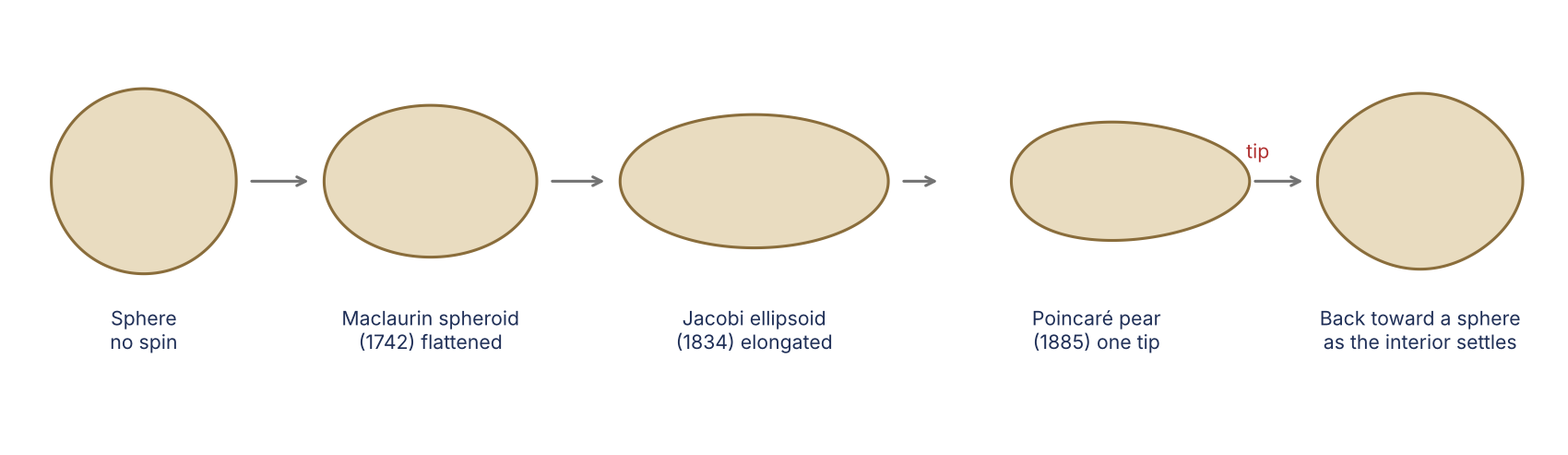
A fluid body that does not spin tends to a sphere; when it spins, it flattens. Maclaurin (1742) showed that a flattened spheroid is a figure of equilibrium for a homogeneous rotating fluid, and Jacobi (1834) that beyond a certain spin there is a further figure, an ellipsoid elongated in the plane of the equator. Poincaré (1885) found that pear-shaped figures branch off Jacobi’s sequence, and Darwin (1902) based on them his account of a Moon that left the Earth through a pear stage. Lyapunov (1905), Jeans (1917) and Cartan (1924) showed that the pear is not stable: it is a passing stage, not a lasting state (Chandrasekhar 1969; Iurato 2014). Bodies also keep a shape that no longer fits their spin, because it froze as their crust stiffened: Iapetus turns once in 79 days but has the shape of a 16-hour spin (Castillo-Rogez et al. 2007), the Moon carries a fossil bulge (Garrick-Bethell et al. 2006), and Haumea, turning once in 3.9 hours, is strongly elongated by its spin (Ortiz et al. 2017).
Simulations of planet building give the planets a fast spin in their first stages, a day of a few hours (§B.3). Their interiors were not symmetric: a flow concentrated in one hemisphere could develop in the mantle of the young Mars (Zhong & Zuber 2001), and to this day the centre of mass of Mars does not coincide with its centre of figure but is displaced from it by about 3 km (Zuber et al. 1998). Sorting began very early — on Mars metal separated from silicate within a few million years (Dauphas & Pourmand 2011) — but it is a long, graded process that continues today: the Earth’s inner core still grows (Labrosse et al. 2001).
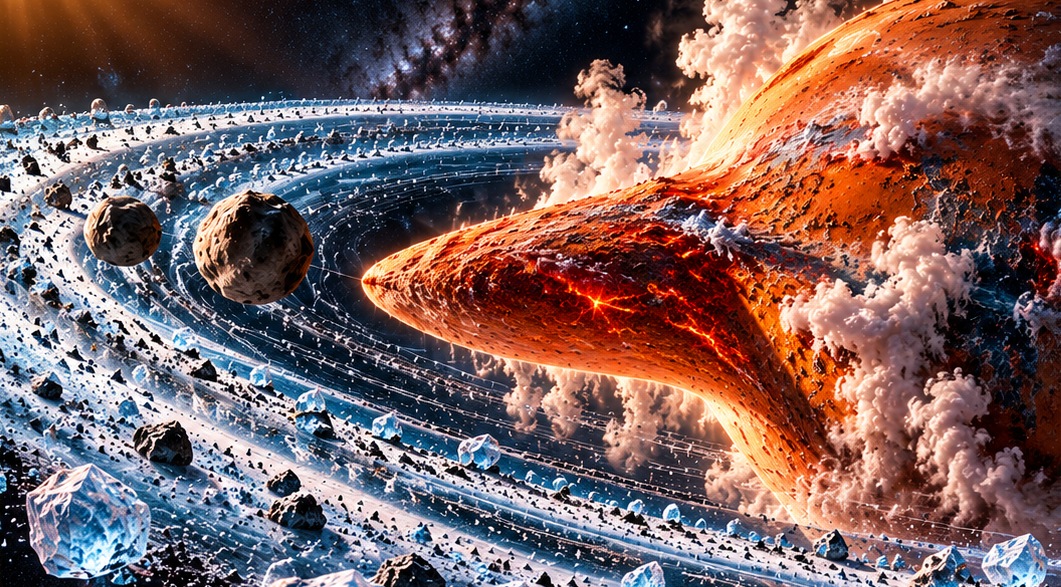
A tapered protrusion and a pear. A spinning planet can grow two different structures on its equator. We call the one that Mars grew a pressure-driven, tapered planetary protrusion — in short, the protrusion. It is local: material of the outer layers rises outward, fed and supported by pressure from within, while the interior hardly takes part. A pear is planetary: the interior moves and the outer layers ride on it. Mars stopped before a pear.
| Tapered protrusion (Mars) | Pear | |
|---|---|---|
| Scale | Local, on the equator | Planetary, the whole body |
| What moves | The outer layers rise outward; the interior hardly takes part | The interior moves; the outer layers ride on it |
| The core | Hardly affected; centred | Displaced, or drawn into a peanut |
| How it grows | Spin pushes mass to the equator; the place with most mass rises, cools and builds itself from within; pressure feeds and supports it | Gravity and spin acting on the whole planet |
| Spin needed | Below the planetary threshold: Mars at 7–9 h (Table 2) | Above : a day shorter than 5.8 h for the young Mars (Chandrasekhar 1969) |
| Shape | Broad base joined continuously to the planet, narrowing outward to a rounded tip; a curved cone (§C.6) | A swollen head joined to the body by a narrow neck |
| Frequency | Common | Rarer |
| Moons | Small moons from the tip (Mars) | A large moon (the Earth’s Moon, in this series) |
| What remains | A broad rise with mountains at its summit, drainage, strong gravity over it; a large one shapes the lowest degrees of the field | The figure of the whole planet offset; the core displaced |
Table 3. A tapered protrusion and a pear. The colour marks the difference in scale and in the spin each requires.
How the protrusion grows.
A young, soft, fast-spinning Mars. The spin pushes the planet outward from its axis, most strongly at the equator. A whole-planet elongation, a pear, would need a day shorter than 5.8 hours; Mars at 7–9 hours was below that threshold (Table 2). The protrusion does not need it.
The spin pushes mass to the equator. Away from the equator the outward push of the spin has a component along the surface, pointing to the equator. In a soft body it moves material, magma and water from the poles and middle latitudes to the equator, where a thick belt builds: the flattening.
The place with the most mass rises, cools and builds itself from within. The belt is not uniform; in one place more material gathers than anywhere else. There the spin pushes hardest, and the material rises outward. A protrusion cools because it stands out: it is far from the hot interior and exposed to space. Its material contracts and becomes dense and stiff, so it does not sink back, and its excess mass draws in more material from around it. At its tip, where the load is least, material from within seeps out and spreads over the protrusion itself, cooling and adding a layer — as seamounts grow from pillow lava on the Earth’s ocean floor, and lava domes swell from within. Only at times is material thrown out. In a planet that does not spin, a broad rise raises the level surface above it by only about three-fifths of its own height and sinks back; the spin and the pressure from within make up the rest. The larger the protrusion, the farther it stands out, the more it cools and the more it draws. It lengthens and tapers to a narrow tip.
The protrusion leans westward. The material that reaches it comes from places nearer the axis, where it moved more slowly; it keeps its angular momentum and lags behind the spin.
The peak. The protrusion stands. Mars slows to 7.3 and then to 8.3 hours, and in this time Deimos and Phobos leave from Pavonis, near its tip (§D, E).
How the protrusion returns.
The protrusion itself slows the planet. When mass moves away from the axis the planet slows, as a dancer who opens her arms; the water and gas that leave through the corotation line take spin with them as well (§E.2).
The planet sorts and cools. Heavy material gathers at the centre, and a body whose mass is concentrated at its centre no longer tends to grow such structures (Jeans 1919). Cooling raises the viscosity.
The protrusion draws inward and leaves its records. Once the spin falls, the protrusion draws inward; its material is taken back into the planet and sorted. While Mars is soft it lies down westward, the way it leaned; as it stiffens, the return slows and stops partway, and the rest freezes. The records are those of this paper: Tharsis, the body that lay down (§C.3–C.6); Noctis Labyrinthus, the neck that broke, and Valles Marineris with its drainage, the way the material flowed back (§H.2–H.4); the long axis of the equator and the high geoid; and the figure of Mars, still offset toward the protrusion (§C.7).
The spin pushes material to the equator; the place where most mass gathers rises, cools and builds itself from within, fed and supported by pressure, and draws in more material. It lengthens into a tapered protrusion; the core need not move. When the spin falls, and as the planet sorts and cools, the protrusion draws inward and leaves its records. The protrusion always comes before the planet settles: it was common at the beginning and is rare today. It was a passing stage, not a state.
C.2 Diagnostic Criteria
The criteria below set out the marks a protrusion should leave after it has returned and lain down. They are reasonable, not rigid: a protrusion that has returned and lain down need not meet each of them in full. Each is tied to what supports it.
| Criterion | Why it marks a protrusion | Rests on | |
|---|---|---|---|
| P1 | On the equator | The outward pull of the spin is greatest at the equator; every elongated figure of a spinning body grows in the plane of the equator | Classical theory (Chandrasekhar 1969) |
| P2 | One long axis | A protrusion has one tip; its remnant is elongated in one direction, not spread to all sides | The tapered shape (§C.1) |
| P3 | Base and tip | A broad base narrowing to a tip, the highest ground at the tip | The tapered shape (§C.1) |
| P4 | Lagging against the spin | Material raised from the ground keeps its angular momentum and falls behind the spin; the tip lies behind the base, on the side opposite to the spin, and the trailing side is steeper. On a planet spinning eastward, as Mars does, the lag is to the west; on one spinning westward it is reversed | Angular momentum in a spinning body |
| P5 | A shape out of step with today’s spin | A remnant of a protrusion is part of the shape that froze and is not explained by the present spin | Castillo-Rogez et al. 2007; Garrick-Bethell et al. 2006 |
| P6 | A mass excess | A protrusion that returned but did not vanish leaves stronger gravity above it | Geodesy |
| P7 | Fractures around it | Rising and sinking stretch the crust around the body; the fractures organise around it, mostly radial | Banerdt et al. 1992 |
| P8 | Early | The protrusion belongs to the fluid, fast period; its remnant is among the oldest structures of the planet | §C.1 |
| P9 | A link to the moons | This model holds that if a planet has moons, they left from a structure raised on its equator — a tapered protrusion or a pear — for only such a structure brings material to the corotation line. A protrusion that has gone should be tied to the place the moons left from | This model, after Darwin |
| P10 | Return and sorting | As the protrusion returns, its material is taken back into the planet, in one way or another, and sorted; a planet that froze may leave masses of the protrusion and traces of the return on its surface | This model |
Table 4. Ten criteria for a protrusion that has gone. Mars is tested against them in §C.9.
C.3Physiography of the Protrusion
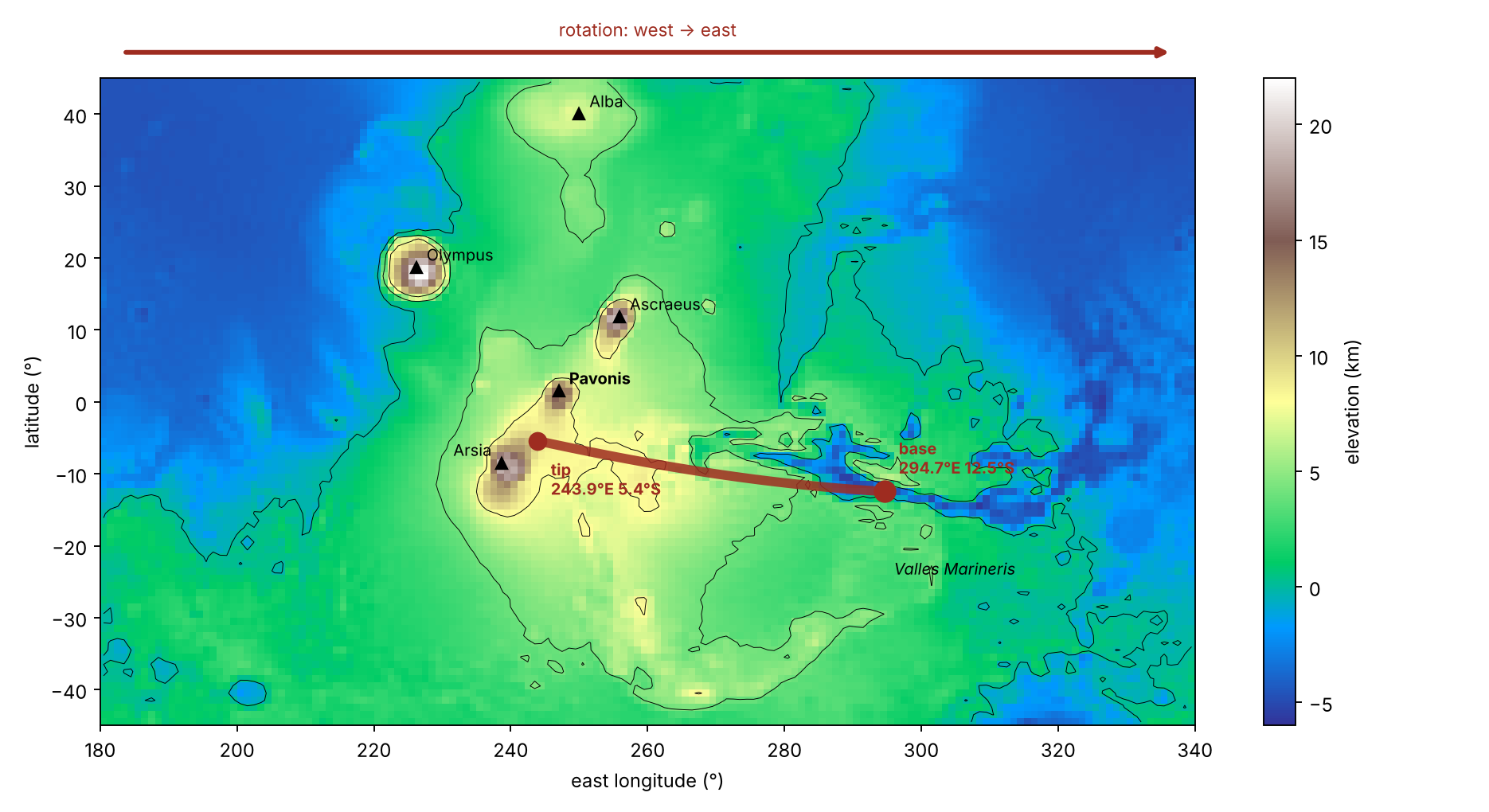
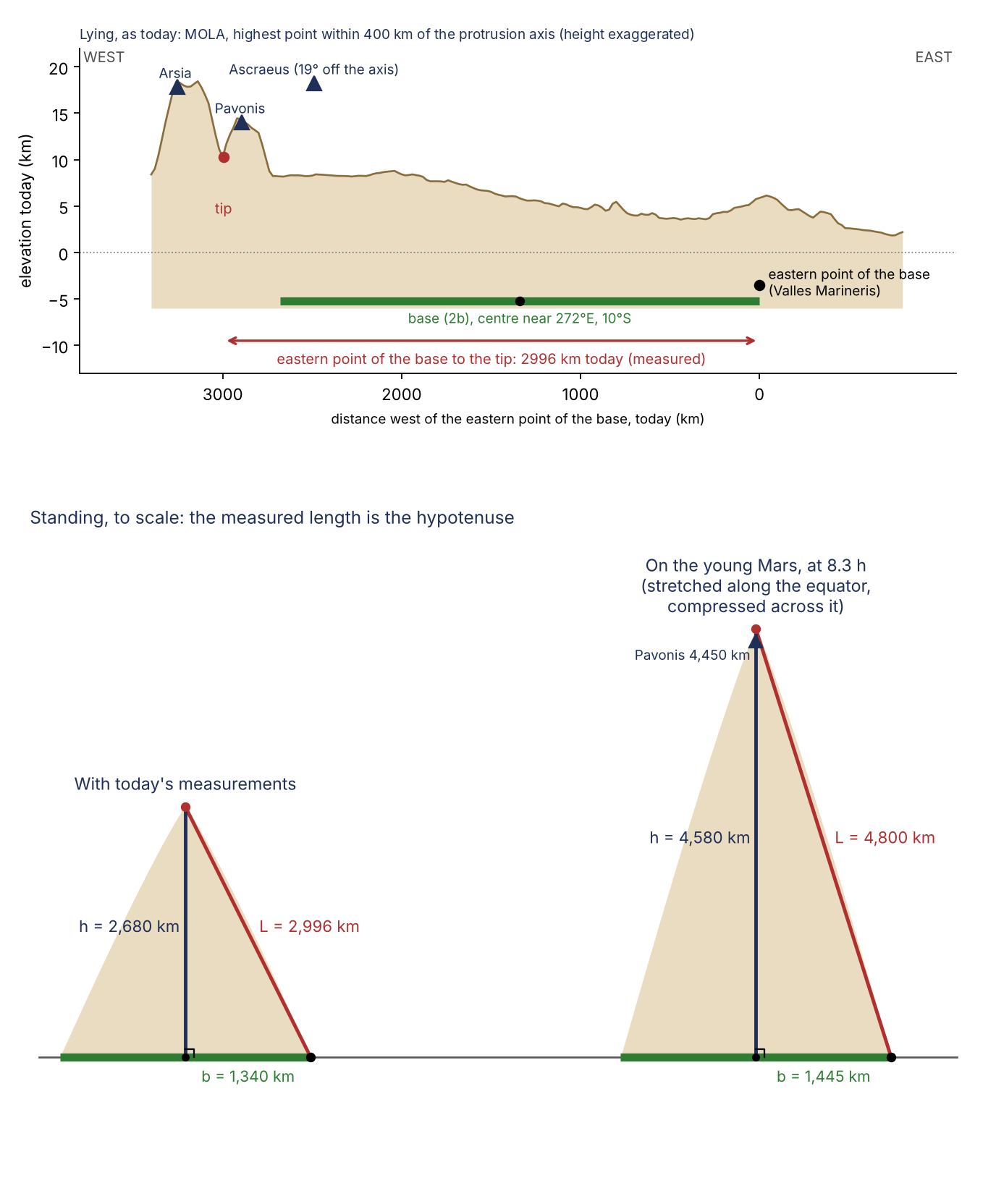
On the topography measured by the laser altimeter MOLA (Smith et al. 2001), expanded here in spherical harmonics from the shape model MarsTopo719 (Wieczorek 2015), the protrusion lies along the equator, just south of it. It runs from its base at 294.7E, 12.5S, in Valles Marineris, to its tip at 243.9E, 5.4S. Its length is 2,996 km on today’s surface, and 4,800–4,920 km on the young, expanded Mars (§C.6; Figure 3).
Beyond the tip, to the west, stand the Tharsis volcanoes. Arsia, just beyond the tip, lies on the continuation of the axis of the protrusion, 4.1 off it, and its edifice is elongated: above the 9-km contour of MOLA it measures 730 by 415 km (ratio 1.75), its long axis running north-north-east — a body at the tip, drawn out as the protrusion was flattened and laid down.
C.4Rotational Lag and Westward Tilt
While the protrusion rose, its elongated tip had to be carried faster and faster round the centre of the planet; because angular momentum is conserved, it lagged behind the spin and leaned westward, as the Earth’s pear did. It had grown on the equator (§C.1), and the pressure from within fed it and supported it. When the moons had left and the vents were open, and as the spin fell, the interior sorted and the planet cooled, the protrusion did not fall: it lay down gradually, over tens to hundreds of millions of years, and the lag went on acting on it all that time. It lay down the way it leaned — westward, against the spin.
C.5 Asymmetry of the Topographic Slopes
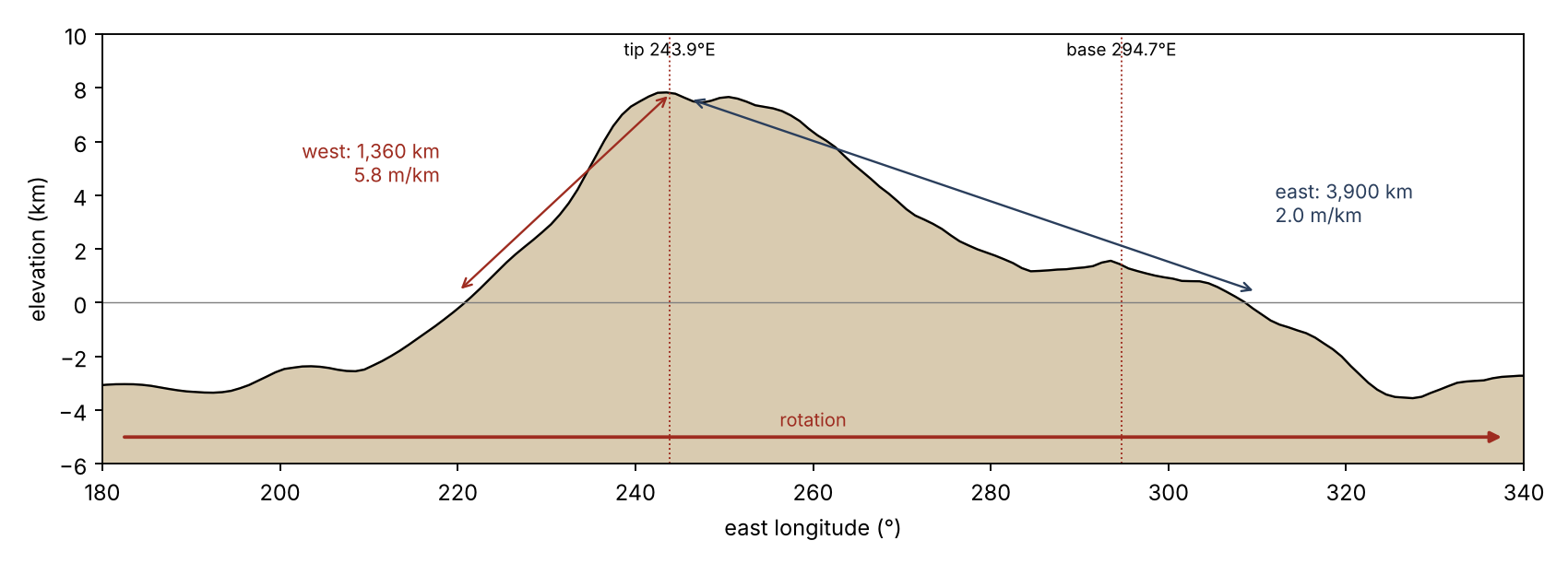
A body that lay down westward should end in a steep western front, facing a long, gentle slope on the east. Measured from the crest of Tharsis to where the ground falls to zero, along bands of latitude (topography smoothed over about 9):
| Band | Crest | West: distance to 0 km | West slope | East: distance to 0 km | East slope |
|---|---|---|---|---|---|
| 15–5S | 240E | 1,570 km | 7.0 m/km | 2,740 km | 4.1 m/km |
| 10S–10N | 244E | 1,360 km | 5.8 m/km | 3,900 km | 2.0 m/km |
| 5S–5N | 246E | 1,480 km | 5.7 m/km | 3,790 km | 2.2 m/km |
| 0–10N | 252E | 1,710 km | 4.2 m/km | 3,180 km | 2.3 m/km |
| 5–15N | 256E | 1,980 km | 4.0 m/km | 1,460 km | 5.4 m/km |
Table 5. The two flanks of Tharsis. Red: the steep western front; blue: the gentle eastern slope. North of 5N the east falls steeply into Chryse and Kasei Valles.
Along the equator and south of it, the western front is two to three times steeper than the eastern slope (Figure 4), as expected of a body that lay down westward.
How do you know that Tharsis is the protrusion?
Three findings in the topography point to it. First, it lies on the equator. Second, its crest is the highest point of the large-scale shape of Mars: the long axis of that shape passes through 252E, the longitude of Tharsis. Third, its two flanks differ along the direction of the spin, steep on the west and gentle on the east (Table 5). This is what a body that leaned back against the spin and lay down westward leaves.
Why does the tip of the protrusion lie west of its base, and not over it?
Had the protrusion collapsed quickly, its tip would have come down over the centre of its base. It did not collapse quickly. It lay down slowly, over tens to hundreds of millions of years, and throughout that time the lag acted on it: the tip, far from the axis, trailed the spin of Mars, as the tip of the Earth’s pear did. The slow lying down let the lag work to the end, and the tip came to rest to the west (§C.4). Nor did the spin push it east on the way down: settling 1,000 km in 10 million years gives a sideways (Coriolis) acceleration of about m s, which the surrounding material removes entirely.
Why is the crest south of the equator, and why does the band north of 5N not follow the pattern?
The protrusion lies along 5–12.5S, from its base at 12.5S to its tip at 5.4S, and its crest follows it. North of 5N the eastern side is cut by Chryse Planitia and Kasei Valles, which were carved later; the pattern holds fully in the bands that cross the protrusion.
C.6The Paleotopographic Reconstruction
The length of 2,996 km is measured on the lying protrusion, from the eastern point of its base to its tip. When the protrusion stood, this line was not its height: it runs from the edge of the base to a tip that stands above the centre of the base. It is the hypotenuse of a right triangle whose other two sides are the height and the half-width of the base : We measured on the MOLA topography, across the axis of the protrusion at its base, smoothed as in Table 5. To the north the rise falls to 0 km 1,280–1,400 km from the axis, at the edge of Kasei Valles and Chryse; to the south no edge is reached, for the axis runs along Valles Marineris and the southern highlands continue beyond it. Taking the northern edge as the half-width of a round base, km today; the centre of the base lies near 272E, 10S.
With today’s measurements the protrusion would stand
On the young Mars the measurements were different. Mars was 1.5 times larger and, of low density and turning fast, flattened into a spheroid (Table 2). Along its raised equator, where the protrusion lies, lengths scale with the equatorial radius : 1.60 times today’s at 8.3 hours, 1.64 times at 7.3 hours. Across the equator, north–south, the flattening compresses them, in proportion to . The hypotenuse therefore grows more than the half-width of the base:
| Today’s measurements | Young Mars, 8.3 h | Young Mars, 7.3 h | |
|---|---|---|---|
| Length lying, | 2,996 km | 4,800 km | 4,920 km |
| Half-width of the base, | 1,340 km | 1,450 km | 1,280 km |
| Height standing, | 2,680 km | 4,580 km | 4,740 km |
When Phobos left, the protrusion stood 4,580 km tall (Figure 5). Every point of the protrusion is carried in the same way: a point at a distance from the eastern point of the base, along the lying protrusion, stands above the base when the protrusion stands. On the lying protrusion the highest ground is at the tip — Pavonis and Arsia — and the base lies low, in Valles Marineris.
C.7The Gravitational Signature
We expanded the GMM-3 gravity field of Mars (Genova et al. 2016) to degree 90.
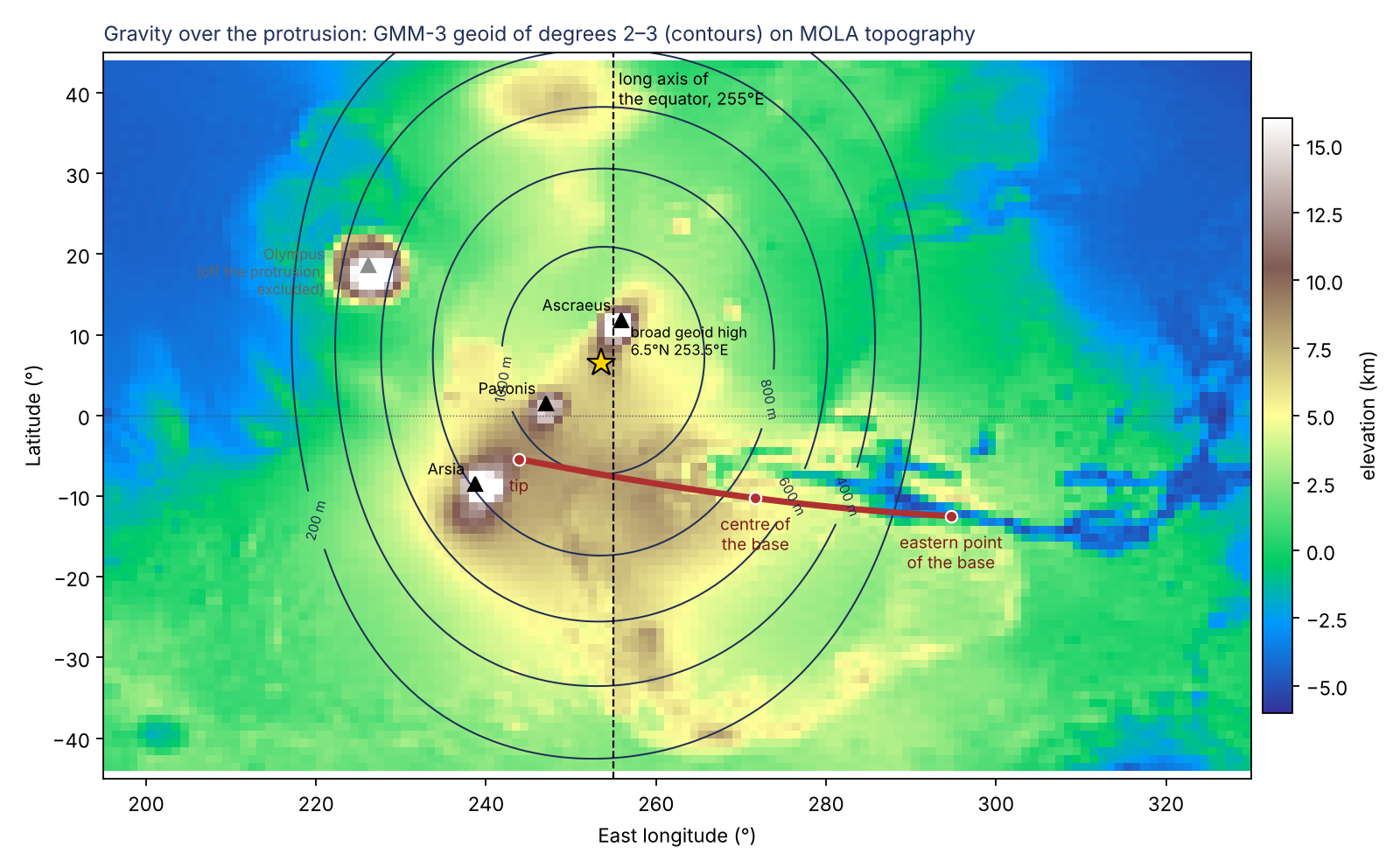
The long axis of the equator. The equator of Mars is not round. In the broadest part of the field, degree 2, its long axis points to 255E: on the protrusion, between its tip (243.9E) and the centre of its base (272E), and close to the long axis of the shape of Mars at 252E (Question and Answer 5). A body that spins symmetrically about its axis has a round equator; this part of the field is therefore not explained by the present spin. It is a frozen shape, as on Iapetus.
The broad high. Keeping only the broadest parts of the field, degrees 2 and 3 — the large structure, not single mountains — the geoid is highest at 6.5N, 253.5E, between Pavonis and Ascraeus, at the tip of the protrusion (Figure 6).
Olympus left out. Olympus Mons stands off the protrusion, a single edifice whose load is its own. With it left out of the full field (within 8, 10 or 12 of its centre; the result is the same in all three), the highest geoid and the strongest free-air gravity both lie at 11.5N, 255.5E, on Ascraeus, the northernmost of the three Tharsis Montes.
Mars still carries the protrusion. The first degree of the MOLA shape model, taken about the centre of mass, gives the offset of the centre of figure from the centre of mass. Its north–south part, 3.0 km, is the known offset of the hemispheres (Zuber et al. 1998). Its part in the plane of the equator is 1.37 km, toward 262.7E — on the axis of the protrusion, between its tip (243.9E) and the centre of its base (272E). The figure of Mars still bulges toward the protrusion: a very mild protrusion, in exactly the direction of the protrusion of the model. The core need not have moved for the protrusion to stand; if it is displaced, the displacement should point toward the protrusion. Its present position is not measured, and is a prediction for a future seismic network on Mars (Appendix B, B16).
From the base to the tip. The free-air gravity rises steadily along the protrusion, from the eastern base to the tip:
| Place | Free-air gravity | |
|---|---|---|
| Eastern point of the base (294.7E, 12.5S) | mGal | the canyon (§H.3) |
| Centre of the base (272E, 10S) | mGal | |
| Tip (243.9E, 5.4S) | mGal | |
| Pavonis | mGal | |
| Arsia | mGal | |
| Ascraeus | mGal |
Table 6. Free-air gravity at the surface, GMM-3 degrees 2–90 without the flattening term . The colour deepens from the base to the tip.
C.8 Structural Geology
Anderson et al. (2001) mapped 24,452 grabens and ridges around Tharsis and divided them into five stages, from the Noachian to the Amazonian. In every stage the centre of the radial fractures lies on the high ground of Tharsis: the large early centres in Claritas and Syria, between the base and the tip, and the last stage centred near Pavonis, at the tip of the protrusion. Most of the mass of Tharsis was in place by the end of the Noachian, in the first hundreds of millions of years of Mars (Phillips et al. 2001), and the tectonic activity around it was greatest at the start and declined with time (Anderson et al. 2001).
C.9Mars Against the Criteria
These are the findings on Mars against the ten criteria of Table 4:
| Criterion | What Mars shows | ||
|---|---|---|---|
| P1 | On the equator | The protrusion lies along 5–12.5S; the broad geoid high at 6.5N (§C.3, C.7) | Met |
| P2 | One long axis | 2,996 km long against a half-width of 1,340 km at the base (§C.6) | Met |
| P3 | Base and tip | The base low in Valles Marineris; the highest ground at the tip, the Tharsis Montes (§C.3, C.6) | Met |
| P4 | Lagging against the spin | Mars spins eastward; the tip west of the base; the western flank two to three times steeper (§C.5) | Met |
| P5 | Frozen shape | The long axis of the equator at 255E, on the protrusion, not explained by today’s spin; the figure still offset 1.37 km toward 262.7E: the protrusion is still there (§C.7) | Met |
| P6 | Mass excess | Free-air gravity rising from to – mGal from the base to the tip; the geoid high at the tip (§C.7) | Met |
| P7 | Fractures around it | 24,452 structures; every stage centred on high Tharsis, the last near Pavonis (§C.8) | Met |
| P8 | Early | Most of Tharsis in place by the end of the Noachian (§C.8) | Met |
| P9 | Link to the moons | Pavonis at the tip; both moons from it (§D, E) | Rests on the model |
| P10 | Return and sorting | Part of the material remains at the surface: Tharsis and its mass excess (P6). On a water-rich Mars, part flowed back in a fluid channel along the axis, unique to Mars: Noctis Valles Marineris basin Eos chaos Chryse (§H.2–H.4) | Met |
Table 7. The protrusion of Mars against the ten criteria of Table 4. Green: met. Orange: rests on the model.
Nine of the ten criteria are met by observation; the tenth rests on the model. Tharsis has every mark that a protrusion which rose, lagged, lay down westward and drained back along its axis would leave.
DVolcanic Dynamics at the Apex
D.1 Gravity and Sideways Acceleration along the Protrusion
Stood up again, the protrusion carries each volcano to a height above the base, where is its distance from the eastern point of the base (§C.6). At these heights gravity falls with the square of the distance from the centre of Mars, while the spin pushes outward in proportion to it. For each volcano there is one day at which the corotation line passes exactly through its vent; on any shorter day the vent stands beyond the line.
| Volcano | On the protrusion | Height above the equator | Distance from the centre | Gravity there | Line through the vent at |
|---|---|---|---|---|---|
| Ascraeus | 42.1 along, 19.2 off | 4,120 km | 9,590 km | 0.47 m s (28%) | 7.9 h |
| Pavonis | 48.9 along, 7.4 off | 4,450 km | 9,880 km | 0.44 m s (27%) | 8.3 h |
| Arsia | 55.0 along (beyond the tip at 50.6), 4.1 off | 4,950 km | 10,330 km | 0.40 m s (24%) | 8.9 h |
Table 8. The three Tharsis Montes on the standing protrusion of the young Mars, flattening included and lengths stretched as in §C.6, each at the day on which the line passes through its vent. Positions are measured along the protrusion from its base and across its axis; percentages are of the gravity at the mean surface. Green: Pavonis.
D.2The Zero-Net-Weight Condition
At the vent of Pavonis gravity is 0.41–0.44 m s, about a quarter of its value at the surface, and the spin almost cancels it: the net weight is m s at a day of 7.3 hours (slightly outward) and zero at 8.3 hours. A body set free there needs no push to rise. It carries the sideways speed of the vent itself, 2.43 km s at 7.3 hours and 2.08 km s at 8.3 hours, against a Keplerian orbital speed there of 2.05–2.08 km s: the spin alone gives it its orbit.
D.3Why Pavonis
Pavonis stood high on the protrusion, near its tip, and beneath it lay the reservoir that fired: its summit pit is the deepest of the four Tharsis calderas for its width, a single circular pit about 5 km deep, the roof of a reservoir that emptied and collapsed (§D.4). Both moons left from Pavonis, one after the other. While the protrusion stood, every vent on it lay above the centre of its base, at about 10S; both moons therefore began on orbits tilted by about 10, and the ring rounded the orbits and brought the tilt down to 1.09 (Phobos) and about 1.8 (Deimos) (§F.1).
Could a protrusion more than 4,000 km tall stand at all?
The load is least where the protrusion is tallest: at its top gravity is about a quarter of its surface value, and the spin cancels the rest (Table 1). It grew on the equator, and the pressure that passed through it fed and supported it (§C.1); how a structure of this kind is raised and held is set out, for the Earth’s pear, in the other papers of this series. Here it is listed as a requirement (§O).
Why Pavonis, and not Arsia, Ascraeus or Olympus?
We tested each of them: a body set free at each vent, on the standing protrusion, at the two days of the releases:
| Volcano | Line through vent | At 7.3 h (Deimos) | At 8.3 h (Phobos) |
|---|---|---|---|
| Ascraeus | 7.9 h | orbit, | falls back: vent inside the line |
| Pavonis | 8.3 h | orbit, | a circle at the line, |
| Arsia | 8.9 h | long orbit, to 52,400 km, | orbit, |
| Olympus | — | no orbit: off the protrusion | no orbit |
Ascraeus could have set Deimos free at 7.3 hours, on an orbit of eccentricity 0.25. But at 8.3 hours its vent already lies inside the line, and whatever leaves it falls back: it could not have set Phobos free.
Arsia could have set free both: Deimos on a very long orbit (, to 52,400 km), and Phobos on an elongated orbit () that the ring would have had to round.
Olympus does not stand on the protrusion: its summit was about 5,600 km from the centre of the young Mars, against a line at 9,080 km, and no shot from it reached an orbit of its own. It may well have erupted strongly; its material reached the inner edge of the ring, came back, and is part of the dust of Mars (§H.5).
Pavonis alone gives Phobos, at 8.3 hours, a circle at the line () with no push, and it alone carries the mark of a reservoir that fired and emptied: a single deep circular pit, about 5 km deep, of the scale of the two moons together; the caldera of Arsia is broad and shallow. The tilt of the orbits does not choose between them: on the standing protrusion every vent lay above the centre of the base, at about 10S, and the ring flattened the tilt (§F.1). The decisive test is gravity: a mass deficit beneath Pavonis larger than beneath Arsia (Appendix B, B10).
The protrusion is measured on today’s surface. How can its length on the young Mars be known?
Its length along today’s surface is 2,996 km. The young Mars was 1.5 times larger and flattened by its spin. The protrusion lies along its equator, which stood 5,430–5,560 km from the centre, so east–west lengths were 1.60–1.64 times today’s and the protrusion was 4,800–4,920 km long; north–south lengths near the equator were compressed by the flattening. Pavonis, near the tip, lay 4,670 km from the eastern point of the base; with the protrusion standing it stood 4,450 km above the base (§C.6).
D.4The Magma Chamber Geometry
The model needs no deep magma chamber and no long feeding conduit. Beneath the summit of Pavonis lay a shallow reservoir, about 5 km down: the summit pit of Pavonis, 47 km wide, is about 5 km deep (Crumpler et al. 1996; NASA/JPL PIA25157), and a pit of that depth is the roof of a reservoir that emptied and collapsed.
Before the moons left, the vent above the reservoir was much narrower than the pit is today — about as wide as the plug it held, some 20–23 km — and the plug had to be pushed through it. The pit widened to 47 km only when its roof collapsed after the shots. In this narrow vent Phobos was scored and its boulders rolled (§K.1, K.3).
D.5 Ejection Mechanics
Gas that gathered beneath the plug, at an overpressure of the kind measured in volcanoes on the Earth, pushed it out along its own length. For comparison: before the Vulcanian explosions of Soufrière Hills, Montserrat, in 1997, the dense cap of the conduit needed about 30 MPa to break, and the material beneath it fragmented after a decompression of only a few MPa (Burgisser et al. 2010). Vulcanian explosions throw blocks at up to about 400 m s (Fagents & Wilson 1993; Clarke et al. 2015). The speed the gas gives a plug pushed along its own length is :
| Overpressure | Exit speed | Phobos’s orbit at 8.2 h |
|---|---|---|
| none (set free) | 0 | 9,890–10,390 km, |
| 10 MPa | 110 m s | about |
| 20 MPa | 160 m s | 9,380–11,030 km, |
| 50 MPa | 250 m s | 9,020–11,570 km, |
Table 9. What the volcano adds to the orbit of Phobos (plug density 1,600 kg m). The colour fades as the push stretches the orbit.
The pressure lifts nothing; its only role is to open the vent. The orbit comes from the spin, and the gentler the release, the rounder the orbit. The account therefore has a wide margin, below ordinary volcanic pressures.
Can a volcano throw a body 23 km across into orbit?
It does not have to, and it does nothing that volcanoes on the Earth do not do: overpressures of 10–50 MPa and speeds of 110–250 m s are the pressures and speeds of ordinary Vulcanian explosions (§D.5). The spin gives the body 2.08–2.43 km s (Table 1), the speed of an orbit at the vent; the volcano adds 0.11–0.25 km s and only sets the body free. At the vent, on the corotation line, the body weighs nothing.
Would a stronger blast not be safer?
No. A strong push upward, at right angles to the sideways speed that the spin gives, stretches the orbit and lowers its near end (Table 9). The gentler the release, the rounder the orbit.
E The Ejection Sequence
Material left through the protrusion all the time. Its volcanoes erupted again and again, and most of what they threw fell back to Mars, or reached the inner edge of the ring and returned (§H.5). As ejections, the moons are not unique events. What is unique about them is that they were caught in orbit, or crossed the corotation line, and stayed.
E.1The First Release – Deimos
Early on, while Mars still turned in 7.3 hours, the vent of Pavonis Mons stood about 1,090 km beyond the corotation line, which then lay 9,080 km from the centre of mass.
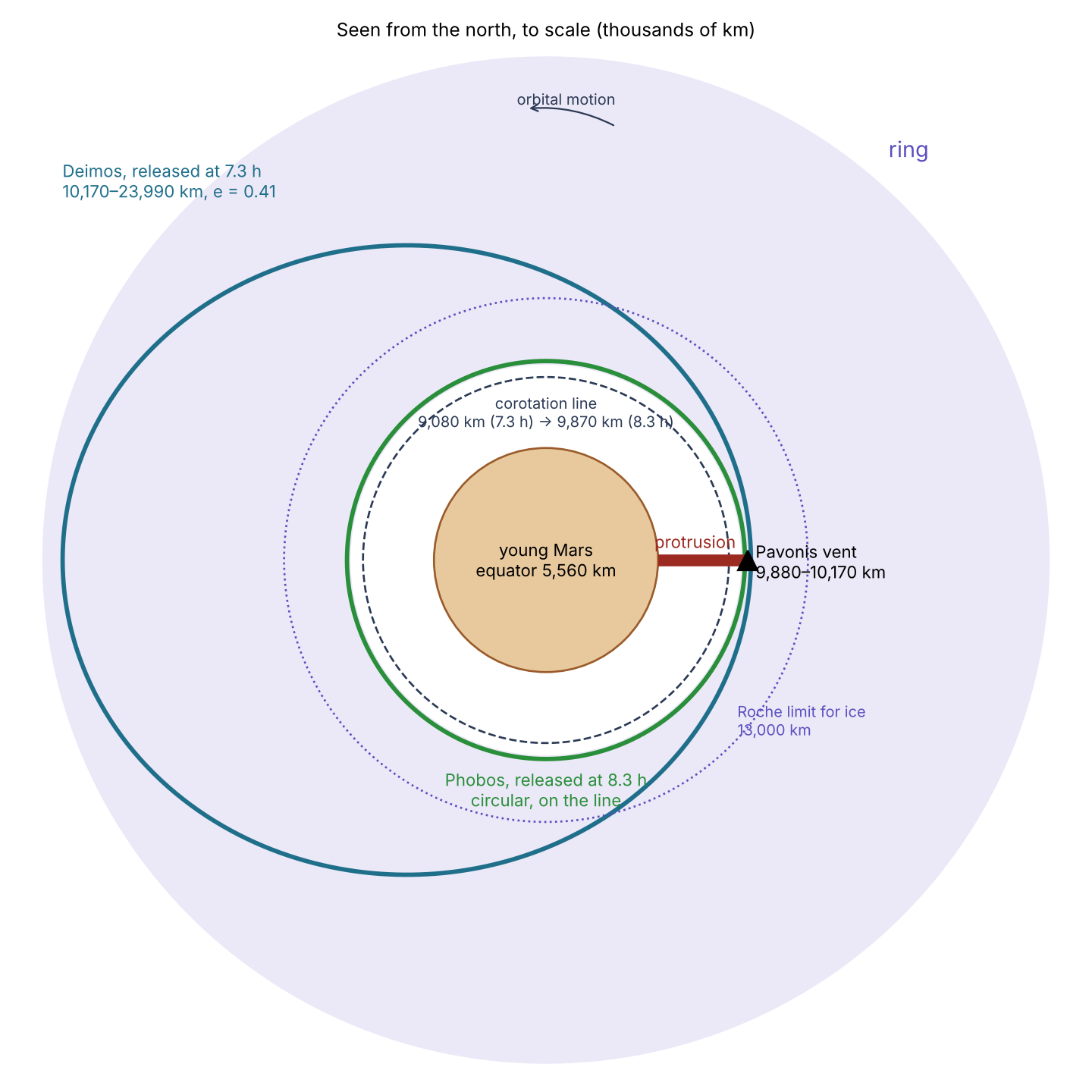
The first plug, a little smaller and lighter than Phobos, was set free carrying the sideways speed of the turning vent, 2.43 km s — more than a circular orbit needs at that radius. With this excess speed it went onto a long orbit (Figure 8): its near point at 10,170 km, its far point at 23,990 km, eccentricity , and an inclination of about 10 to the equator of the young Mars. On every revolution along this orbit it crossed the equatorial ring, whose material moves on circles, at hundreds of metres per second: the ring held it, ground it and in time rounded its orbit (§F).
What decides that Deimos left first and Phobos second, and not the other way round?
Each volcano on the protrusion has a window, set by the spin of Mars: while the day is shorter than the day at which the line passes through its vent, a body set free there goes into orbit outside the line. Mars was slowing all the time, and the window of Pavonis Mons closed at 8.3 hours. A body set free at the start of the window, at 7.3 hours, left with excess speed on a long orbit: Deimos. A body set free at the end of the window, near the moment the line passed through the vent, went onto a circle just outside the line: Phobos. A body set free later than 8.3 hours would have started inside the line and fallen back.
Why is Deimos smaller than Phobos, and so much less dense?
Deimos is the first plug, from the top of the vent, and so is made of the youngest material — porous and rich in trapped gas and vapour. Hence its low density, 1,471 kg m, against 1,853–1,887 kg m for Phobos. It left while Mars was still full of water; in the hour of spin that passed before Phobos left, Mars lost water through the line and slowed (§E.2, J.3). It left about 20.7 km across, a little smaller than Phobos, and drag and grinding in the ring reduced it to its present size, about 12.4 km (§F). Had it not been ground so heavily, Deimos would very likely carry parallel grooves like those of Phobos (§K.1), the marks of a forced passage, under pressure, through a narrow vent. The grooves show that both moons were forced out through the vent under pressure, from the height to which the protrusion had raised them, into orbit. Other bodies may have left the same source and not survived to an orbit of their own (Appendix B, B9).
E.2Rotational Deceleration
Between the two releases Mars slowed from 7.3 to about 8.3 hours, and the slowing went on until the day settled at 24.6 hours. The brake is not the moons, whose mass is negligible, but the material that left through the corotation line: water, steam, gas and dust that reached the line carried away the angular momentum of an orbit there. The budget:
| Day of the young Mars | Spin, times today’s | Share that must leave | Mass through the line |
|---|---|---|---|
| 5 h | 12.2 | 92% | 11–19% of Mars |
| 7 h | 8.7 | 88% | 8–12% |
| 8 h | 7.6 | 87% | 7–10% |
| 9 h | 6.8 | 85% | 6–8% |
Table 10. Angular momentum of a homogeneous young Mars, as a function of the length of its day, against today’s (, 24.62 h). The mass is the amount of material that must cross the corotation line to remove the excess angular momentum; each kilogram carries the angular momentum of a circular orbit at the line, from 9,080 km to 20,428 km. The colour fades with the load.
The moons play no part in this budget: the orbital angular momentum of Phobos is about a millionth of the spin of the young Mars. In the window between 7.3 and 8.3 hours, 6–11% of the mass of Mars must leave this way — about half of what a five-hour Mars would need, and a fifth to a third of the water a young Mars rich in water held. The contraction of Mars, from 5,084 to 3,390 km, makes the load larger, not smaller: had Mars kept its angular momentum while it contracted, it would have spun up by a factor of 2.5, and the brake had to be strong enough to overcome that as well. A young Mars of today’s size, turning in 8.5 hours, would need to lose only 2–3% of its mass.
If the mass of the two moons is negligible, what braked Mars so strongly?
The slowing of Mars has nothing to do with its moons; their orbital angular momentum is about a millionth of the spin of the young Mars. Mars was slowed by the water and gas that crossed the line: each kilogram took with it the angular momentum of an orbit at 9,000–20,000 km, four to fifteen times what it held on the ground. A few per cent of the mass of Mars carry off 86–88% of its spin (Table 10).
Is a loss of 6–11% of the mass of Mars in water and gas not far beyond the accepted estimates? The accepted estimate is that the young Mars held water equivalent to a global layer at least 137 m deep, most of it, about 87%, lost to space.
That estimate, about kg, measures the slow escape of the atmosphere, which enriched the remaining water in deuterium. Water that left in bulk directly through the corotation line is not sorted by mass, and so leaves no such record. The accepted estimates count only the water that left a record; they include no ring through which water left in bulk. A young Mars rich in water also fits its place in the Solar System: it is the terrestrial planet nearest the asteroid belt, built at the edge of the water-rich region; part of its building material came from the belt (Lunine et al. 2003), and the largest body there, Ceres, is about a quarter water by mass (McCord & Sotin 2005; Park et al. 2016). The account requires a young Mars rich in water — more than 30% of its mass — of which a fifth to a third left this way (§O).
What allowed Mars to slow to 22 hours within its first billion years?
The engine was at its strongest at the start. A hot, expanded planet full of water releases most of its volatiles while it is young; the release fades as it cools and contracts. Most of the slowing came early, and almost all of it before the ring dried: from 8.3 to 22.3 hours, 6–9% of the mass left; from 22.3 to 24.6 hours, only 0.1%. The first billion years is also when, in the accepted view, Mars lost most of its water and atmosphere (Villanueva et al. 2015; Jakosky et al. 2018). How long it took depends on where Phobos stood when the ring dried (Table 13).
E.3The Second Release – Phobos
When Mars had slowed further, to about 8.3 hours, the corotation line had moved out to 9,870 km, level with the vent of Pavonis Mons. The second plug, Phobos — larger and harder than the first, times its present size — was set free there carrying the vent’s sideways speed of 2.08 km s, almost exactly the speed of a circular orbit at that height:
| Day | Line | Orbit from the vent | ||
|---|---|---|---|---|
| 7.3 h | 9,083 km | 10,170–23,990 km | 0.41 | Deimos |
| 7.5 h | 9,248 km | 10,100–18,850 km | 0.30 | |
| 7.7 h | 9,411 km | 10,030–15,420 km | 0.21 | |
| 7.9 h | 9,574 km | 9,970–12,970 km | 0.13 | |
| 8.0 h | 9,654 km | 9,950–12,000 km | 0.09 | |
| 8.1 h | 9,735 km | 9,920–11,140 km | 0.06 | |
| 8.2 h | 9,814 km | 9,890–10,390 km | 0.03 | |
| 8.27 h | 9,870 km | 9,877–9,919 km | 0.002 | Phobos |
| 8.4 h | 9,973 km | inside the line | 0.04 | too late |
Table 11. The orbits of bodies set free from the vent of Pavonis Mons as Mars slows, with no further push. The window closes at 8.3 hours. Green: the nearly circular orbit in which Phobos was placed, right at the line.
Phobos went directly into a nearly circular orbit just outside the line, at the inner edge of the ring, moving with it at almost its speed.
FThe Planetary Ring Dynamics
F.1Ring Formation and Orbital Damping
The ring was built before the releases, fed directly by Mars itself: steam and fine material from every fissure that reached the corotation line — the height at which turning with Mars is already an orbit — went into orbit, condensed into grains of ice and dust, and settled into an equatorial disc from the line outward. Beyond about 13,000 km the material gathered into clumps.
The material of the ring moves on circles, and a body that lives in it for long takes its orbit from it: circular and equatorial. This is the damping by which discs of gas and debris round the orbits of the bodies within them and flatten them into the equatorial plane. A ring around Mars has been proposed before, on other grounds: from a resonance that tilted Deimos (Ćuk et al. 2020), and as a stage in a cycle of rings and moons (Hesselbrock & Minton 2017). This damping is why the two moons are on such nearly circular orbits today — Deimos at only .
F.2The Split Interaction
The very different fates of the two moons come from the different conditions in which they met the ring. Three things act the same way:
| Deimos | Phobos | |
|---|---|---|
| Its orbit in the ring | long (): crosses the circling material at hundreds of m s on every revolution | nearly circular: moves with the ring, almost no relative speed |
| Where | through the whole ring, into the clumps beyond 13,000 km | the thin inner edge, next to the line |
| Size against the ring | smaller and lighter: area per unit mass 2.3 times that of Phobos today | larger and denser |
| Result | held, ground, its orbit rounded; it lost most of its mass | barely touched; held at the line; kept its grooves, pits and Stickney |
Table 12. Two bodies, one ring: how each moon responded to it.
On the long orbit of Deimos, the drag of the ring added speed where the body was slowest, at the far end of its orbit, where it moved slower than the ring, and so gradually raised the near end: the orbit rounded outward. With its own angular momentum alone, Deimos would round near 14,300 km; the ring, faster than it at the far end, carries it further out.
F.3 The Velocity Limit
The ring moves on circles at the speed of an orbit. It can bring a slower body up until the speeds are equal — as it did for Deimos, at the far end of its long orbit — but it cannot give a body more than its own speed. Phobos left at almost the speed of an orbit at the line; there was no difference in speed between it and the ring material, and the ring had nothing to give it.
F.4The Gas Leash
At its innermost edge, next to the line, the ring is mostly thin gas. Gas held up partly by its own pressure moves a little slower than an orbit, so Phobos met there a weak head wind — the same head wind that a gas disc exerts on the solid bodies within it, the basis of the theory of how planets grow (Weidenschilling 1977).
The tide pushed Phobos outward with an acceleration of only about m s; to balance it, a head wind of about 100 m s needs a gas density of only – kg m, as thin as the Earth’s air at about 115 km. A balance followed: the tide pushed, the gas held back, and Phobos stayed at the inner edge, just outside the line. As Mars slowed, the line moved outward; the inner edge of the ring moved with it and carried Phobos along.
F.5 The Ring Dissipation
The steam that slowed Mars is the steam that fed the inner edge of the ring. The ring was fed as long as the ground was loose. The young Mars — hot, fast-spinning and not yet sorted — had a crust that was not yet compacted, and its volatiles escaped through it freely: everything that drives volatiles out acted at once, and at first the ring was massive. With time the ground tightened. As the spin slowed and the interior went on sorting, the confinement grew stronger; as the crust cooled and thickened, it became complete. Volcanic outgassing on Mars follows the same course: most efficient before about 4.1 billion years ago, strongly declining through the Hesperian, and insignificant later (Grott et al. 2011).
When the confinement was complete, and Mars had lost its water and approached its present spin, the flow of steam stopped and the ring dried: its material spread, fell back inside the line as frost and dust, or evaporated. Phobos was then near 19,000 km, and the day of Mars about 22 hours.
The drying went from the outside in: the ring was fed only at its inner base, on the line; its distant parts received material only by spreading, and beyond 13,000 km its material gathered into clumps that no longer behaved as a ring.
F.6Dating the Dissipation
The present orbit of Phobos allows the drying to be dated backwards. From the moment the ring and its band of gas had gone, Phobos fell inward; running its fall backwards at the tidal friction measured today gives the time, and the place it stood gives the day of Mars then:
| Phobos when the ring dried | Day of Mars then | Dried, years ago | Time Mars had to slow |
|---|---|---|---|
| 17,000 km | 18.7 h | 1.8 Gyr | 2.7 Gyr |
| 18,000 km | 20.4 h | 2.6 Gyr | 1.9 Gyr |
| 18,800 km | 21.7 h | 3.5 Gyr | 1.0 Gyr |
| 19,100 km | 22.3 h | 3.9 Gyr | 0.6 Gyr |
| 19,500 km | 23.0 h | 4.5 Gyr | none |
Table 13. When the ring dried, from the orbit of Phobos today (tidal friction , constant). 19,500 km is the upper limit: beyond it the ring would have dried before Mars existed. A softer Mars after the drying would make the fall faster and the drying later.
The most likely reading places the drying of the ring 3.5–3.9 billion years ago, at a day of about 22 hours.
Why did the ring, which carried Deimos out to its present orbit, not push Phobos outward too?
A ring can bring a body up only until its speed equals that of the ring material, not beyond it (§F.3). Deimos left on a long orbit, at the far end of which it was slower than the ring, and so it was pushed outward; Phobos left directly onto an orbit at the line, already at the ring’s speed, and there was nothing to push it.
What held Phobos at the line and kept the tide from pushing it outward?
The head wind at the gaseous inner edge of the ring (§F.4). A gas density of a few kg m balances the tide; the gas there was fed by the same steam that left Mars and slowed its spin.
Why are the two orbits so nearly circular and equatorial?
It is the direct result of the time they spent in the ring. The ring was round and lay in the equatorial plane, and a body that lives in it takes its orbit from it (§F.1). Deimos kept this in full, . The present eccentricity of Phobos, 0.015, is not original: the tide raised it later, during its fall inward.
Why should the outer ring have gone first?
The ring was fed from the inside, at the line; its outer parts received material only as it spread. Beyond 13,000 km the material gathered into clumps that no longer behaved as a ring. And as the line moved out, the inner edge was rebuilt on it as long as steam came. When the flow stopped, the outer parts emptied first, and the last of the ring was the gaseous band at the line — the leash.
GTidal Mechanics
Beyond the corotation line, the tide of the young Mars — hot, soft and less viscous — pushes a moon outward. The climb is faster for a heavier moon and for a larger Mars:
| Climb | Mass | 8 today’s friction | 20 |
|---|---|---|---|
| Deimos, 14,300 23,463 km | at release, kg | 370 Myr | 150 Myr |
| Deimos, 14,300 23,463 km | today, kg | 1.7 Gyr | 680 Myr |
| Phobos, 9,880 19,000 km | kg | 58 Myr | 23 Myr |
Table 14. Tidal climbs of the moons on the young Mars (radius 5,084 km), by the mass of the body and the tidal friction of Mars.
Deimos was carried out while it was still heavy, before it was ground, and Mars still large, and passed 20,428 km — the final place of the line — before the line got there; the outer ring shortened the climb. Phobos, the heavier, would have climbed fast, but the leash of the ring’s inner edge held it next to the line (§F.4), and it moved outward only as fast as the line did. When the ring dried, near 19,000 km and a day of about 22 hours, the line passed it. From then on Phobos was inside the line, and the tide drew it back — slowly at first, because it was close to the line, where the tide is weak. running its fall backwards at today’s tidal friction places it at 19,100–19,500 km 3.9–4.5 billion years ago.
The fall was slow at first and fast at the end:
| Since the drying | Years ago | Phobos | Falling, per century |
|---|---|---|---|
| 0 | 3.9 Gyr | 19,100 km | about 4 cm |
| 1 Gyr | 2.9 Gyr | 18,250 km | |
| 2 Gyr | 1.9 Gyr | 17,100 km | |
| 3 Gyr | 0.9 Gyr | 15,250 km | |
| 3.5 Gyr | 0.4 Gyr | 13,500 km | about 24 cm |
| 3.8 Gyr | 0.1 Gyr | 10,900 km | |
| 3.9 Gyr | today | 9,376 km | 1.8 m (measured) |
Table 15. The fall of Phobos from the drying of the ring to today, at today’s tidal friction. In the first three billion years it fell only 3,800 km; in the last 400 million years, more than 4,000 km.
The leash, then, had to hold until the late stages of the slowing of Mars. Had the ring dried early, while Phobos was still near 9,900 km, the line would have passed it there, and at today’s tidal friction it would have fallen to its present orbit in less than a hundred million years and broken up soon after.
Is a fall lasting 3.9 billion years plausible?
Yes. The tide that draws Phobos down weakens with about the 5.5th power of its distance: at 19,100 km it falls fifty times more slowly than today. The rate today is measured — Phobos runs ahead of its predicted place as it falls about 1.8 m a century — and the tidal friction of Mars used here comes from that measurement (; Lainey et al. 2021). Phobos will reach the Roche limit and break into a ring within some tens of millions of years (Black & Mittal 2015; Hesselbrock & Minton 2017). Most of the fall came in the last few hundred million years (Table 15).
Why did Phobos not fall onto Mars long ago?
Because the leash at the inner edge of the ring held its orbit until Mars had almost finished slowing. Had the ring dried while Phobos was near 9,900 km, the tide would have brought it down to its present orbit in less than a hundred million years and broken up soon after.
Is the tide fast enough to bring Deimos to 23,463 km in time?
Yes, if the tide carried it while it was still heavy and Mars still large and soft: 150–370 million years from 14,300 km (Table 14). It had to pass 20,428 km before the line arrived there; the outer ring, while it lasted, carried it further.
HThe Post-Ejection Drainage
H.1Relaxation and the Tharsis Rise
With the two bodies gone and the vents open, and as the spin fell, the interior sorted itself and the planet cooled, the protrusion returned. It sank and lay down slowly and westward, the way it had leaned (§C.4). Its body is today the Tharsis rise.
The volcanoes that stood on the protrusion now stand on the ground, Pavonis Mons among them, with the single deep pit from which the two moons left. As the protrusion returned, the fluid or viscous material inside it drained back from the tip to the base, along its axis and down the slope to the east.
H.2The Neck
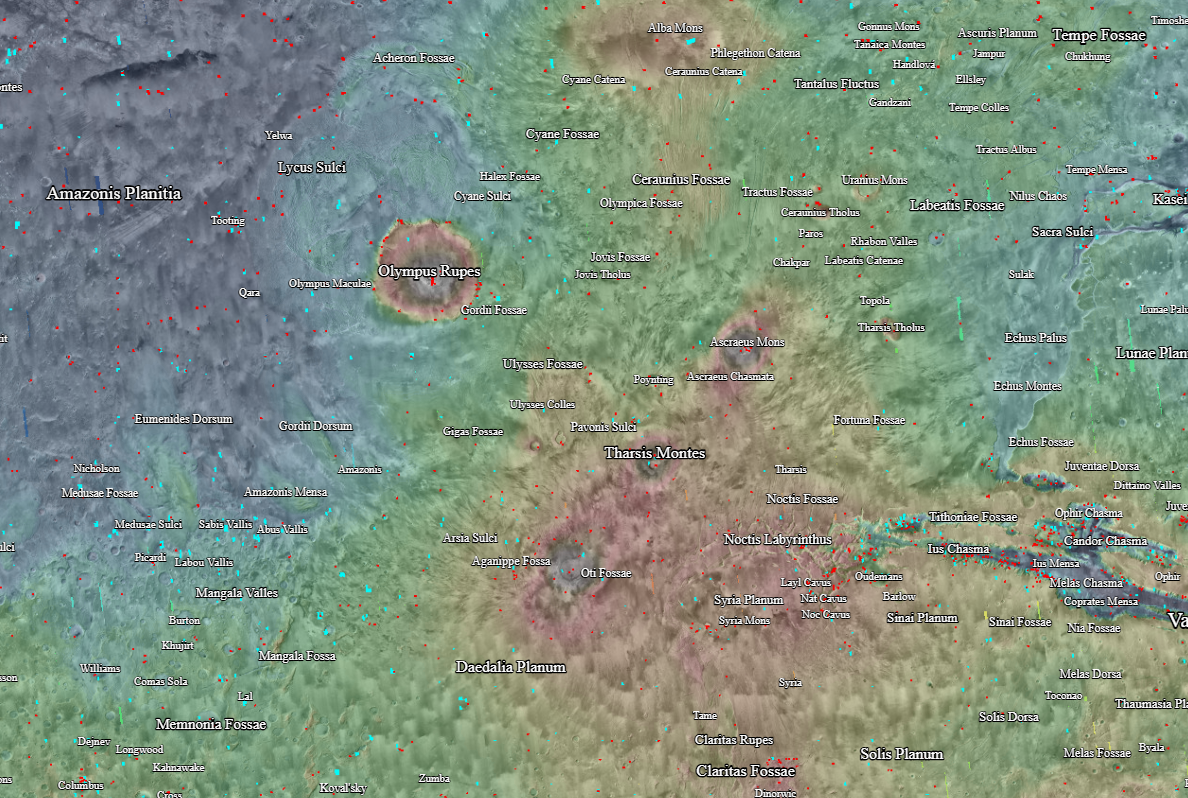
Between the tip and the centre of the base, on the axis of the protrusion (within 70 km of it, 1,750–2,460 km from the eastern point of the base), lies Noctis Labyrinthus: a network of troughs and pits that cross one another and leave blocks between them, like a broken slab (Figure 9). Toward the east the troughs join into one broad channel — the head of Valles Marineris.
Blocks form when the crust is pulled apart in several directions at once; stretching in one direction gives only parallel cracks. The pits show that material beneath the surface left and the ground above it sank. In the accepted reading the network is a set of grabens at the top of the Tharsis rise, with collapse after material below withdrew.
In this account, at the neck lay a large mass, at the centre of the descent of the protrusion. As the protrusion returned, the plates of its surface came down from above. Where the steep slope met the gentle one, the change of angle bent them and broke them into blocks. The fluid or viscous floor beneath them spread sideways, as continents spread but on a small scale, and carried the broken plates apart with it; the troughs are the gaps between them. The labyrinth is thus the head of the drainage: like the tributaries of a river, its troughs gather into one main channel that runs east.
The grooves around the neck. North of the labyrinth, between the equator and about 3S, and to its south-east near 16S, the ground is cut by long, straight, parallel grooves (arrows in Figure 9). In the accepted reading they are grabens of the Tharsis fracture system (§C.8). In this account they are the stretching of the same descent: the surface that came down from the protrusion was pulled toward the spreading floor, and where it did not break into blocks it opened in parallel cracks.
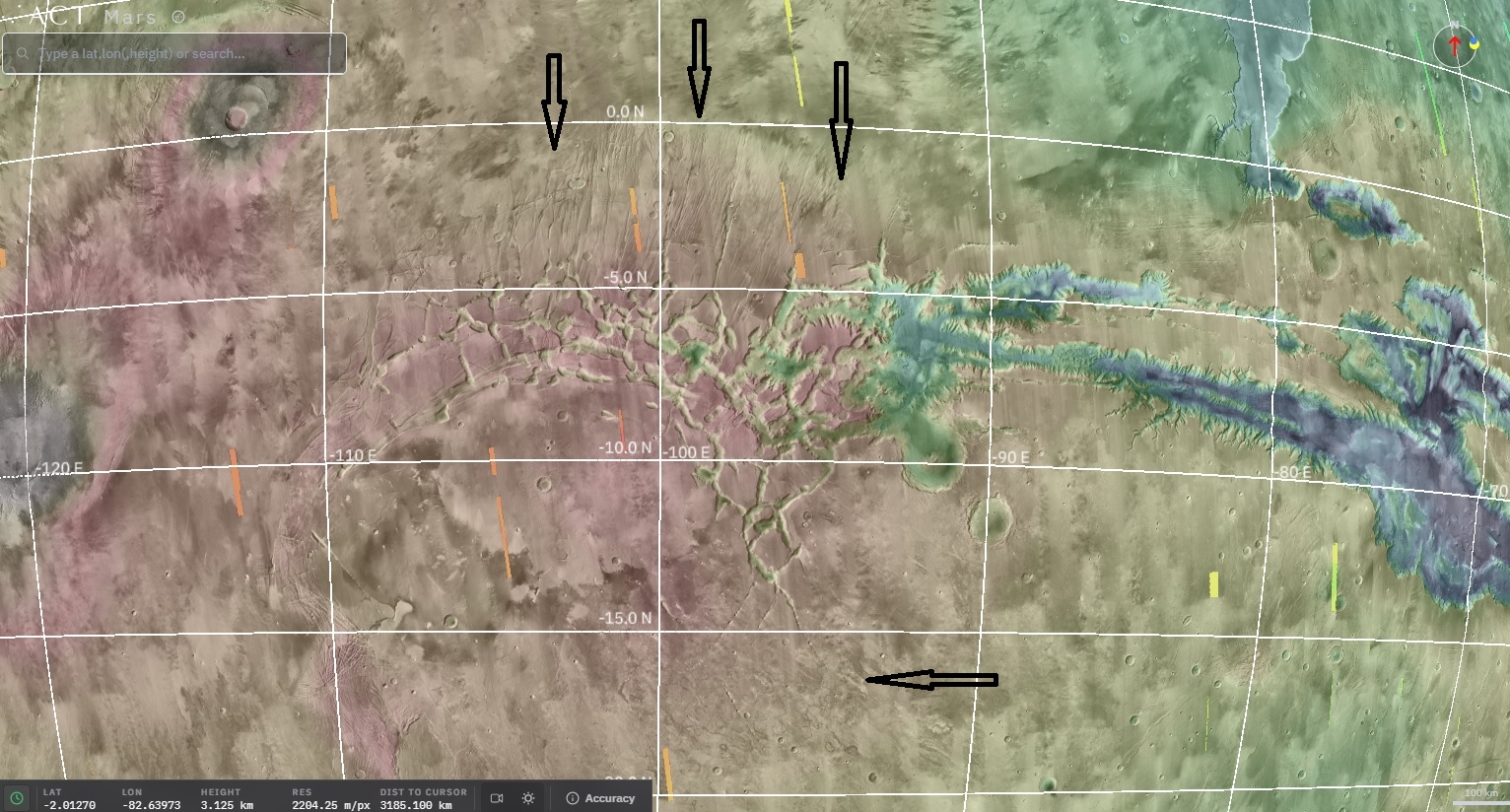
H.3 The Axial Conduit
Valles Marineris is the route by which the interior material of the protrusion flowed east as the protrusion sank, down the slope. Three findings support this.
It runs along the axis. For about 1,700 km, from within the base to its eastern point, the floor of the canyon runs 100–360 km north of the axis of the protrusion and nearly parallel to it. The canyon does not cross the protrusion; it follows it. (The eastern point of the base was itself placed in the canyon; its continuing along the axis for 1,700 km does not follow from that choice.)
Its floor descends to the east. Measured on MOLA expanded to degree 719 (about 15 km) and relative to the areoid computed from GMM-3 — the level along which a fluid flows:
| Longitude | Place | Floor |
|---|---|---|
| 262E | Noctis Labyrinthus | km |
| 270E | km | |
| 278E | Ius / Melas | km |
| 288–306E | Melas, Coprates | to km |
| 310–320E | Eos / Capri | to km |
Table 16. The floor of Valles Marineris, the deepest point at each longitude. The colour deepens as the floor falls eastward; deep floors narrower than the resolution are smoothed.
A total fall of about 10 km from west to east, in the direction of the flow.
It lacks mass. The free-air gravity over the canyon is about mGal (Table 6): a channel that material passed through and left.
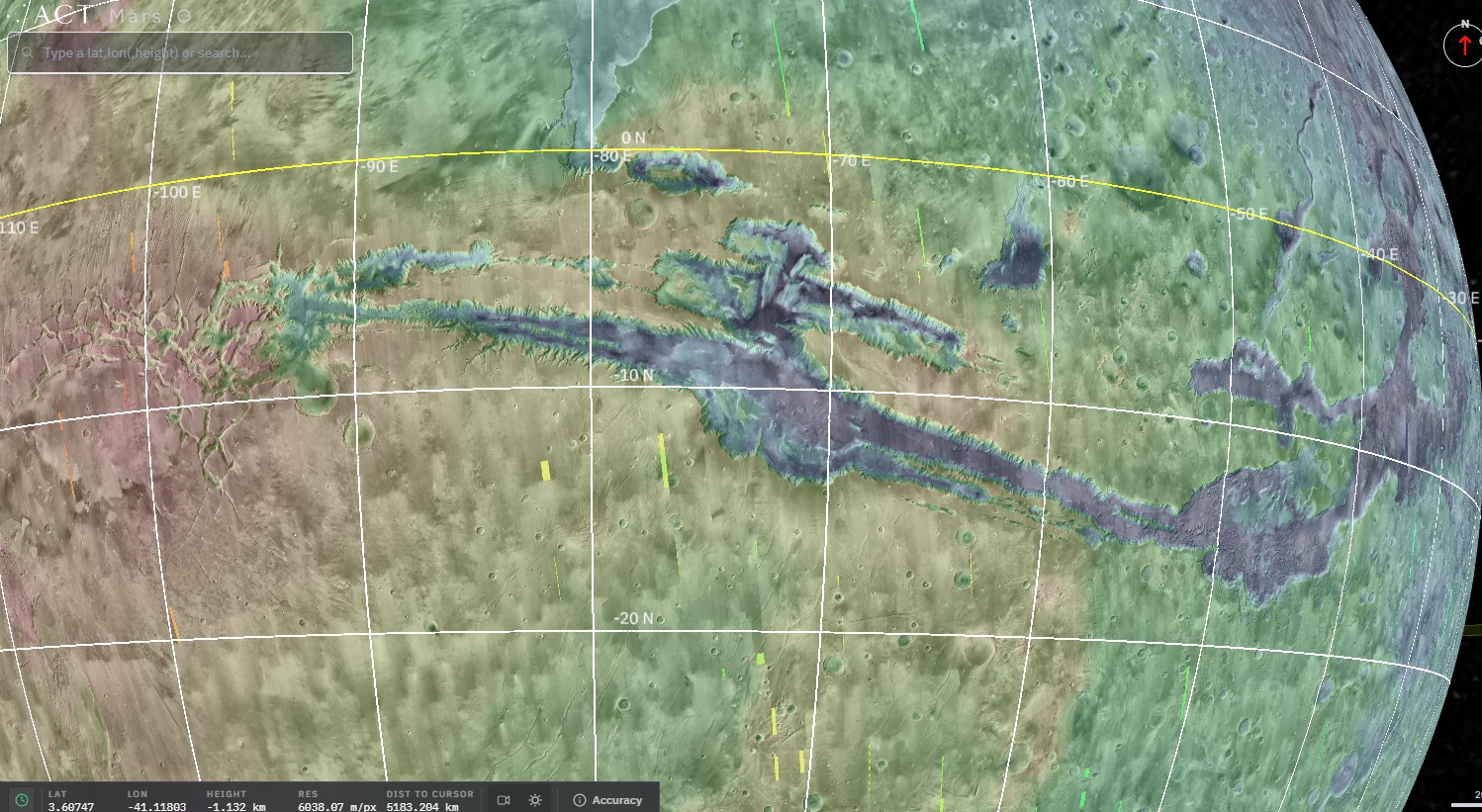
H.4The Basin and the Spill
The floor does not fall all the way to the eastern exit: from its deepest point it rises about 0.8 km before the eastern exit. This is a basin. Harrison & Chapman (2008) found it on the inner walls of the canyon: scarps and terraces over about 1,500 km, all at one elevation, m, the level of a lake that filled the centre of the canyon. The lake overflowed at the eastern end, in Eos Chasma, into the chaos and the outflow channels; the erosion near the spill point runs east–west. The inner walls kept the level of the flow, and the exit was to the east.
The basins of the canyon open toward the equator. On its northern side Hebes, Ophir, Candor and Juventae Chasmata lie as separate depressions, and from Juventae the channel of Maja Valles runs north (Figure 10). At the eastern end, Eos and Capri Chasmata open into the chaos of Aurorae and Hydraotes, and from there the outflow channels Simud and Tiu run north toward the equator and on to Chryse, with Ares Vallis to their east (Figure 11).
Baker & Milton (1974) described in these channels streamlined hills and longitudinal grooves, like those of the great floods of the Channeled Scabland on Earth; a streamlined hill points its tail downstream. At our resolution the floors of these channels are nearly level ( to km); their direction is shown by their forms, not by their slope.
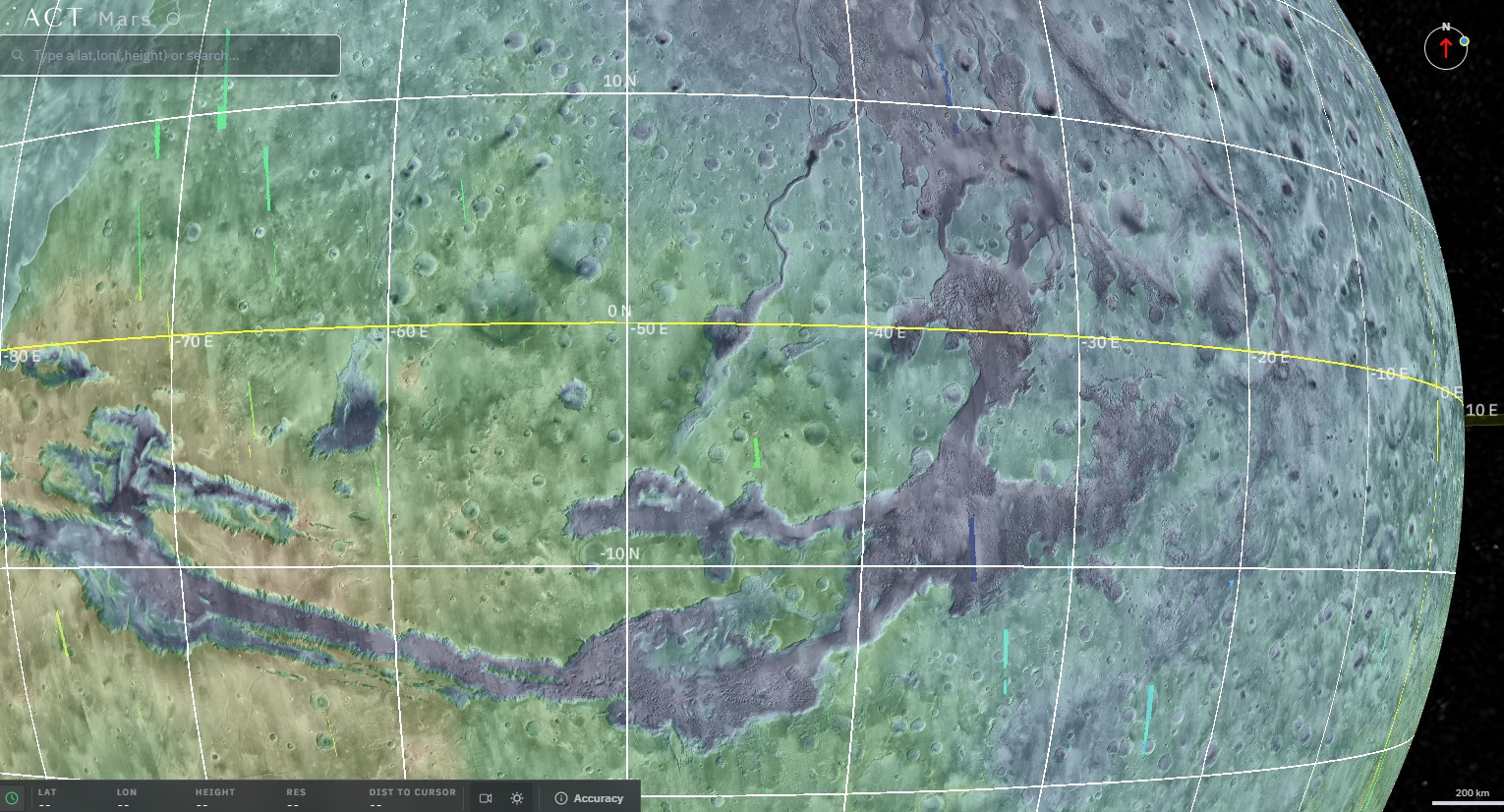
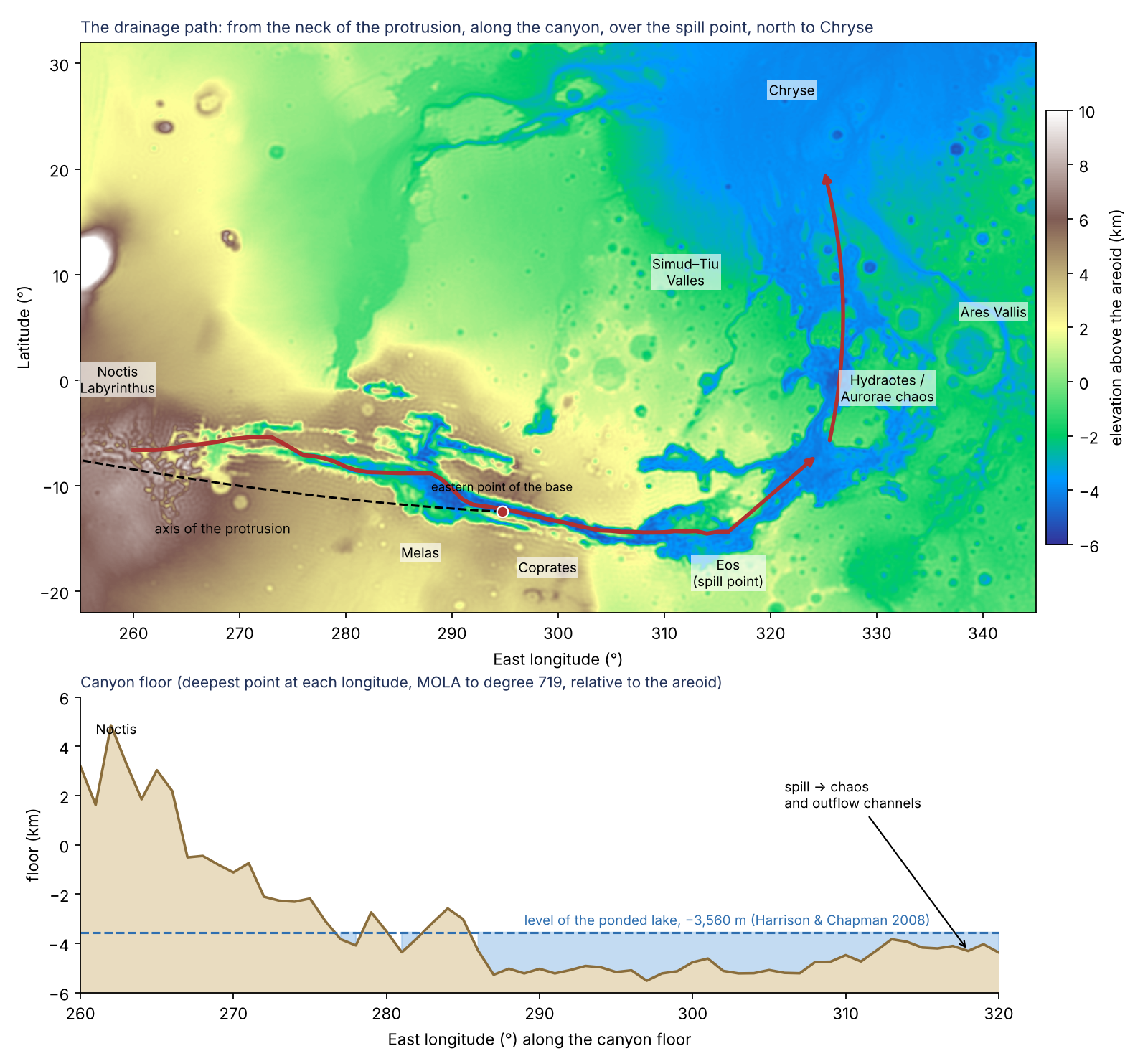
Head of the drainage (Noctis Labyrinthus, at the neck) channel along the axis (Valles Marineris, falling 10 km to the east) basin filled to one level on the walls ( m) spill to the east (Eos Chasma) chaos outflow channels north toward the equator and Chryse, with the forms of flow.
H.5 The Dust Provenance
The ring was not made of steam alone. Besides the enormous amount of volatiles that built it, the volcanoes on the protrusion threw out solid Martian material — matter of Mars itself — that reached no orbit of its own — shots weaker than those of the two moons, and the debris of the vents. It reached the inner part of the ring, and most of it came back to Mars. While it was in the ring it was ground, against the ring’s material and against itself, into small fragments and fine dust.
When the ring dried, its water was broken apart by sunlight and the solar wind, and the light hydrogen escaped to space; the heavy isotope, deuterium, stayed behind, and the water left on Mars became enriched in it. The fine dust the ring had held came down on Mars, mostly near the equator, together with frost.
In this account that is the source of the dust of Mars: a fine material spread over the whole planet, of much the same composition wherever it has been measured (Berger et al. 2016). The accepted view looks for its source on the ground, in deposits eroded by the wind, the largest being the Medusae Fossae Formation (Ojha et al. 2018). Dust that spent its time in the ring carries what the ring gave it: an age older than 4 billion years, the composition of the Phobos regolith, and grains that carry helium and neon from the solar wind; it should be most abundant in the broad equatorial band (prediction N.8). The loss of the ring left the surface dry.
H.6The Residual Volatiles
The water inside Mars did not have to come back in when the protrusion sank: most of it never went out. The steam that fed the ring and the gas beneath the vent, which burst the plugs, were the part of the volatiles that found a way out through fissures and vents.
The rest stayed sealed beneath the crust, and remains there today, in the pores of the mid-crust where InSight found it.
The Evidence
Part I described the sequence of mechanical and hydrodynamic events in the early history of the system. Part II sets out the geomorphological and geophysical evidence that this sequence left behind, place by place. Each section sets the observation against what the model says about it, and gives the numbers.
IThe Summit Caldera
I.1 The Caldera Geometry
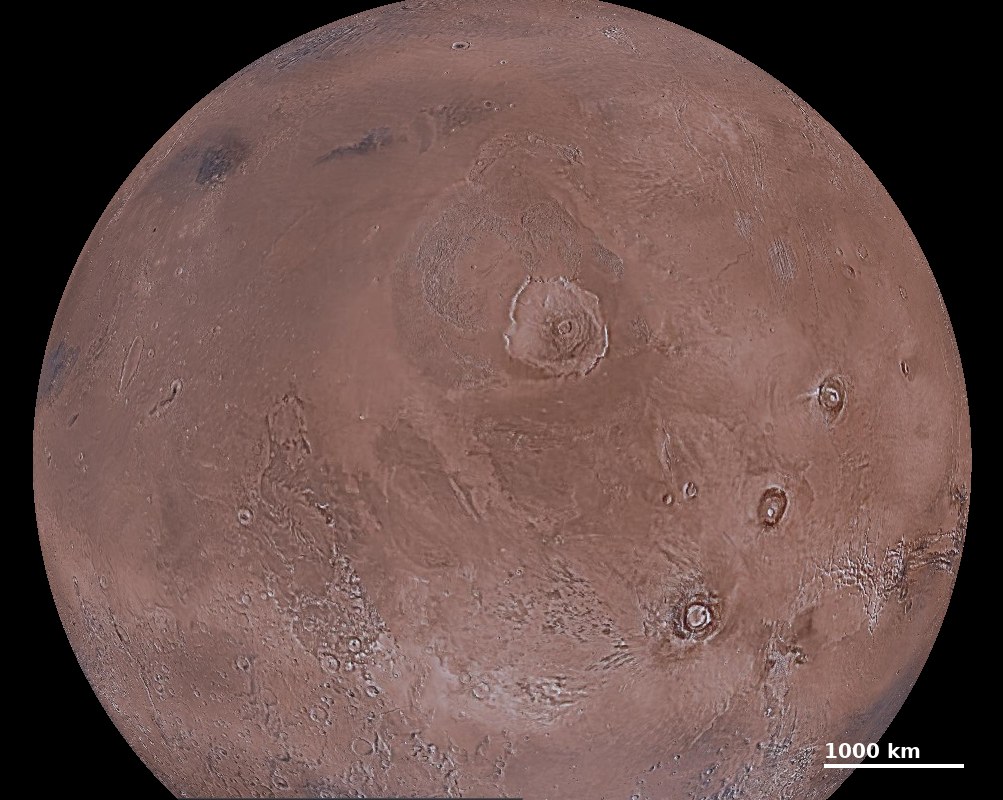
Pavonis Mons rises about 14 km above the mean level of Mars on a base about 375 km wide. Its summit caldera is a single circular pit 47 km across and nearly 5 km deep. It is a steep-walled cylinder, not a shallow bowl; to its north-east lies a secondary depression, broader and shallower, about 90 km across (USGS/IAU Gazetteer; NASA/JPL). The ratio of depth to width, about 0.10, is the measure of how much the summit is a barrel.
A comparison of the summits of Tharsis brings out what is particular to Pavonis:
| Volcano | Latitude | Caldera width | Caldera depth | Form |
|---|---|---|---|---|
| Pavonis Mons | 1.5N | 47 km | nearly 5 km | single deep circular pit |
| Olympus Mons | 18.7N | about 70 km (nested) | about 3 km | a complex of overlapping, stepped pits |
| Arsia Mons | 8.4S | about 110 km | to be measured | one broad pit |
| Ascraeus Mons | 11.8N | nested pits | to be measured | several overlapping pits |
Table 17. The geometry of the four calderas of Tharsis. Green marks Pavonis: a single pit, narrow and deep against those of the other mountains. The depths marked "to be measured" can be read from MOLA topography.
I.2 The Volume Balance
The volume of the Pavonis caldera, taken as a cylinder 47 km wide and 4.8–5.0 km deep, is 8,300–8,700 km. The two moons today hold about 5,740 km (Phobos) and about 1,000 km (Deimos), together about 6,740 km.
The pit is therefore of the scale of the two plugs that left it. It is not a mould of the bodies themselves but the space that collapsed after the shots, so it does not set their size.
I.3 The Caldera Collapse
When the plugs had left, the shallow reservoir beneath the vent lost what held up its roof. The roof cannot stand, and it falls vertically inward.
A steep, deep, circular pit is what a reservoir leaves when its roof collapses vertically; its depth, about 5 km, is the depth of the reservoir (§D.4). The model expects a measurement of the gravity beneath the caldera to show the missing mass of a reservoir that fired (prediction N.5).
JThe Deimos Record
J.1 The Damped Satellite
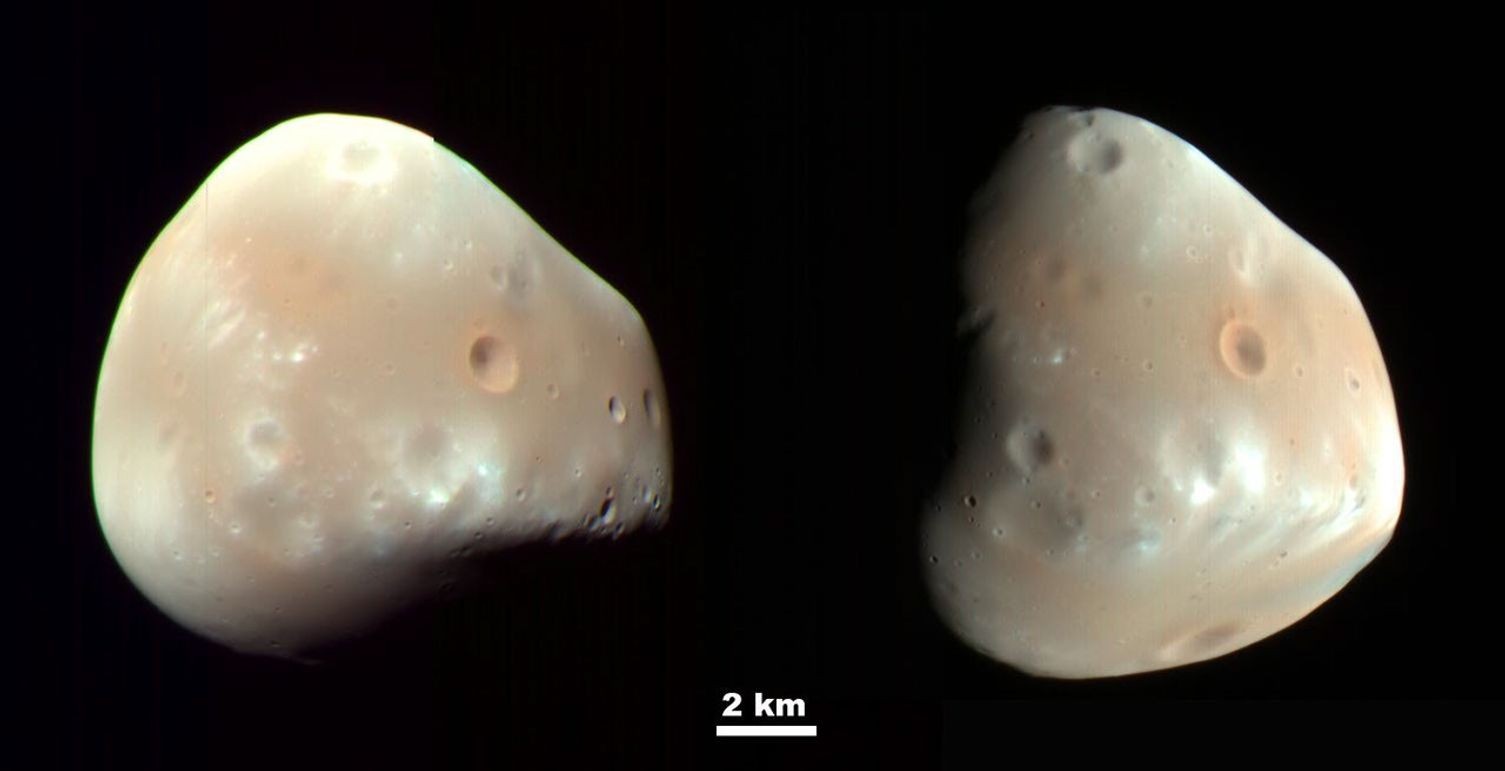
Deimos is the smoothest small body yet seen near Mars. Its depressions are shallow and worn, and it has no grooves or long drag marks. Measured on the shape models of Ernst et al. (2023) in the same way for both moons, the depressions wider than 0.7 km on Deimos have a median depth of 1.9% of their width, against 5.5% on Phobos; 84% of them are shallower than 6% of their width, against 56% on Phobos, and only 3% are deeper than 12%, against 13%.
Its orbit is almost a perfect circle (eccentricity 0.0003), close to the equatorial plane, and it lies beyond the corotation radius — the distance at which a body turning with the planet already moves at the speed of a free orbit. A circular, equatorial orbit together with a smooth, worn face are the marks of a body that spent a long time in a ring: the ring carried it into a circular, equatorial orbit, and its particles wore it down.
Deimos goes round more slowly than Mars turns, and it has done so throughout the history of the system: at 14,300 km, where its orbit became round, it went round in 14.4 hours against a Martian day of 7.3–8.3, about 0.5–0.6 times a day; today, at 23,463 km, it goes round in 30.3 hours against 24.6, 0.8 times a day. It has always stood beyond the line. The line moved outward behind it and never caught it — the reverse of Phobos (§K.8).
J.2The Mass Ablation Profile
Grinding and drag in the ring remove material. Deimos left the vent of Pavonis considerably larger than it is now, but not larger than Phobos, and it left smooth: as the first plug in the vent it did not rub against its walls. How much it lost during its stay in the ring depends on its diameter when it left:
| Diameter on leaving | Volume, km | Share lost by today | Layer ground away |
|---|---|---|---|
| 12.4 km (today) | 1,000 | — | — |
| 14.0 km | 1,430 | 30% | 0.8 km |
| 15.6 km | 2,000 | 50% | 1.6 km |
| 16.8 km | 2,500 | 60% | 2.2 km |
| 20 km | 4,190 | 76% | 3.8 km |
| 22.3 km (as Phobos) | 5,800 | 83% | 4.9 km |
Table 18. Deimos at departure and in the ring: larger than today, not larger than Phobos. The colour deepens with the share ground away as the diameter at departure grows.
J.3The Volatile-Rich Composition
Deimos is much lighter than Phobos: 1,471 kg m, against 1,853–1,887 kg m. The difference supports the order of events in the model directly. The first plug (Deimos) came from the top of the vent, from the youngest part of the crust, the richest in water, steam and trapped gas. The second plug (Phobos) formed later and deeper in the emptied vent, from material that had already dried and compacted.
The order of the densities is the order of the shots, and it is also the order in which Mars dried. Between the two releases Mars lost large amounts of water and gas through the corotation line — that loss is what slowed its spin from 7.3 to 8.3 hours (§E.2). Deimos was made of a planet still full of water; Phobos, an hour of spin later, of a partly dried one, and so it is the denser of the two.
The moons are samples of the crust of the young Mars: a third to a half of each is empty space, a foam that froze, and their densities, 1,471 and about 1,860 kg m, are those of the upper layers of a planet whose mean density was only about 1,170 kg m — light, porous and rich in water.
KThe Phobos Record
K.1The Striation Evidence
The surface of Phobos is crossed by extensive, coherent families of long, parallel grooves (Thomas et al. 1979; Murray & Heggie 2014). In the model of this paper they are the marks of the walls of the vent. Before the moons left, the vent of Pavonis was much narrower than its pit is today, about as wide as the plug it held, and the plug was pushed through it under high pressure (§D.4).
The steam and fragments that opened the vent did not leave its wall smooth: they left it ribbed with long, thin, hard plates standing out from the wall, like the gills under the cap of a mushroom. A hard, dry plug pushed through such a ribbed vent, and pressed against one side of it by the Coriolis force (a body rising through a spinning planet lags behind the speed of the walls and is deflected westward), is cut by the plates along its whole length, parallel to its motion.
A modern analogue is the solid spines extruded from the crater of Mount St Helens in 2004–2006, which left the conduit scored along their direction of motion (Cashman et al. 2008). The grooves of Phobos survived because it stayed only briefly in the thin edge of a waning ring and lost about 1% of itself, a layer of some 40 m.
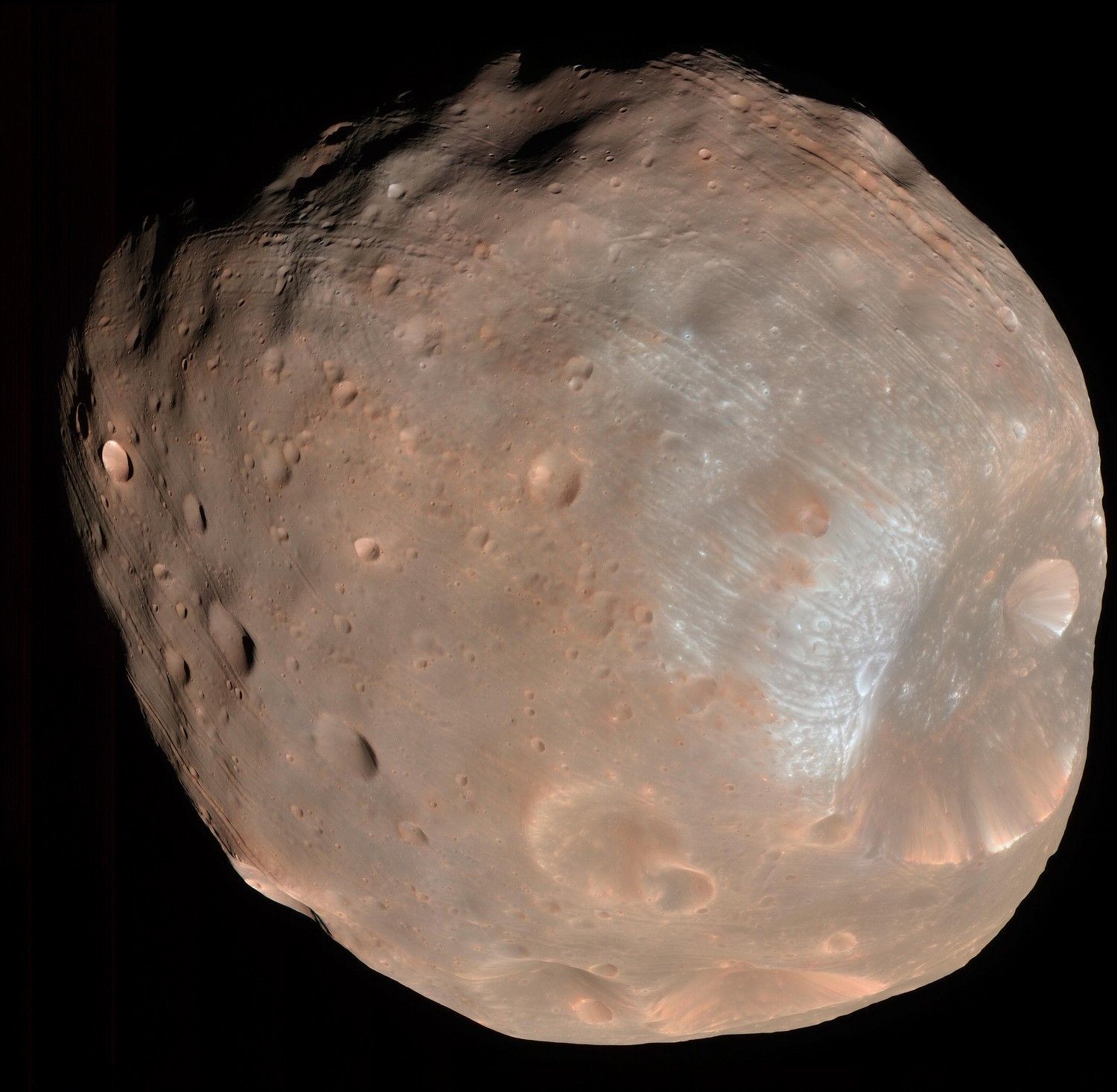
K.2The Post-Ejection Relaxation
Phobos left the vent long and soft, warm and drawn out along its motion, and its grooves were cut straight along that axis. In space, as it cooled, it settled gradually toward a rounder shape, and the grooves, carried on its surface, bent with it.
Today the grooves form a few large, coherent families across the whole body, curved rather than straight (Figure 16). In the model they are grooves that were straight when cut, on a body that changed its shape afterwards; restoring the present shape to the elongated one should straighten them (prediction N.2).
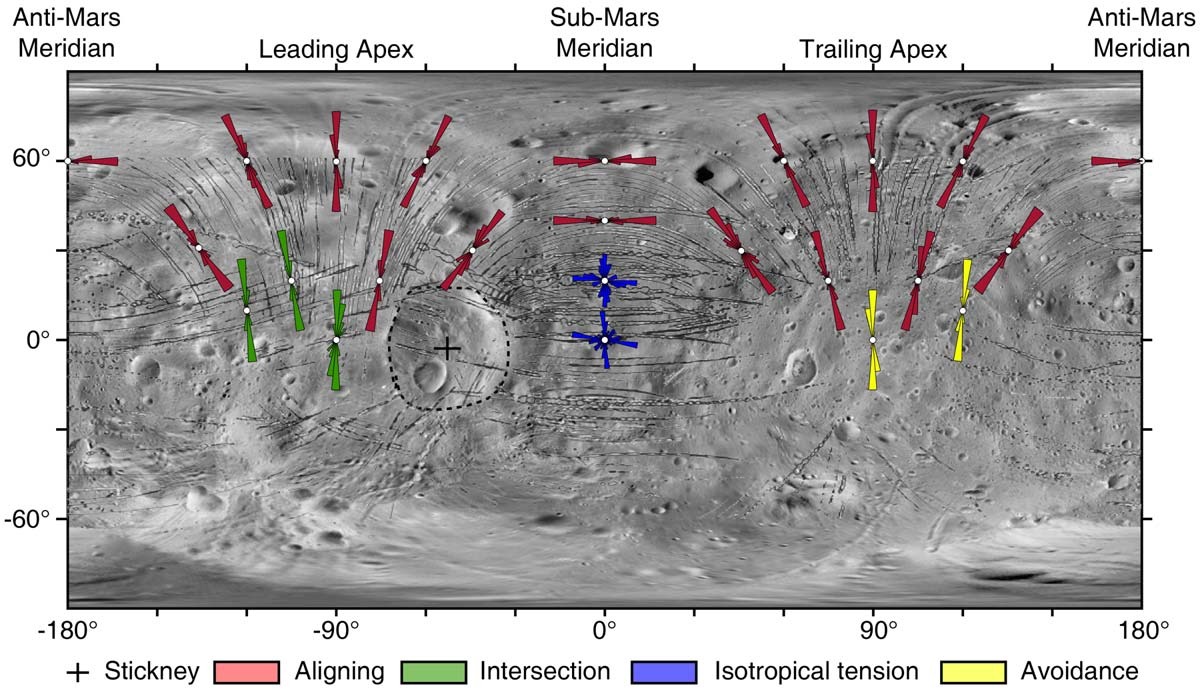
K.3The Roller-Bearing Pits
The chains of pits that run beside the grooves, parallel to them, are a second record of the same passage through the vent, made by a different tool. Boulders caught in the narrow gap between the plug and the wall did not bounce: they were held against the wall and pressed into the soft surface of the plug.
As the plug moved past, they rolled along it like the balls of a bearing, and every bump on a boulder pressed one pit at each turn. This mechanism accounts for the properties of the chains:
A chain is straight and parallel to the motion.
Its pits are evenly spaced, at a spacing set by the circumference of the boulder and the number of its bumps.
It runs toward the rear end of the body, which passed the caught boulders last.
Grooves and chains were made at the same time and in the same direction, so the chains always run beside the grooves and never cross them.
Pit chains and impact craters. The chains are not chains of secondary impacts. An impact crater that lands on a groove cuts it and erases the part it falls on; such craters exist on Phobos, superposed on grooves (Figure 17, centre). The chains do the opposite: they keep to the direction of the grooves and never cut them. Beside them Phobos carries true impact craters, of three generations: old, shallow, rounded hollows from the time of the ring; small, sharp craters made by material moving in the ring almost in step with Phobos; and sharp, young craters made after the ring had gone (§L).
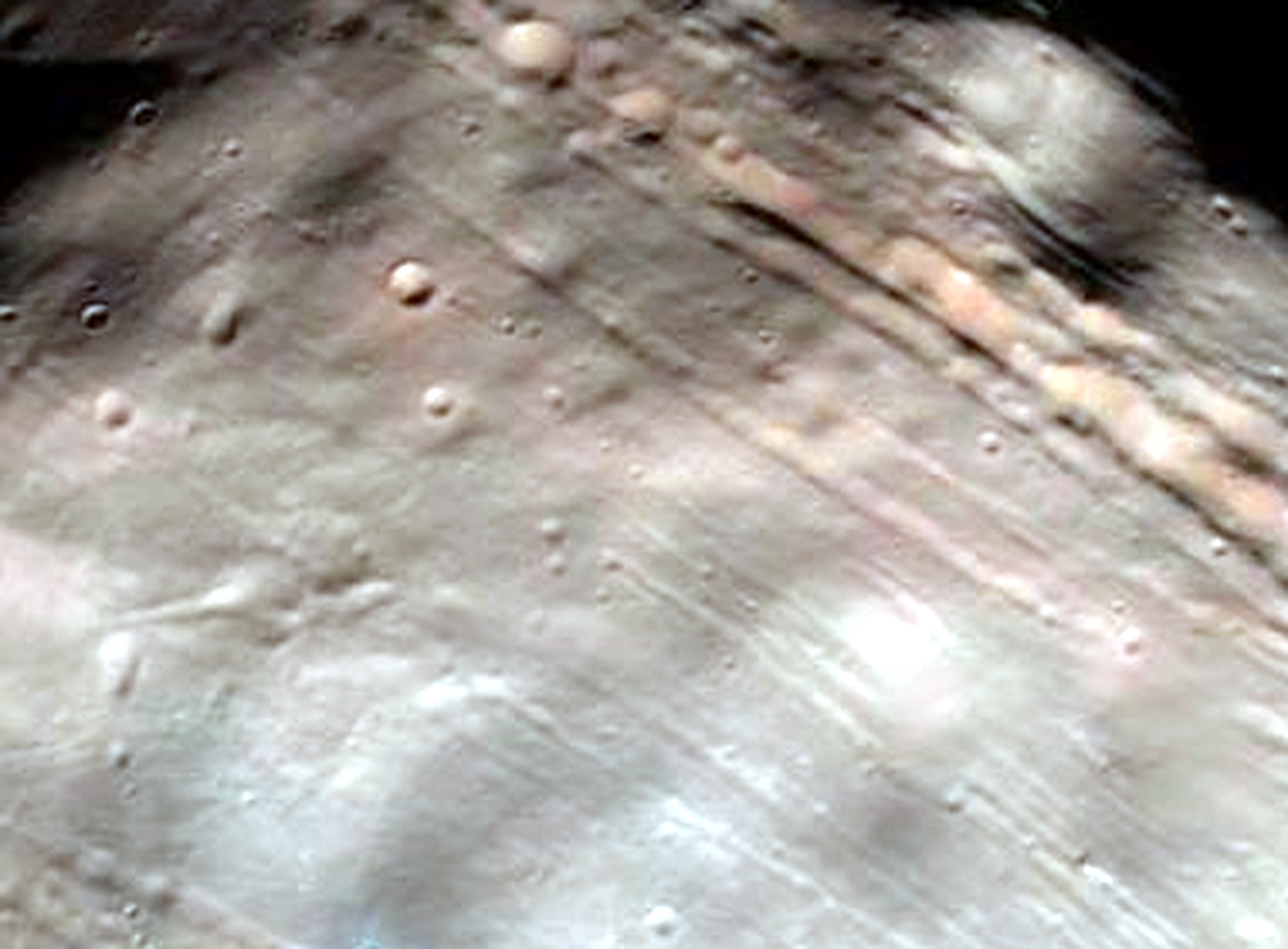
K.4The Leading Apex
Stickney, 9 km across (IAU centre 1S, 49W), lies at the blunt end of Phobos. On the shape model of Ernst et al. (2023) its centre lies 79% of the way from the sharp tip to the blunt one, and its rim reaches to within 0.4 km of the blunt tip, at the corner toward the leading side (Figure 19).
In the model the blunt end of the plug led the rise through the vent. At the vent mouth the leading end met the material in its way and pushed it out, and the hollow left by that encounter is Stickney. Stickney therefore formed after the grooves, whose remains are seen on its floor (§K.5).
A second reading. A second reading remains open: Stickney as the mark of a solid body, already moving in the ring before Phobos left, met by a Phobos that was still warm. An impactor of 1.5–2 km at a relative speed of about 1 km s suffices; such an impact would have slowed Phobos by about 1 m s. Both readings place the formation of Stickney on a warm, soft Phobos, and both make it younger than the grooves.
K.5The Intracrater Deformation
The grooves on the floor of Stickney were cut on the plug before the hollow formed, and were pressed in the encounter. On the 36-m shape model of Ernst et al. (2023) we compared the floor of Stickney, within half its radius and without the later inner crater Limtoc, with a ring around it, from 1.2 to 2 radii (Figure 18). The same filter was applied to both: it picks out long troughs 50–350 m wide in any direction and removes the curvature of the bowl. To judge whether the difference is unusual, the same comparison was repeated at 80 random places on Phobos.
The measurements gave the following values:
| Measure | Floor | Outside | Floor / outside | Stickney lower than, of 80 places |
|---|---|---|---|---|
| Typical groove relief, m | 1.56 | 1.74 | 0.89 | 65% |
| Area with strong grooves (3 m) | 0.9% | 5.5% | 0.17 | 76% |
| Sharpness: depth for width | 0.34 | 0.44 | 0.77 | 89% |
Table 19. Grooves on the floor of Stickney and around it, measured with the same filter. The colour deepens with how unusual Stickney is among 80 random places on Phobos.
Inside, the grooves keep most of their depth but are wider for it, and the sharp ones have nearly gone; in sharpness the floor is below 89% of the random places. This is the shape of a groove pressed flat, not one cut afresh or covered. No loose material flowed in to fill the floor: the grooves on it are pressed, not buried.
The shape model at this resolution smooths grooves to a few metres of relief, against tens of metres in images, so the contrast it gives is a lower bound; data at higher resolution should show it more sharply (prediction N.2).
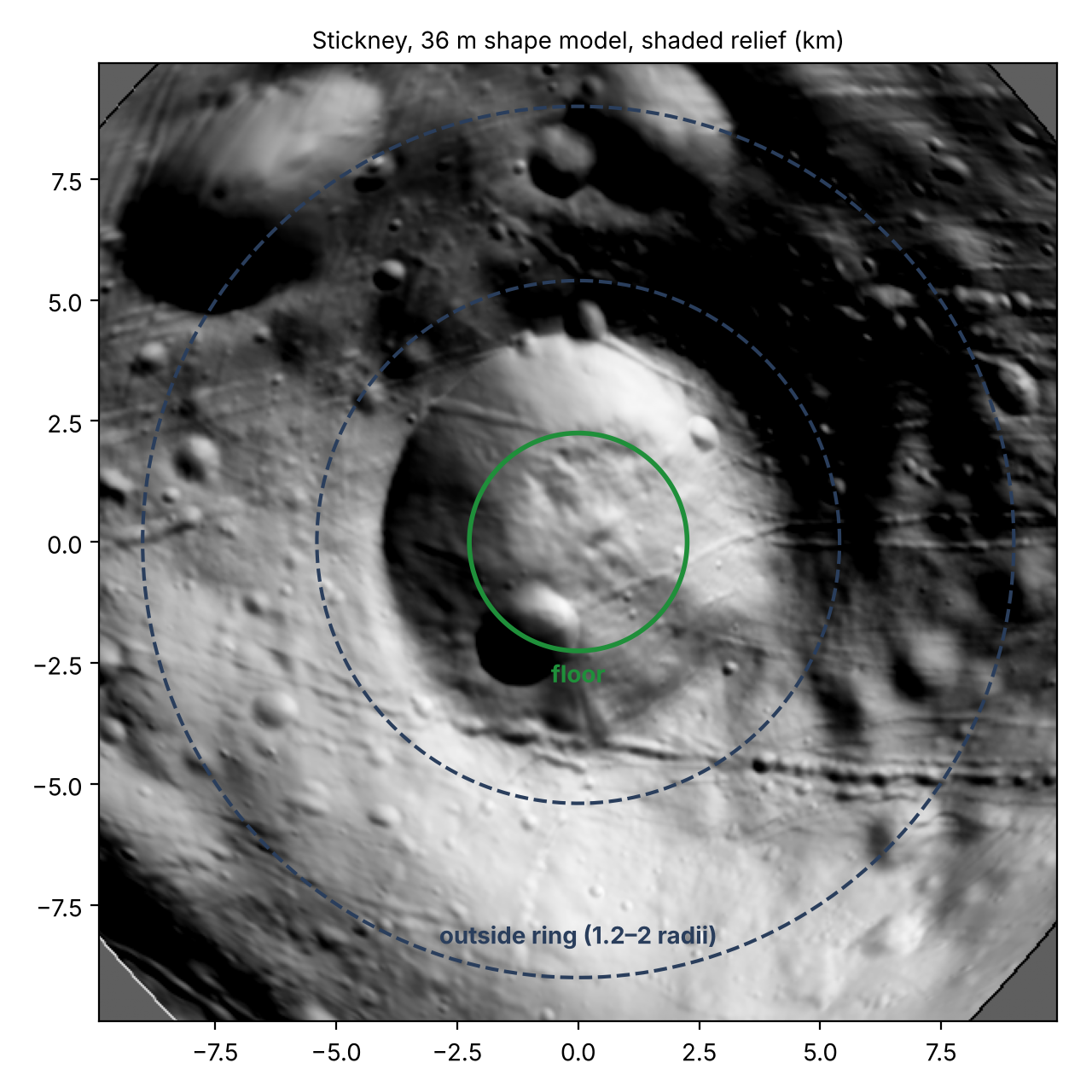
K.6 Mass Asymmetry and Centre-of-Mass Offset
The centre of mass of Phobos is not at its geometric centre: it is displaced toward its blunt end. This distribution was set in the reservoir, by the fast spin of the young Mars, before the plug left it. At the top of the standing protrusion the spin outweighed gravity: the net pull on the plug pointed outward, up to 0.17 m s (Table 1, §D.2). Under this reversed pull the denser material gathered at the outer end of the plug, and the plug left with that end leading. Gas pressing from below soaked the lower part of the plug and foamed it at the vent mouth, while the front was compacted against the material in its way: a dense front and a light, foamed rear.
As Phobos left the vent, its heavy end led, pointing away from Mars (Figure 19). Today it faces Mars. The spin set the heavy end outward; the gravity of Mars then turned it toward the planet, through 180. The tide holds the long axis of Phobos toward Mars but does not by itself tell one end from the other; how the turn was completed is set out as a requirement of the model (§O). The prediction stands either way: the centre of mass of Phobos is displaced toward Mars, toward its blunt end, by 300–500 m (prediction N.6).
We examined whether the push of the ring, which held Phobos at the corotation line throughout (§F.4), could have turned its centre of mass. The push acts on the body as a whole, and the centre of mass, displaced by 300–500 m, gives it a lever; the tide, which holds the long axis toward Mars, is stronger by a factor of twenty million to a hundred million (between 19,000 and 9,900 km). The push could turn the heavy end by less than a millionth of a degree. The turning of the centre of mass by the ring is therefore neglected.
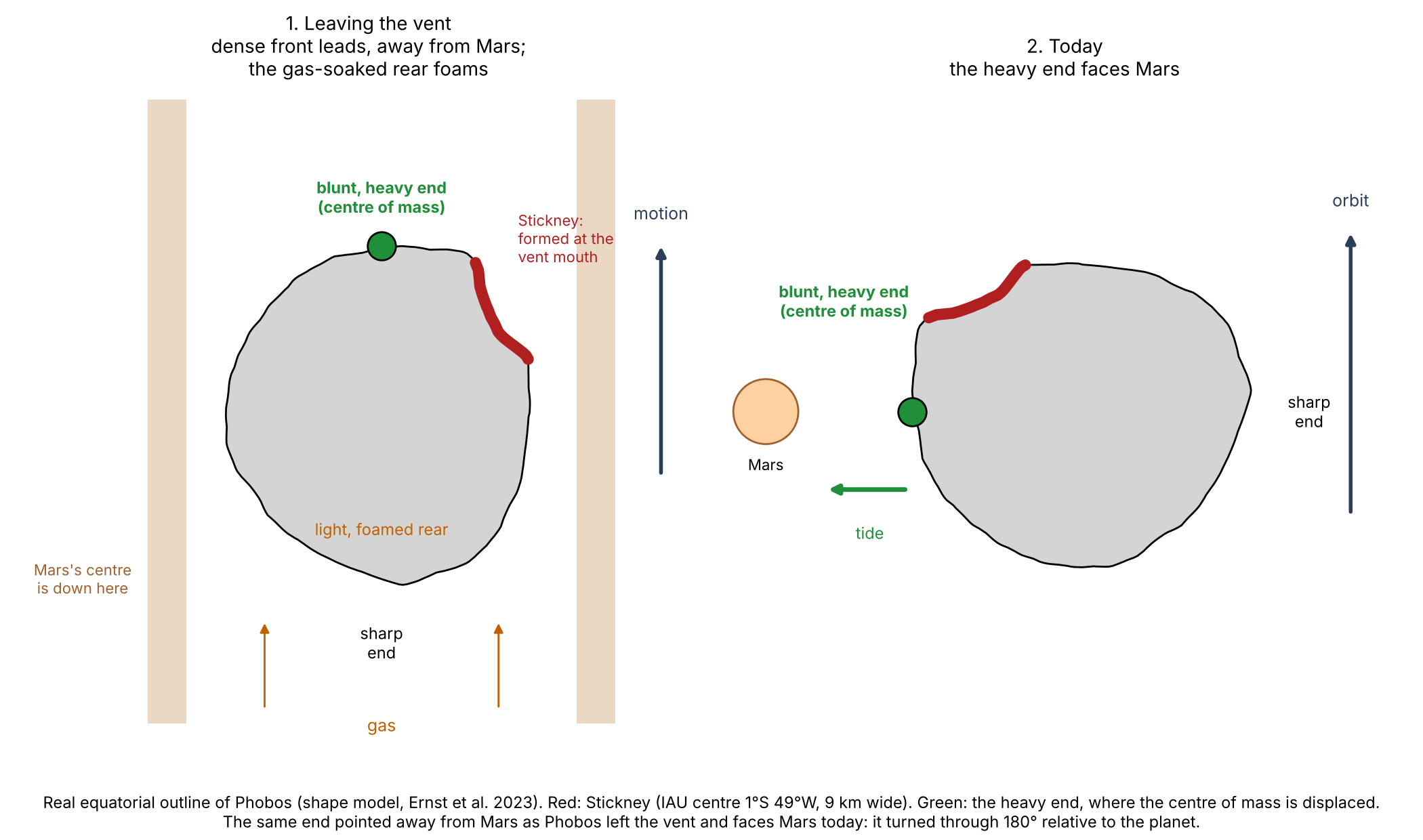
K.7The Paleo-Orbit Reconstruction
Phobos today goes round Mars in 7.65 hours — 3.2 times in each Martian day — at 2.14 km s. Its orbit is nearly circular (eccentricity 0.015) and within about a degree of the equatorial plane. Inside the corotation line, every body goes round faster than the planet turns; the tide it raises lags behind it and holds it back, and it spirals down. That is what Phobos is doing, and what it has done since the moving line passed it, at about 19,000 km (§F.5, G).
The back-integration below does not depend on how Phobos reached that height; it fixes only where it stood when its fall began:
| Fall began | Distance then | Its orbital period then |
|---|---|---|
| 3.5 billion years ago | 18,807 km | 21.8 h |
| 3.9 billion years ago | 19,119 km | 22.3 h |
| 4.5 billion years ago | 19,541 km | 23.0 h |
| Today | 9,375 km | 7.65 h |
Table 20. Phobos run backwards with the tidal friction measured for Mars today (). In every case the starting point of the fall lies within a few per cent of the corotation line of a slowed Mars, and it has fallen since.
K.8The 3.2 Commensurability
When its fall began, Phobos and Mars were nearly in step: at about 19,100 km Phobos went round once in 22.3 hours, and Mars turned once in about 22 hours — close to one orbit per Martian day. The ratio of 3.2 seen today was built afterwards, by two changes acting together in the same direction:
Phobos fell, and falling made it faster. A moon’s speed is set by its distance from the centre of the planet: the closer, the faster. The tide holds Phobos back and takes energy from it, and it sinks; as it sinks it speeds up, from about 1.50 km s at 19,100 km to 2.14 km s at 9,375 km. Its period shortened from 22.3 to 7.65 hours — a factor of 2.9.
Mars slowed. The planet went on losing spin with the water, gas and steam that left it through the corotation line, the ring among them: a ring outside the line carries away the spin it holds, and when it was gone that spin did not return. The Martian day lengthened from about 22 to 24.6 hours — a factor of 1.1.
The two changes together give the ratio of today:
| When the fall began | Today | Change | |
|---|---|---|---|
| Distance of Phobos | 19,100 km | 9,375 km | |
| Speed of Phobos | 1.50 km s | 2.14 km s | |
| Period of Phobos | 22.3 h | 7.65 h | faster (the fall) |
| Martian day | h | 24.6 h | slower (Mars) |
| Orbits per Martian day | 3.2 |
Table 21. From one orbit per day to 3.2. Phobos began nearly in step with Mars; its fall and the slowing of Mars together produced the ratio seen today. The colour shows the growing difference between the speed of the moon and the spin of the planet.
LThe Ring Signatures
Two equatorial orbits. Both moons go round Mars within two degrees of the equatorial plane and on nearly circular orbits. This is direct dynamical evidence of an ancient ring: a ring in the equatorial plane draws any body crossing it into that plane and absorbs its excess motion until its orbit is round.
A face that follows time and place in the ring. The surfaces of the two moons reflect where they were in the ring and for how long. Deimos stayed long in the heart of the ring: it is smooth and rounded, and on the more perfect circle (eccentricity 0.0003). Phobos met only the thin inner edge of a waning ring: it was not smoothed, kept the grooved, rough face it was given in the vent, and was left with a small eccentricity (0.015).
The inclination of Deimos. The ring left Deimos on a circle in the equatorial plane; its present tilt of about 1.8 is not original: it was added later, in a passage through a resonance with a massive inner moon. In the accepted literature this tilt has been read, independently, in the accepted literature as the trace of a past ring around Mars (Ćuk et al. 2020). Independent work thus already places a ring around the young Mars.
Worn hollows. The depressions of Deimos are three times shallower than those of Phobos (§J.1), and both moons carry an old generation of worn, rounded hollows beneath a young generation of sharp craters. The model explains this by the state of the moons when they were struck: a moon struck while still warm and soft is not dug into a sharp-rimmed bowl but folds inward, and low-speed contact with bodies moving almost in step with it in the ring leaves broad, shallow hollows. Only a moon that passed through a ring carries them. They were made early, at 10,000–24,000 km, so the near ring held solid bodies — stone and ice thrown from the volcanoes, which survive well inside the 13,000-km limit for loose ice (a solid ice block to about 7,700 km, stone to about 5,300 km). The grinding in the clumpy outer ring came later, and the sharp craters last, on bodies that had cooled and hardened.
The Moon never passed through a ring. No lasting ring could form around the young Earth: the pear that built the Moon swept the equatorial belt in which it would have formed and gathered its material into the forming Moon. At Mars, the time a body spent in the ring sets how much of its first face it lost: Deimos, long in the heart of the ring, is smooth, rounded and reduced; Phobos, briefly at its edge, is grooved and kept its mass; the Moon keeps a saturated crater record and its whole mass.
Ages. Crater counts put the surface of Phobos at about 4.3 billion years in a Mars-orbit chronology, or 3.5 in an asteroid-belt chronology (Schmedemann et al. 2014); the surfaces of both moons are near saturation and of similar crater density. The model expects a direct test of the material to show that Deimos is the older of the two.
M The Hydrological Record
Water that left. Heavy hydrogen in today’s atmosphere enriched six to seven times relative to the Earth’s oceans, and an early global water layer of at least 137 m (Villanueva et al. 2015): the record of the equatorial ring and of the steam that crossed the corotation line and went to space.
Water that stayed. A water-saturated mid-crust between 11.5 and 20 km depth beneath InSight, equivalent to a global layer 1–2 km deep (Wright, Manga & Panning 2024), fits the model: it is the water that found no path to the vents or the fractures and stayed sealed beneath the crust. The moons, soft when they were struck in the ring (§L), show that the ground beneath the surface of the young Mars was soft and soaked with water; the mid-crust of today is what remains of it, frozen and stable.
One sealed crust. The same impermeable crust that held the gas under pressure until the plugs moved and the moons left is the crust that holds the water inside Mars today.
Empirical Predictions
A scientific hypothesis must give quantitative predictions that can be refuted. This part collects the predictions that follow from the LEF model. Each prediction gives what is expected, its value where one can be given, the instrument or data that will measure it and when, and what the accepted explanation expects at the same place — so that each measurement separates the two. The tests will become possible with the data of the coming missions, foremost among them the Martian Moons eXploration (MMX) mission of the Japan Aerospace Exploration Agency (JAXA), which will land on Phobos, fly past Deimos and return samples to the Earth.
N The Predictive Matrix
| Prediction | Expected (this paper) | Measured by | When | Accepted explanation expects |
|---|---|---|---|---|
| N.1 Composition of Phobos | Original Martian crust altered by water: oxygen, chromium and titanium isotopes on the Martian line alone, with no foreign impactor component; moderately volatile elements (zinc, potassium) showing no evaporative shift; hydrated minerals; closed vesicles of a cooled foam | Laboratory analysis of MMX samples, g of regolith | Return 2031 | Impact disc: a mixture of Mars and impactor, much of it melted and re-condensed. Capture: primitive asteroid material |
| N.2 Phobos grooves | Cut by the rigid plates of the vent wall: parallel to the direction of motion, concentrated on the side that faced west in the vent; bent with the body as it rounded, so that restoring an elongated shape straightens them; on the floor of Stickney pressed, wider for their depth than outside, more clearly at higher resolution, with no cover of loose regolith; rims sharp or only slightly worn, the surface etched, not smoothed | MMX imaging; HRSC; shape models | Now and 2027 on | Tidal stress or Stickney ejecta; no difference inside Stickney |
| N.3 Phobos pit chains | Pressed by trapped boulders that rolled between the plug and the wall, as in a ball bearing: straight, parallel to the grooves and never crossing them; pits at equal, regular spacing within each chain; chains running continuously to the rear, sharp end | MMX imaging | 2027 on | Secondary impacts or drainage into fractures: irregular spacing, no relation to the ends of the body |
| N.4 Deimos surface | Ancient, shallow, worn hollows (median depth about 2% of width, against 5.5% on Phobos), the result of long grinding within the ring; same composition as Phobos | MMX flybys of Deimos | After 2027 | Accreted rubble; smoothness from later regolith infill |
| N.5 Pavonis caldera | The deepest caldera for its width of the four (depth/width 0.10); a mass deficit beneath it, the mark of the shallow reservoir that emptied | MOLA topography; gravity models (GMM-3) | Now | An ordinary summit caldera of a shield volcano |
| N.6 The two moons | The same Martian material in both, Deimos the wetter (richer in volatiles, and so lighter and more porous); the centre of mass of Phobos displaced toward Mars, toward its blunt end, by 300–500 m; a light, foamed rear (sharp) end | MMX samples, flybys and gravity field | 2027–2031 | Separate histories; no prediction for the centre of mass |
| N.7 Water beneath Tharsis | A water-saturated mid-crust beneath the whole of Tharsis, continuing what was found beneath InSight | Future seismic stations | Future | No link between moons and buried water |
| N.8 Martian dust | A component older than 4 billion years, from the material of the ring that fell, of the composition of the Phobos regolith, with grains that carry solar-wind helium and neon; most abundant in the broad equatorial band and the dust continents (Tharsis, Arabia Terra, Elysium), mixed with material ground by drought and wind | Returned Perseverance regolith samples; MMX | 2031 on | Dust from weathering and wind erosion of surface material alone; no separate ancient component |
Table 22. Predictions, instruments and dates of the tests, against the accepted explanation. MMX launches in October 2026, lands on Phobos in 2027 and returns its samples in 2031, with several flybys of Deimos (JAXA; Kuramoto et al. 2022). The full list of proposed measurements, mission by mission, is in Appendix B.
O System Constraints and Boundary Conditions
The requirements and conditions on which the model rests, collected in one place for the whole paper:
The principle of the protrusion: every planet with a moon raised, early in its history, a structure on its equator from which material reached orbit — on Mars a tapered protrusion, on the Earth a pear. On Mars, the Tharsis rise is read as the protrusion lying down, from its base in Valles Marineris to its tip beside Pavonis (§C).
A fast, expanded young Mars: 1.5 times today’s radius, hot and homogeneous (not yet sorted into layers), turning in 7.3 hours at the first release (Deimos) and 8.3 hours at the second (Phobos) (§B, E).
A tapered protrusion grown on the equator of a fast-spinning Mars, fed and supported by pressure from within: the core need not have moved; it stood until the moons had left, high enough to put the vent of Pavonis 4,450 km above the young equator (§C.6, D; the length measured today, 2,996 km, is the hypotenuse).
An ordinary volcano at Pavonis: a shallow reservoir about 5 km down, a vent about as wide as the plug, an overpressure of 10–50 MPa or less; no deep chamber, no long conduit (§D.4–D.5).
The loss of about 87% of the spin through the corotation line, carried by water and gas: 6–11% of the mass of Mars, from a young Mars of which more than 30% was water, most of it in the first billion years (§E.2).
A ring from the line outward, built of steam and fine material before the releases, round and in the equatorial plane, which rounded both orbits and flattened their tilt from about 10 (§F.1).
The leash: the gaseous inner edge of the ring, at a density of a few kg m or more, lasting until Mars had slowed to a day of about 22 hours; its headwind balanced the push of the tide on Phobos and held it at the receding line until it stood near 19,000 km (§F.4–F.6).
A soft young Mars: dissipating tidal energy 8 to 20 times more than today while Deimos climbed, carrying it past 20,428 km before the line arrived there (§G).
The turn of Phobos: its heavy end led, away from Mars, as it left the vent, and faces Mars today; what turned it through 180 is left to a focused study (§K.6).
The colour: the dark, primitive-looking spectra of both moons, which give them the look of asteroids, are not a sign of a foreign origin; they must arise from Martian material altered by water and steam and by long exposure in space.
Sensitivity: a focused study may give approximate numbers somewhat different from those of this paper; the sequence does not depend on their exact values.
Computational Reproducibility
Every number of this paper is computed and printed by the script
mars2_numbers.py (Python 3, standard library only), kept
with the files of this paper.
Input values. km s; today’s radius 3,389.5 km; day 24.6229 h; today’s inertia coefficient 0.3644. The young Mars: radius today, homogeneous (), its figure a Maclaurin spheroid at each rate of spin (Chandrasekhar 1969).
The geometry of the protrusion. The protrusion, from its base at 294.70E, 12.46S to its tip at 243.86E, 5.40S, is read on the MOLA shape model MarsTopo719 expanded to degree 180 (Smith et al. 2001; Wieczorek 2015). Each candidate volcano stands, on the standing protrusion, at a height above the equator, where is its distance from the eastern point of the base and the half-width of the base (1,340 km today, read on MOLA across the axis of the protrusion, north edge at 0 km). On the young Mars east–west lengths scale with the equatorial radius and north–south lengths with of the Maclaurin spheroid at the day in question.
Release, tide and headwind. A body is set free at a vent with the sideways speed of the vent and, where stated, a push upward of with kg m; Phobos at release kg, Deimos kg. Tidal friction is today and 8–20 times more on the young Mars (§G), with . The headwind at the ring’s edge balances the tide on Phobos, with m s, where is the gas density and the cross-section of the moon. The spin removed through the line is carried at the angular momentum of a circular orbit at the receding line, from 9,080 to 20,428 km.
The topography and the shape models of Phobos and Deimos were analysed with separate scripts kept with the code.
Observational Protocols
The predictions of this paper can be tested with measurements that current and planned missions are designed to make. We list them by mission, so that each team can see what the account asks of its data. Each row gives what to measure, what the account expects, the result that would refute it, and what the accepted explanation expects.
| # | Measure | Expected here | Refuted by | Accepted explanation |
|---|---|---|---|---|
| MMX (JAXA): Phobos landing 2027, sample return 2031, Deimos flybys | ||||
| B1 | O, Cr and Ti isotopes; D/H of Phobos samples | On the Martian line alone | Values departing from Mars and matching a primitive asteroid | Capture: asteroid. Impact: Mars plus impactor |
| B2 | Foreign component | None: pure Mars | A significant impactor component | Impact: a large one |
| B3 | Zn and K isotopes | Unshifted: no evaporation and re-condensation | Light isotopes depleted | Impact: depleted |
| B4 | Grain texture | Cooled volcanic foam: closed vesicles, hydrated minerals | Vapour-condensed glass spherules | Impact: melted and re-condensed |
| B5 | Gravity field of Phobos | Centre of mass displaced toward Mars, toward the blunt end, by 300–500 m | Displaced toward the sharp end | No prediction |
| B6 | Imaging of the grooves | Concentrated on one side; bent with the body, straight on an elongated shape; pressed on the floor of Stickney; rims sharp or slightly worn; surface etched, not smoothed | Grooves on the floor of Stickney as sharp as outside | Tides or Stickney ejecta |
| B7 | Imaging of the pit chains | Straight, beside the grooves and never crossing them; evenly spaced pits; chains ending at the rear, sharp end | Pit chains crossing grooves at random; irregular spacing | Secondary impacts |
| B8 | Deimos flybys: shape and hollows | Shallow, worn hollows; composition as Phobos | A composition unlike Phobos | Accreted rubble; regolith infill |
| Mars orbiters (MRO, Mars Express, TGO) | ||||
| B9 | Images east of each of the four Tharsis volcanoes, along their latitude | Chains of large blocks or craters: weak shots that fell back | — | No link to the volcanoes |
| B10 | Gravity beneath the Pavonis caldera, against Arsia | A mass deficit beneath Pavonis, larger than beneath Arsia: the reservoir that fired | A mass excess beneath Pavonis; a larger deficit beneath Arsia (Arsia must then be re-examined) | An ordinary shield caldera |
| Returned regolith samples of Perseverance | ||||
| B11 | Age of single dust grains | A component older than 4 billion years (the material of the ring that fell), mixed with locally ground material | — | Weathered material alone |
| B12 | Solar-wind He and Ne in the grains | Ancient grains that carry them, from their time in space in the ring | No such grains | No such grains |
| B13 | Composition of the ancient component | As the Phobos regolith | Unlike it | No prediction |
| Future seismic stations | ||||
| B14 | Mid-crust beneath Tharsis | Water-saturated, as beneath InSight | Dry | No link to the moons |
| B16 | Position of the core | Centred, or slightly displaced toward the protrusion, 255–263E (§C.7) | Clearly displaced in another direction | No prediction |
| A future mission | ||||
| B15 | A sample of Deimos | The same Martian fingerprint as Phobos | A different origin | Unrelated histories |
Table B1. Proposed measurements and tests of refutation, mission by mission.
References
Anderson, R. C., Dohm, J. M., Golombek, M. P., et al. (2001). Primary centers and secondary concentrations of tectonic activity through time in the western hemisphere of Mars. Journal of Geophysical Research: Planets, 106, 20563–20585.
Baker, V. R., & Milton, D. J. (1974). Erosion by catastrophic floods on Mars and Earth. Icarus, 23, 27–41.
Banerdt, W. B., Golombek, M. P., & Tanaka, K. L. (1992). Stress and tectonics on Mars. In H. H. Kieffer et al. (Eds.), Mars (pp. 249–297). University of Arizona Press.
Basilevsky, A. T., Lorenz, C. A., Shingareva, T. V., Head, J. W., Ramsley, K. R., & Zubarev, A. E. (2014). The surface geology and geomorphology of Phobos. Planetary and Space Science, 102, 95–118.
Berger, J. A., Schmidt, M. E., Gellert, R., et al. (2016). A global Mars dust composition refined by the Alpha-Particle X-ray Spectrometer in Gale Crater. Geophysical Research Letters, 43, 67–75.
Black, B. A., & Mittal, T. (2015). The demise of Phobos and development of a Martian ring system. Nature Geoscience, 8, 913–917.
Burgisser, A., Poussineau, S., Arbaret, L., Druitt, T. H., Giachetti, T., & Bourdier, J.-L. (2010). Pre-explosive conduit conditions of the 1997 Vulcanian explosions at Soufrière Hills Volcano, Montserrat: I. Pressure and vesicularity distributions. Journal of Volcanology and Geothermal Research, 194, 27–41.
Canup, R., & Salmon, J. (2018). Origin of Phobos and Deimos by the impact of a Vesta-to-Ceres sized body with Mars. Science Advances, 4, eaar6887.
Cartan, É. (1924). Sur la stabilité ordinaire des ellipsoïdes de Jacobi. Proceedings of the International Mathematical Congress, Toronto, 2, 9–17.
Cashman, K. V., Thornber, C. R., & Pallister, J. S. (2008). From dome to dust: shallow crystallization and fragmentation of conduit magma during the 2004–2006 dome extrusion of Mount St. Helens, Washington. In A Volcano Rekindled, U.S. Geological Survey Professional Paper 1750, 387–413.
Castillo-Rogez, J. C., Matson, D. L., Sotin, C., Johnson, T. V., Lunine, J. I., & Thomas, P. C. (2007). Iapetus’ geophysics: rotation rate, shape, and equatorial ridge. Icarus, 190, 179–202.
Chandrasekhar, S. (1969). Ellipsoidal Figures of Equilibrium. Yale University Press.
Cheng, B., Asphaug, E., Ballouz, R.-L., Yu, Y., & Baoyin, H. (2022). Numerical simulations of drainage grooves in response to extensional fracturing: testing the Phobos groove formation model. The Planetary Science Journal, 3, 249.
Clarke, A. B., Esposti Ongaro, T., & Belousov, A. (2015). Vulcanian eruptions. In H. Sigurdsson et al. (Eds.), The Encyclopedia of Volcanoes (2nd ed., pp. 505–518). Academic Press.
Crumpler, L. S., Head, J. W., & Aubele, J. C. (1996). Calderas on Mars: characteristics, structure, and associated flank deformation. Geological Society, London, Special Publications, 110, 307–348.
Ćuk, M., Minton, D. A., Pouplin, J. L. L., & Wishard, C. (2020). Evidence for a past Martian ring from the orbital inclination of Deimos. The Astrophysical Journal Letters, 896, L28.
Darwin, G. H. (1902). On the pear-shaped figure of equilibrium of a rotating mass of liquid. Philosophical Transactions of the Royal Society A, 198, 301–331.
Dauphas, N., & Pourmand, A. (2011). Hf–W–Th evidence for rapid growth of Mars and its status as a planetary embryo. Nature, 473, 489–492.
Ernst, C. M., Daly, R. T., Gaskell, R. W., et al. (2023). High-resolution shape models of Phobos and Deimos from stereophotoclinometry. Earth, Planets and Space, 75, 103.
Fagents, S. A., & Wilson, L. (1993). Explosive volcanic eruptions — VII. The ranges of pyroclasts ejected in transient volcanic explosions. Geophysical Journal International, 113, 359–370.
Garrick-Bethell, I., Wisdom, J., & Zuber, M. T. (2006). Evidence for a past high-eccentricity lunar orbit. Science, 313, 652–655.
Genova, A., Goossens, S., Lemoine, F. G., et al. (2016). Seasonal and static gravity field of Mars from MGS, Mars Odyssey and MRO radio science. Icarus, 272, 228–245.
Grott, M., Morschhauser, A., Breuer, D., & Hauber, E. (2011). Volcanic outgassing of CO and HO on Mars. Earth and Planetary Science Letters, 308, 391–400.
Harrison, K. P., & Chapman, M. G. (2008). Evidence for ponding and catastrophic floods in central Valles Marineris, Mars. Icarus, 198, 351–364.
Hesselbrock, A. J., & Minton, D. A. (2017). An ongoing satellite–ring cycle of Mars and the origins of Phobos and Deimos. Nature Geoscience, 10, 266–269.
Hurford, T. A., Asphaug, E., Spitale, J. N., et al. (2016). Tidal disruption of Phobos as the cause of surface fractures. Journal of Geophysical Research: Planets, 121, 1054–1065.
Hyodo, R., Genda, H., Charnoz, S., & Rosenblatt, P. (2017). On the impact origin of Phobos and Deimos I: thermodynamic and physical aspects. The Astrophysical Journal, 845, 125.
IAU Working Group for Planetary System Nomenclature / USGS Astrogeology Science Center. Gazetteer of Planetary Nomenclature, entry “Pavonis Mons”. https://planetarynames.wr.usgs.gov/.
Iurato, G. (2014). The dawning of the theory of equilibrium figures: a brief historical account from the 17th through the 20th century. arXiv:1409.3858.
Jakosky, B. M., et al. (2018). Loss of the Martian atmosphere to space: present-day loss rates determined from MAVEN observations and integrated loss through time. Icarus, 315, 146–157.
JAXA. Martian Moons eXploration (MMX), mission overview and schedule. https://www.mmx.jaxa.jp/en/.
Jeans, J. H. (1917). On the instability of the pear-shaped figure of equilibrium of a rotating mass of liquid. Philosophical Transactions of the Royal Society A, 217, 1–34.
Jeans, J. H. (1919). Problems of Cosmogony and Stellar Dynamics. Cambridge University Press.
Kokubo, E., & Genda, H. (2010). Formation of terrestrial planets from protoplanets under a realistic accretion condition. The Astrophysical Journal Letters, 714, L21–L25.
Kuramoto, K., Kawakatsu, Y., Fujimoto, M., et al. (2022). Martian Moons Exploration MMX: sample return mission to Phobos elucidating formation processes of habitable planets. Earth, Planets and Space, 74, 12.
Labrosse, S., Poirier, J.-P., & Le Mouël, J.-L. (2001). The age of the inner core. Earth and Planetary Science Letters, 190, 111–123.
Lainey, V., et al. (2021). Mars moon ephemerides after 14 years of Mars Express data. Astronomy & Astrophysics, 650, A64.
Lunine, J. I., Chambers, J., Morbidelli, A., & Leshin, L. A. (2003). The origin of water on Mars. Icarus, 165, 1–8.
Lyapunov, A. M. (1905). Sur un problème de Tchebychef. Mémoires de l’Académie Impériale des Sciences de St.-Pétersbourg, 17(3).
McCord, T. B., & Sotin, C. (2005). Ceres: evolution and current state. Journal of Geophysical Research: Planets, 110, E05009.
Miguel, Y., & Brunini, A. (2010). Planet formation: statistics of spin rates and obliquities of extrasolar planets. Monthly Notices of the Royal Astronomical Society, 406, 1935–1943.
Murray, J. B., & Heggie, D. C. (2014). Character and origin of Phobos’ grooves. Planetary and Space Science, 102, 119–143.
NASA/JPL Solar System Dynamics. Planetary Satellite Physical Parameters. https://ssd.jpl.nasa.gov/sats/phys_par/.
Ojha, L., Lewis, K., Karunatillake, S., & Schmidt, M. (2018). The Medusae Fossae Formation as the single largest source of dust on Mars. Nature Communications, 9, 2867.
Ortiz, J. L., Santos-Sanz, P., Sicardy, B., et al. (2017). The size, shape, density and ring of the dwarf planet Haumea from a stellar occultation. Nature, 550, 219–223.
Park, R. S., Konopliv, A. S., Bills, B. G., et al. (2016). A partially differentiated interior for (1) Ceres deduced from its gravity field and shape. Nature, 537, 515–517.
Pätzold, M., Andert, T. P., Cardesín-Moinelo, A., Cicchetti, A., & Ziese, R. (2025). Investigations of the Moon Phobos by Mars Express and implications towards its origin. Space Science Reviews, 221, 41.
Phillips, R. J., Zuber, M. T., Solomon, S. C., et al. (2001). Ancient geodynamics and global-scale hydrology on Mars. Science, 291, 2587–2591.
Ramsley, K. R., & Head, J. W. (2019). Origin of Phobos grooves: testing the Stickney crater ejecta model. Planetary and Space Science, 165, 137–147.
Rosenblatt, P., Charnoz, S., Dunseath, K. M., et al. (2016). Accretion of Phobos and Deimos in an extended debris disc stirred by transient moons. Nature Geoscience, 9, 581–583.
Schmedemann, N., Michael, G. G., Ivanov, B. A., Murray, J. B., & Neukum, G. (2014). The age of Phobos and its largest crater, Stickney. Planetary and Space Science, 102, 152–163.
Smith, D. E., et al. (2001). Mars Orbiter Laser Altimeter: experiment summary after the first year of global mapping of Mars. Journal of Geophysical Research, 106, 23689–23722.
Thomas, P. (1979). Surface features of Phobos and Deimos. Icarus, 40, 223–243.
Thomas, P., Veverka, J., Bloom, A., & Duxbury, T. (1979). Grooves on Phobos: their distribution, morphology and possible origin. Journal of Geophysical Research, 84, 8457–8477.
Villanueva, G. L., Mumma, M. J., Novak, R. E., et al. (2015). Strong water isotopic anomalies in the martian atmosphere: probing current and ancient reservoirs. Science, 348, 218–221.
Weidenschilling, S. J. (1977). Aerodynamics of solid bodies in the solar nebula. Monthly Notices of the Royal Astronomical Society, 180, 57–70.
Wieczorek, M. A. (2015). Gravity and topography of the terrestrial planets. In Treatise on Geophysics, 2nd ed., vol. 10, Elsevier, 153–193.
Wright, V., Manga, M., & Panning, M. P. (2024). Liquid water in the Martian mid-crust. Proceedings of the National Academy of Sciences, 121, e2409983121.
Zhong, S., & Zuber, M. T. (2001). Degree-1 mantle convection and the crustal dichotomy on Mars. Earth and Planetary Science Letters, 189, 75–84.
Zuber, M. T., Smith, D. E., Phillips, R. J., et al. (1998). Shape of the northern hemisphere of Mars from the Mars Orbiter Laser Altimeter (MOLA). Geophysical Research Letters, 25, 4393–4396.
Declarations
Author: Zohar Duran, Independent Researcher, Ramla, Israel. ORCID 0009-0005-3194-9387.
Funding: This research received no external funding.
Conflicts of interest: The author declares no conflicts of interest.
Data availability: The script that reproduces every number in the paper and its output are provided as supplementary material. The public data used are cited in the text.
Use of AI tools: The author used AI assistants (Claude, Anthropic; ChatGPT, OpenAI; Google’s AI search assistant) to write and run the computation script, to analyse the shape models, to prepare figures and tables, and for language editing. The account and its conclusions are the author’s. The author checked the content and takes full responsibility for it.