LEF Mechanism in Practice
Pressure and the pear: building the Moon from within and from without
The physical environment of the paper
The calculations describe a scenario on the early Earth, around the time of the Moon’s formation about 4.5 billion years ago. In the initial state the mass of the material that will form the Moon is included in the parent body — the young Earth before the Moon left it. During construction that mass passes to a developing body, while the density distribution, the spin, the gravitational field and the thermal state change. This paper treats the whole of that construction — the feed from within and the rise of the outer shell — as one process on one body.
Because so much changes during the process, a number taken from one moment cannot be used at another. The table therefore defines the environment: for each domain it states which values are inputs, which change with time, and which belong to a defined test state. An isolated numerical value cannot replace the physical profile required for a calculation. The left column names the domain; the right column gives the working values and the rules for using them.
|
Domain |
Working environment and inputs for Paper 3 |
|---|---|
| Epoch and duration | The scenario begins around 4.5 billion years ago. 600 million years is the scenario window, from the start of the bulge to release: roughly 400 Myr for the bulge and the pear, about 100 Myr of flattening and about 100 Myr to release at 3.873 Ga. It is not a measured construction duration; 100 million years serves as sensitivity. |
| The initial mass | , without loss: the sum of the adopted masses of the Earth and the Moon. |
| The masses at the end of the reference account | , . During construction and are used. |
| Material in transit and in ejection | Material in the connection, returning material and lost material are assigned to explicit reservoirs. The same mass is counted once. |
| Radius and shape of the parent | Adopted initial volumetric radius ; equatorial about 6,721 km and polar about 6,128 km in the homogeneous Maclaurin state. The shape changes with spin and structure. |
| Spin and angular momentum | ; , conserved as a vector in the closed system. changes with mass, radius and distribution; 5.5 hours must not be inserted at every stage. At release the Earth day is 5.77 h: the lengthening pear slows the spin and the centralising core speeds it up (Paper 2, §A.4). |
| Corotation | 15,818 km at the initial 5.5-hour day (Paper 2); at release, at the 5.77-hour day, 16,331 km (test particle) and 16,399 km (two-body) on the equator, and 17,287 km at latitude 22.5° (Paper 4). The Moon begins to separate when its centre of mass reaches the line and is released about 210 km beyond it. |
| The body at the reference states | Full target mass throughout Part B. As a sphere: about 2,270 km at 1,500 kg/m³, 1,890 km at 2,600, 1,738 at 3,340 (3,344, the Moon today). Seated on the 6,000-km tip of the pear (stage 2): 1,300 kg/m³, its upper dome about 3,650 km above the rim of the contact (Part B.2). These are test states, not a solved contraction history. |
| The shell | The parent’s outer sialic layer over the construction region, which rises with the pear and slides slowly up to its tip, where it forms the surface of the upper dome; with the returning material it builds the far-side crust, many layers of compacted sial laid one upon another (Part B.7); density 2,800 kg/m³; the gathered source area is set by the upper dome (Part B.1). |
| The openings | Feed openings through the shell, through which deep material rises and is ejected; identified with basins whose classification is examined in Paper 11. |
| Heat and pressure | Fields , , melt fraction and composition are required. The source pressure is computed from the same field from which the required head is computed. |
| Volatiles | An ancient inventory larger than the one remaining today is the scenario assumption. Volatiles may be dissolved, in a separate phase or in vapour, according to pressure and temperature; bubbles must not be assumed at all depths. Their role is to lower the density of the rising material, not to raise the source pressure above the lithostatic value. |
| Density and viscosity | and are different quantities. The shell is stiff and cold ( Pa s if it is to keep its craters); the interior is hot and mobile; the interface between them is the weakest layer. |
| Connection and release | Balances of pressure, force, mass and energy in Parts A and C. Corotation does not lift material — the pear does — but it is what detaches the Moon: the Moon begins to separate when its centre of mass reaches the line and is released about 210 km beyond it, the contact resisting only a little (§C.5). |
| Geographic source | The base of the pear, with its openings, near Kiritimati, Kiribati (about ), above the Pacific large low-velocity province; the pear leaned back, westward, and north, over the north-central Pacific (the earlier reading, about ), its tip at about N at release (Paper 4). Present coordinates, per the author’s reconstruction (§B.1). |
| After release | The feeding connection from the Earth ceases. Orbit and survival conditions are those of Paper 2; the orbital evolution belongs to Paper 4. |
Several rows need a word of explanation. Mass. The initial mass is today’s Earth and Moon added together; nothing is assumed to escape, so the whole Moon was once part of the Earth, and its kg is counted once — inside the parent before the transfer, in the Moon after it, and in transit (the connection, material thrown out and falling back) only while it is on its way. Size and shape. The radius of 6,517 km is larger than the Earth’s today because a young, hot Earth is expanded (Paper 2). A spinning fluid body bulges at its equator; the Maclaurin state is the classical equilibrium shape of a uniformly dense spinning fluid, a flattened sphere, and it turns that volume into an equatorial radius of about 6,721 km and a polar radius of about 6,128 km. Spin. Angular momentum, , is the amount of rotation the system holds; internal processes can only pass it from one part to another. The moment of inertia, , measures how the mass is spread about the spin axis: mass moved outward raises it and slows the spin, mass moved inward lowers it and speeds the spin up, as a skater turns slower with her arms spread and faster with them pulled in. This is why the day is not fixed at 5.5 hours: the pear carries mass outward and the iron gathering into the core carries mass inward, and at release the two leave a day of 5.77 hours.
Corotation. Anything that turns with the Earth goes round once in every Earth day, and the farther out it is, the faster it moves; the speed needed for a free circular orbit falls with distance. The corotation radius is the distance at which the two are equal — about 16,400 km at release, about two and a half Earth radii. A body carried out to it while still turning with the Earth already has the speed of an orbit. The test-particle value (16,331 km) treats the Moon as a small particle; the two-body value (16,399 km) includes its own mass, and the small difference shows how little that simplification matters. At latitude 22.5° the line lies farther out, at 17,287 km, because there a body at the same distance from the centre is closer to the spin axis and moves more slowly. The body. The same lunar mass occupies a larger volume when it is less dense, so the table lists its size at several densities. At 1,300 kg/m³ the body is foamed — full of gas from its volatiles, at well under half the density of the Moon today — and in this light state the pressure of Part A can feed it and raise material within the pear, while the pear lifts the body. These are test states for the calculations, not a solved history of how the body contracted.
The shell is sial: the light outer layer of the parent, rich in silicon and aluminium, lying on the denser, magnesium-rich sima beneath it (§C.10). The openings are holes through that shell, through which deep material rose and was thrown out. Pressure and volatiles. The pressure that drives the feed and the pressure the feed must overcome are computed in the same field, so that the test cannot borrow a favourable value from one picture and an unfavourable one from another. The volatiles do not add pressure; the source pressure stays at the lithostatic value, the weight of the overlying material. What they do is lighten the rising melt, so that the same pressure lifts it higher. Density and viscosity. Density is how heavy a material is for its volume; viscosity is how strongly it resists flowing. A shell of Pa s or more flows so slowly that its craters keep their shape (§B.3), while the hot interior beneath it flows readily; where the two meet is the layer that gives way first. Place. The base of the pear stood near Kiritimati, in the central Pacific. Beneath it, at the bottom of the mantle, lies the Pacific large low-velocity province: a continent-sized region in which seismic waves travel slowly; its nature is left open (Part E). The region at 25°N, 165°E, read earlier as the source, is the back of the pear, which leaned west and north.
One body, built two ways at once. In the LEF model, the Moon was built from Earth material while still attached to it. This paper presents the mechanism as one process on one body. From within, a magmatic upwelling — deep, hot material driven up by internal pressure — feeds a rising body under pressure. From without, the parent’s outer sialic shell (its light top layer), rises with the pear over the construction region and slides slowly up to its tip, where it is the body’s skin, the surface of its upper dome; it becomes the Moon’s far-side crust as the body rounds.
From within: the push is priced. A one-dimensional pressure test on the initial parent gives an equatorial source pressure of 150.26 GPa — the pressure at the parent’s centre, made by the weight of the material above it. Lifting deep melt to the corotation radius, where turning with the Earth already gives orbital speed, costs 139.78 GPa at a deep density of 3,500 kg/m³ and leaves 10.49 GPa, so that the feed passes for melt lighter than about 3,864 kg/m³ and fails above it. A joint test of pressure head, flow resistance and radial load in one non-equatorial state shows that a narrow, massless passage cannot build the Moon: the radial balance passes only above a passage radius of about 1,000 km, at which the passage already holds 0.46 lunar masses and must carry a lateral load of order N. The connection is therefore broad, hot and massive.
From without: the body on the tip. The external part supplies that connection and its geometry. At the intermediate stage the body sits on the wide tip of the pear, a squashed body over a 6,000-km contact: its lower dome hugs the curved tip and its upper dome rises about 3,650 km above the rim — the height at which the full lunar mass has the density of the foamed launch state, 1,300 kg/m³. The body then rounds outward, each part keeping its share of the surface: the contact narrows to 3,000 km and stays attached, the rest of the lower dome peels away slowly with the sial it sat on, and the three parts — the contact, the peeled annulus and the upper dome — become a near-side cap of about 31°, a belt to 70°, and the far side. It then flattens with the spin, when most of the large craters form, and rounds inward as the flattening relaxes and the body densifies: the craters keep their size and gather at the poles (Paper 7); at release it is round. The far-side crust is many layers of compacted sial, built up from sial that migrated to the tip and from material that returned again and again, and it should grow denser and richer in iron with depth.
The pear and the release. There is one bulge: drawn out by the pressure, it becomes a pear of the Earth’s own material — 9,000–11,000 km wide at the surface, its tip 6,000 km wide at the start and 3,000 km at release, in a single arc without a waist — a part of the Earth, held by the Earth’s gravity like any other part of it; its tip carries the body, which becomes the Moon. When the Moon’s centre of mass reaches the corotation line — about 16,400 km from the Earth’s centre on the equator, 17,287 km at latitude 22.5° — it begins to separate; the corotation forces pull it outward with force, with the internal pressure assisting, and it is released about 210 km beyond the line, on a nearly circular orbit (Paper 4; §C.5a). The pear, which lies wholly inside the line, leaves no residue in orbit; after release the sorting gathers it back into the Earth over tens to hundreds of millions of years.
What the paper delivers. The paper defines quantitative constraints on geometry, rheology and the division of mass, and states the requirements it places on the deep equation of state, the energy release and the three-dimensional structure. Part A prices the feed; B follows the shell; C, the connection, pear and release; D, predictions, tests and conclusions; E, what the pear left in the Earth.
What the abstract means, in plain words. Fed from within and rose from without describes two supplies to one body. Picture a balloon being filled from a pipe beneath it while its own skin is the stretched surface of the ground it was lying on. The filling is the feed: deep, hot material rising under pressure and flowing into the body. The skin is the shell: the Earth’s outer layer over the construction region, which rose with the pear and slid slowly up to its tip, into the body, where it became the body’s surface. Neither supply alone makes the Moon. The feed gives the body its interior — the Earth’s own mantle, which is why the two share their composition (§C.10) — and the shell gives it a crust that already carried craters from its time on the Earth.
What 150 GPa means. Deep inside any large body the material is squeezed by the weight of everything above it. At the parent’s centre that weight, slightly relieved by the spin, amounts to 150.26 GPa. This pressure is the engine of the feed: open a path from the deep interior to the surface and the squeezed material rises along it, as toothpaste rises when the tube is pressed. The question is whether the push is strong enough. To carry melt from the depth of the source all the way up to the corotation radius, the pressure must hold up the weight of the whole column of melt along that path; for melt of 3,500 kg/m³ at depth, foamed to 1,500 kg/m³ above the surface, that weight is 139.78 GPa. The push exceeds it by 10.49 GPa, and it would exceed it for any melt lighter than about 3,864 kg/m³. That is the meaning of “the push is priced”: the paper does not assume that the pressure suffices, it computes it.
Why the connection must be wide. If the feed rose through a thin pipe, the pipe would have to hold the body against the Earth’s pull along the line between them (the radial load) and against the sideways pull of the spin at latitude 22.5°, which draws the body toward the equatorial plane (the lateral load). Only a passage more than about 1,000 km in radius passes the radial test, and a passage that wide is no longer thin: it holds almost half a Moon’s mass of material itself and carries a sideways force of order N. The conclusion is that the connection is a broad, hot, massive part of the Earth, and Part C shows what it is: the pear.
What the pear is. The pear is one bulge of the Earth, drawn out. The pressure that raised a hill over the source went on raising it, and the hill grew into a long, wide extension of the Earth’s own material: broad at its base on the Earth’s surface — 9,000 to 11,000 km, wider than the Earth’s radius — and narrowing in one smooth curve to its tip, which carries the body. It is part of the Earth, and it is held by the Earth’s gravity like any other part of the Earth. It is not thrown out, because its speed is not a throwing speed and it lies wholly inside the corotation line (§C.7). Its mass, derived from the width of its base, is some nine to twelve lunar masses, and the energy needed to lift it is of the order of that released when the Earth’s iron sinks into its core (§C.9).
Why it releases where it does. The whole pear lies inside the corotation line, and there the combined pull of gravity and spin points toward the Earth, and the pear is held there by the Earth’s gravity as part of the Earth. The body on its tip rises with it until its centre of mass reaches the line, and there it begins to separate. There the speed it already has from turning with the Earth is the speed of a circular orbit, and beyond it the spin pulls outward more than gravity pulls inward; the contact resists only a little, and the body is pulled outward with force and released about 210 km beyond the line (§C.5). The pear stays inside the line, part of the Earth, and after release the sorting gathers it back into the Earth over tens to hundreds of millions of years.
The Moon was fed from within and rose from without — one body, built two ways at once. From within, a magmatic upwelling pushed deep material into a body standing on the Earth; the push is priced, and a parent of this mass and spin holds 150 GPa at its source, enough to lift a foamed melt to the corotation radius with 10 GPa to spare. From without, the parent’s outer shell over the region rose with the body as the surface of its upper dome, and became the Moon’s crust. The body sat on the wide tip of the pear like a squashed ball on a rounded support; at the foamed density the push requires, 1,300 kg/m, its upper dome stood about 3,650 km above the 6,000-km contact. It rounded outward with each part keeping its share of the surface, which is why the contact is a near-side cap of about and the peeled annulus a belt to ; it flattened and rounded inward while still attached, which is why the poles are crowded, and was round when released; and its far-side crust was built in layers, which is why it is thick.
The mechanism is specific about its connection, and the connection releases the body where the orbit needs it. A narrow, massless passage cannot do the work: the radial balance passes only above about 1,000 km of radius, at which the passage already holds 0.46 lunar masses and carries a lateral load of N. The connection is therefore the broad base of the dome — 3,000 km across at the last stage — and beneath it the Earth is drawn into a pear, a part of the Earth held by the Earth’s gravity; the body begins to separate when its centre of mass reaches the corotation line, at about 16,400 km on the equator and 17,287 km at 22.5°, and is released about 210 km beyond it, pulled outward with force, with the internal pressure assisting — the release of Papers 2 and 4 (§C.7–C.8). Every requirement this places on the deep melt, the energy release and the connection’s structure is listed in §D.1. The requirements of the model, and what would test it, are collected in Paper 11 (The Requirements).
One bulge, drawn into a pear. The bulge is drawn out into a pear of the Earth’s own material, held by the Earth’s gravity — 9,000–11,000 km wide at the surface and narrowing in a single arc to a tip 6,000 km wide at the start and 3,000 km at release, some nine to twelve lunar masses that the sorting gathers back into the Earth after release, while the body on its tip rounds and becomes the Moon; the equilibrium figure of such a pear is the calculation the mechanism now requires (§C.7–C.9).
How the box reads. The first paragraph gives the two supplies and what each explains on today’s Moon. The near-side cap of about 31° is the patch of the body that was the 3,000-km contact with the pear: it was not wholly covered until release: Serenitatis peeled away from it first, while Imbrium stayed connected until detachment. The belt from 31° to 70° is the ring of the lower dome that peeled away from the Earth during the outward rounding, taking with it the sial it sat on. Everything beyond 70° is the upper dome: shell from the beginning, exposed from the flat stage and carrying its craters up with it (§B.4). The rounding works like a slightly squashed ball becoming round: every patch of its surface shrinks in the same proportion, so no zone moves relative to another. The flattening that followed is the spin flattening the body at its poles; the inward rounding is the body becoming round again as it densified. During the inward rounding the polar surface was drawn in most, while the craters already on it kept their size, so they were crowded together near the poles (Paper 7). These changes happened while the body was attached: the axis ratio reached 1.69 at the peak of the flattening and fell to 1.2 late in the attached stage (Paper 7), and by release the body was round, its outer shell rigid, its axis ratio at most 1.04 (Paper 2, §B.7).
The second paragraph states the condition on the connection and its consequence. The third states what becomes of the pear. The pear is not lost at release; after release the sorting gathers it back into the Earth, gradually, over tens to hundreds of millions of years. Its heavy part — including most of the iron that rose into it (§C.10) — sinks deep into the Earth beneath the base of the pear (Part E); its leading side is gathered into the stripes of the North Pacific, and its back into the arcs of the western Pacific (Paper 9, The Stripes). The mass does not leave the Earth; it moves from high outside to deep inside. Its range of nine to twelve lunar masses is set by the width of the base, 9,000 to 11,000 km, and is derived in §C.7.
Introduction — one body, two supplies
In the model the parent body does not eject a finished Moon. The attached body grows and moves outward while receiving material from two sources at once: deep material rises into it through a magmatic upwelling, and the outer shell of the parent — the sialic layer over the construction region — rises with it as its surface. Paper 2, LEF Mechanism in Principle, established that at the corotation radius the speed a corotating mass already has is the speed a free orbit requires, and that the parent’s angular-momentum budget permits the transfer. In other words, Paper 2 showed where the Moon had to be released and that the Earth had enough rotation to put it there. This paper asks how the mass reached that radius and what supported it along the way.
The two sources contribute to the same body. The shell travels to the body: it rises with the pear and slowly separates and slides up to its tip, into the body, where it becomes the body’s skin; the slide is eased by the lubricated layer between sial and sima (§C.10). The construction region is a dome, the dome rises, and its surface goes with it: the crust is the Earth’s, it carried its craters onto the Moon, and on the far side it was built up in layers. This is why one paper treats both supplies: they are not two mechanisms competing to explain the Moon, but the inside and the outside of one growing body.
Corotation provides a link between spin and orbital velocity. It does not lift material — the pear does — but it is what detaches the Moon: once the Moon’s centre of mass reaches the line, the corotation forces pull it free. Material at the Earth’s surface turns with it, but far more slowly than an orbit requires; something must carry it outward and hold it there until it reaches the corotation radius. For that, a driving pressure, a mass and energy balance, a structure that permits flow, and a connection able to carry the required load are needed. We examine these in four Parts: A, the feed from within — the transport problem, the source, the thermal boundaries, and whether the pressure, rate and energy suffice; B, the rise from without — the four stages of the dome, its geometry and what it becomes; C, the connection and the release — the loads it carries, and how the body begins to separate at the corotation line and is released just beyond it; D, predictions, tests and conclusions. Part C also follows the pear that forms the connection, what the body is made of, and the material the Earth went on throwing after release. A fifth Part, E, follows the pear back into the Earth, records where its base stood relative to the deep Earth seen today, and asks what it did to the Earth’s interior; a closing section collects openings for further research.
The novelty is the combination of the processes into one connected construction. The laws of gravity, flow, heat conduction and viscous adhesion are the physics by which the mechanism is examined, not independent evidence that it occurred. Each of these laws is standard; what the paper adds is their application to one body in one sequence, with the numbers of one consistent environment, so that each step can be checked against the next.
From within: the transport problem and the material balance
how does deep material join a body growing above the Earth’s surface? In this Part we define the fed body and the forces required, before examining whether the pressure can supply them.
Paper 2, LEF Mechanism in Principle, showed where the Moon is released — at the corotation radius, where the speed of turning with the Earth is already the speed of a free orbit — and that the Earth’s angular momentum is enough to place material there. It did not show how the material got there. This Part takes up that question from the inside of the Earth. It first keeps an account of the mass (§A.1), then explains why the Earth’s spin by itself cannot lift the body (§A.2), and then writes the force balance that any feed from depth must satisfy (§A.3). The sections that follow describe the source, the passage and the thermal boundaries (§A.4–A.8), and the next continuation of this Part puts numbers on the pressure, the rate and the energy (§A.9–A.13).
A.1A body that grows while moving
The first step is bookkeeping. Before any force is computed, we must be able to say where every kilogram is at every moment, so that no mass is counted twice and none is lost from the account.
At the start of the mass account the lunar material is included in the parent body: in the initial state there is only one body, the parent, of mass . As construction proceeds, that mass is divided among four reservoirs. When a terrestrial reservoir, a developing body and material in transit are distinguished, the balance is:
In words: at every time , the initial mass equals the mass still in the Earth, , plus the mass already in the developing body, , plus the mass on its way between them (in the connection, or thrown up and not yet landed), , plus whatever has left the system altogether, . The equation is simply conservation of mass; its use is that it forces each kilogram into exactly one place.
The mass accumulated in the body satisfies:
Equation (2) says how fast the body grows. A dot over a mass denotes a rate, in kilograms per second. is the internal feed — deep material arriving from below through the connection; is the incorporation of the shell that rises with the body (Part B) — the Earth’s outer layer, which becomes the body’s skin; and is the exit from the body, the material thrown out through its openings. The body’s mass grows by what comes in from within and from without, less what goes out.
Material that leaves and returns is recorded accordingly in both rates: a parcel ejected through an opening is subtracted when it leaves and added again when it lands back on the body. Not every exit is therefore to be identified with escape from the system; most ejected material stays in the account as material in transit and returns. The internal share of the final Moon — how much of it came from depth rather than from the rising shell — is determined from the integral of the feed and the losses over the whole construction, not from the assumption of a fixed percentage. (Part B.7 discusses that division.)
A.2 Why rotation is not the transport itself
The question this section answers is why the Moon could not simply be thrown off the spinning Earth, and why something must therefore carry it out.
Paper 2 (§A.1.2) gave the reason a thrown body fails. At the equator of a parent turning once in 5.5 hours, the ground moves at about 2,133 m/s, while a free orbit just above the surface requires about 7,701 m/s. Material let go from the surface, or thrown up from it, moves far too slowly sideways to stay in orbit: its path is a short ellipse that runs back into the parent, and it falls back. Only at the corotation radius, about 15,818 km from the centre at the 5.5-hour day, does the speed of turning with the Earth reach the speed of an orbit. The material must therefore be brought to that distance while it is still attached and still turning with the Earth. Bringing it there is what we call transport: a continuous supply of deep material, pushed up from a source inside the Earth through a connection into the growing body, rather than a single throw.
A natural objection is that the Earth’s fast spin might do the lifting by itself. The following loading example tests this. In the example of a body with the full lunar mass and an equivalent radius of 2,270 km (the radius of a sphere with the Moon’s mass at the low density of 1,500 kg/m³), touching a parent of equatorial radius 6,721 km, the distance between the centres is 8,991 km — the sum of the two radii. (At stage 2 of Part B the same mass sits on the tip of the pear as a squashed body over a 6,000-km contact; the loading example is kept in the spherical form for comparison with Paper 2.) At that distance we compare two accelerations at the body’s centre: the Earth’s gravitational pull inward, and the outward centrifugal acceleration that the spin gives to a body turning with the Earth. Using and a 5.5-hour spin gives approximately:
Here is the Earth’s pull at km, being the gravitational constant, and is the centrifugal acceleration, being the angular velocity of a 5.5-hour spin ( divided by the period in seconds). The comparison is the one felt by a child on a turning roundabout: the faster it turns and the farther out she stands, the harder she is pushed outward. At 8,991 km the outward push is less than a fifth of the inward pull. The two would be equal only at the corotation radius, where the pull has weakened with the square of the distance and the centrifugal term has grown in proportion to it.
The remaining inward acceleration is about 4.03 m/s² (4.93 less 0.905): every kilogram of the body still weighs, toward the Earth, about two fifths of what it would weigh at the Earth’s surface today. This is a defined loading example, not a description of a tiny bulge at the start of construction. It shows why an additional mechanism transferring force and energy is required: rotation alone provides no support in this state. The spin lightens the load; it does not carry it.
Buoyancy may drive light material inside denser material, as oil rises through water. But buoyancy needs a denser surrounding medium to push against, and above the parent’s surface there is none; passage above the parent’s surface therefore requires a solution that includes the external shape and the connection. The mechanism examined here is continuous feed under pressure: deep material is pushed up by the pressure of the parent’s interior, through a connection, into the body. It is not necessary to exclude every other possible ejection mechanism in order to examine it. The paper asks whether this one mechanism works, and puts it to quantitative tests.
A.3What drives the material
Having named the mechanism, we write the balance it must satisfy. The question is how large a pressure is needed to push material from depth up a path to the body.
In a frame rotating at a constant rate — that is, as seen by an observer who turns with the Earth — gravity and the centrifugal effect can be combined into a single quantity, the effective potential. A potential is the energy per kilogram that a parcel has because of where it is; material tends to move from high potential to low, as water runs downhill. The effective potential is:
where is the gravitational potential, the angular velocity, and is the distance from the spin axis. The second term is the centrifugal contribution: it lowers the potential the farther a parcel is from the axis, which is why turning makes the climb outward easier. Lifting material outward in this frame means climbing a slope in that grows gentler with distance and becomes flat at the corotation radius.
Along a slow feed path, the force-balance component is approximately:
where is the distance measured along the path, the pressure, the density of the material in the path, and represents flow resistance per unit length — the friction of a viscous material moving through a channel. Equation (5) says that, along the path, the pressure must fall by two amounts per unit length: the weight of the material in the effective field (the first term), and the friction of moving it (the second). The first term is the familiar rule that pressure grows with depth under the weight of the material above; the required pressure to hold up a column against effective gravity is called its hydrostatic head. Note that the head is proportional to the density : a lighter material needs less pressure to be lifted the same distance. This is the reason the density of the rising material becomes the decisive quantity in §A.10.
The pressure difference must carry the effective-gravity head, the resistance and the load at the receiving boundary — the weight of the body pressing down on the top of the feed. This equation expresses the continuum momentum balance along the feed path; at a varying spin rate and in three-dimensional flow, accelerations and the momentum carried with the material must also be included [1]. For the slow, steady feed examined here, those terms are small, and equation (5) is the form that the pressure test of §A.9 uses.
A deep source, a developing body and different thermal boundaries
having defined feed under pressure, we must explain how it remains concentrated and feeds a single body. We examine the geometry of the source and the connection, and the difference between the external surface and the hot region that feeds it.
The previous sections established that the body must be fed from depth under pressure. This continuation asks three practical questions about that feed: where inside the Earth it comes from and why it stays focused on one place (§A.4); what keeps the passage open (§A.5); and how the body can have a strengthening outside while its inside and its feed stay hot and mobile (§A.6–A.7). It ends with the order in which the steps occur (§A.8).
A.4 The feed source and the internal organisation
A feed that wandered over the Earth would build many small heaps, not one Moon. The source must therefore be concentrated, and must feed the same surface region for a long time.
The working hypothesis is that the feed was concentrated in one region of the Earth’s interior as the interior reorganised; that region lay north of the equator (§B.1). In the young Earth, iron was sinking to form the core and the interior was separating into layers; during that reorganisation the interior need not have been symmetric. Non-uniformity in composition, temperature and the distribution of dense material can change the pressure and the flow paths. In the model, this non-uniformity may sustain prolonged feed to the same surface region: hot, lighter material gathers on one side and keeps rising beneath the same place, as a pot heated off-centre keeps boiling at the same spot.
A concentrated feed region of this kind does not follow from the mere existence of differentiation. To examine it, the potential of the mass distribution and its response to feed must be computed. Both the redistribution of dense material and the outward transfer of mass change the moment of inertia — the measure of how far from the spin axis the mass sits — and therefore change the spin. Iron sinking inward makes the Earth turn faster, as a skater who draws in her arms; mass carried outward slows it. For this reason the coupled states of Paper 2 are used rather than a constant spin throughout the process: the day lengthens only from 5.5 to 5.77 hours by release, because the two effects largely offset each other (Paper 2, §A.4).
As the body grows, its own gravity begins to matter. The gravity of the developing body becomes increasingly important for material near it:
Here is the body’s mass at time and its radius; is the acceleration toward the body’s own centre felt at its surface. It grows as mass accumulates, and for the closed body at 1,890 km it reaches 1.37 m/s² (Part B.3). It can attract incoming material and shape the body: returning ejecta land back on it, and its material pulls itself toward a rounded form. However, internal forces do not accelerate the body’s own centre of mass. One cannot lift oneself by pulling on one’s own boots: every internal pull between two parts of the body is matched by an equal and opposite pull, and the two cancel. The overall lift still requires exchanges of force and momentum with its surroundings — with the Earth, through the connection and the feed.
A.5What keeps a passage open
Melt rising through a cooler body tends to freeze and choke its path. The path is not a walled channel: the pear itself is the connecting passage between the Earth’s interior and the body. This section states what keeps that passage open and what that does and does not provide.
The connection receives heat from the feed and from the hot bodies around it: the melt passing through it carries heat up from depth, and the parent below and the growing body above are both hot. The external surface, in contact with the cold surroundings, can lose heat and strengthen at the same time. The system may therefore have a mobile interior and a stronger exterior, with viscosity varying between them. Viscosity is the resistance of a material to flowing — honey is more viscous than water; a hot interior has a low viscosity and flows readily, a cooled exterior a high one and holds its shape.
Heating on both sides of the connection helps prevent local freezing, but is not a confining force in itself: warmth keeps the path fluid, but does not by itself confine it; the path is the hot interior of the pear. The shape of the passage must satisfy a balance of pressures and lateral stresses, against gravity, spin and flow. The three-dimensional stability of the connected structure is a requirement the mechanism places on itself; the pressure calculation of §A.9–A.13 is the first of its tests, and §D.1 lists the rest.
A.6 Volatiles, atmosphere and cooling of the exterior
Two properties of the young Earth shape both the density of the rising material and the way the exterior cools: the volatiles it held, and the atmosphere they formed.
Volatiles are the substances that turn readily into gas — chiefly water, together with carbon dioxide and similar compounds. Deep under pressure they stay dissolved in the melt, as carbon dioxide stays dissolved in a closed bottle. In the scenario examined there is an ancient volatile inventory larger than the inventory remaining today. On decompression — as the melt rises and the pressure on it falls — volatiles may be released from the magma and change its density and behaviour, as the bottle foams when it is opened. A melt full of gas bubbles is a foamed melt. Its density is far lower than that of the same melt without bubbles, because part of its volume is gas.
This low density is what makes the feed possible. By equation (5), the pressure needed to lift material is proportional to its density: a foamed melt needs much less push to reach the same height than a dense one. Part A.10 turns this into a threshold — the source pressure of the parent can lift deep melt to the corotation radius only if that melt is lighter than about 3,864 kg/m³ — and Part B.2 finds that the body on the tip of the pear has the foamed density of about 1,300 kg/m³. The role of the volatiles is to lower the density of the rising material, not to raise the source pressure above the lithostatic value (the pressure set by the weight of the overlying material); and bubbles must not be assumed at all depths, since deep down the volatiles may still be dissolved.
The presence of water in lunar inclusions — tiny droplets of melt trapped inside crystals of lunar volcanic material, which kept their original water — provides a constraint on some lunar magma sources; it does not measure the total volatile inventory at the time of construction [2]. It shows that some of the Moon’s source material was not dry, without setting how much water the whole system held.
A cycle of rise, cooling and return may transfer heat from the material to the environment: material thrown up through the openings loses some heat in flight, yet lands still hot. The cooling of the whole system, however, requires energy to leave to space; heat moved from the material to its surroundings is not yet lost. A vapour atmosphere can also limit the outgoing radiation: water vapour absorbs the infrared radiation by which a hot surface cools, so a thick steam atmosphere acts as a blanket, and the whole surface cannot be modelled as if it were exposed to a vacuum. Calculations of a saturated atmosphere demonstrate a radiation limit under certain conditions — a ceiling on the heat flux a steam-covered body can radiate away; a constant flux from those calculations cannot be applied to every height and stage in this scenario [3], because the atmosphere, the temperature and the gravity all change as the body rises.
A.7A cooling envelope over a mobile base
The body needs a solid skin while its interior and its feed stay molten. This section estimates how fast such a skin forms. A freezing front is the boundary between the solid layer that has formed at the cold surface and the melt beneath it; as heat leaves through the solid, the front advances downward and the solid layer thickens. The frozen cap matters for the thermal survival of the body: once formed, it stands between the hot melt and the cold exterior, and because heat can leave only by conducting through it, the thicker it becomes, the more slowly the melt beneath loses heat. The cap thus protects the mobile interior that the feed requires, while itself becoming the strong outer boundary.
A simple conductive estimate for the advance of a freezing front is:
Here is the thickness of the solid layer after time ; is the thermal conductivity of the solid — how readily it lets heat through; is the temperature difference across the solid layer, between the melt at its base and the cold top; is the density of the solid; and is the latent heat of fusion — the heat that must be removed from each kilogram of melt to freeze it, without any change in its temperature. The equation says that the thickness grows with the square root of time. The reason is the protective effect just described: the thicker the solid, the less heat passes through it, and the slower the next layer freezes. Doubling the thickness takes four times as long; a layer fifty times thicker takes 2,500 times as long.
This is a one-dimensional approximation of a latent-heat balance, with a constant temperature difference and conduction through the frozen layer. Inserting , and — values typical of silicate material — gives the following times. The two columns are two choices of the temperature difference: 1,200 K, for a surface that is cooled hard, and 100 K, for a surface kept warm, for example by a vapour atmosphere or hot surroundings (§A.6).
|
Solidified thickness |
||
|---|---|---|
| One metre | about 1.9 days | about 23 days |
| One kilometre | about 5,280 years | about 63,400 years |
| 50 km | about 13.2 million years | about 158 million years |
The table reads down each column as the solid grows, and across each row as the cooling weakens. Down a column, the times rise steeply: a metre of solid forms in days, a kilometre in thousands of years, fifty kilometres in millions. Across a row, every time is twelve times longer in the warm case, because the time to reach a given thickness is inversely proportional to . The first metre is thus formed almost at once, whatever the conditions; a thick shell is not.
The table demonstrates sensitivity to the boundary conditions. It does not determine the final thickness, because hot feed, internal convection, an atmosphere and a finite heat reservoir change the solution: hot feed arriving from below re-melts the base of the solid, convection carries heat to it, an atmosphere reduces , and a body with a limited store of heat eventually cools throughout. The tidal rigidity of a Moon-sized body — its ability to resist being deformed by the Earth’s tide — is supplied by the shell of Part B, not by this first metre.
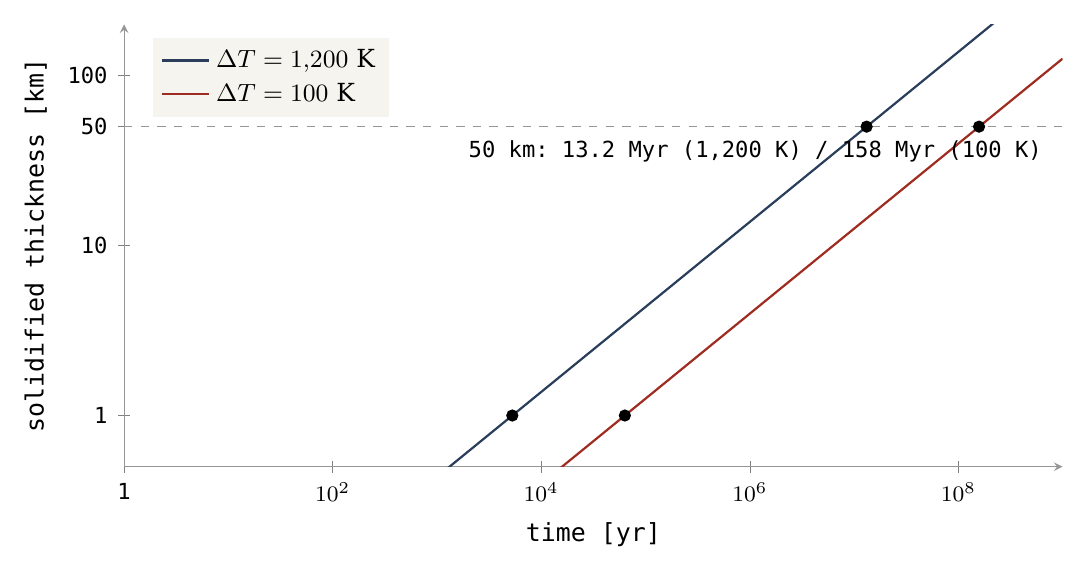
Figure 1 shows the same law over the whole range of times. Both axes are logarithmic, so a square-root law appears as a straight line rising one step in thickness for every two steps in time. The navy line (hard cooling) and the red line (warm surface) are parallel: the warm case reaches every thickness later by the same factor. The dashed line marks 50 km, an example thickness, and the points are the entries of the table.
The crust of the Moon’s far side is built, among other things, from the sialic shell that rises as the surface of the dome — the light, silica- and aluminium-rich outer layer of the parent. The internal material, which came into the Moon from the Earth through the feed, froze over time and stayed in the Moon’s centre and in its near part. Part B examines their respective contributions and the geometry of the dome. Here it is only required that the external boundary can strengthen while the feed passage remains mobile, and the estimate shows that it can: a solid skin forms within days, while the melt beneath, insulated by it and resupplied from below, stays fluid.
A.8The order of construction
The pieces of Part A act together, and their order matters, because a step taken out of order would contradict the record the body carries.
In this scenario, internal feed and dome uplift overlap while ejections through the openings are still occurring: the body is fed from below, its shell rises with it, and material is thrown out through the openings and returns, all at once. The ejections never stop while the body is attached: they decline as the pear grows and the body moves away from the Earth’s centre, and they stop at detachment, when the body is cut off from the Earth’s pressure. The closing of the outer shell plays no part in this. The whole sequence, from the start of the bulge to release, takes about 600 million years — roughly 400 million for the bulge and the pear, about 100 million for the flattening, and about 100 million more to release at 3.873 billion years ago; this is the 600-million-year scenario window of the environment table, and the 100-million-year case remains a sensitivity test. Ejections of the construction stage must not be identified with late volcanism in a body that has already separated; they belong to the attached body and are a different process from the volcanism of a free Moon. The four stages are set out in Part B.
What we now have: a mass account that places every kilogram, the reason the body must be carried rather than thrown, the force balance the feed must satisfy, a concentrated source, a passage kept open by heat, a foamed melt light enough to be lifted, and a frozen skin that forms quickly over a mobile interior. Whether the pressure, the rate and the energy are sufficient is the subject of the next continuation of this Part.
Are the pressure, the rate and the energy sufficient?
the geometric description requires numbers. We compute a consistent pressure test, translate a possible pressure surplus into a flow rate, and define the energy account required. The same scenario must satisfy all three tests.
The preceding sections described the feed in words: a deep source, a passage kept open by heat, and a body growing at its end. This continuation of Part A asks whether that description holds up when it is priced. Three questions are asked in turn, and each has a number for an answer. First, pressure: does the parent hold enough pressure at its source to push deep melt all the way up to the corotation radius (§A.9–A.10)? Second, rate: if it does, can the push move the lunar mass through a passage in the time available (§A.11)? Third, energy: where does the work of lifting the mass come from (§A.12)? The last section (§A.13) puts pressure, flow and load together in one state, close to release, and shows what the connection must look like for all three to be met at once. That last result is the bridge to Parts B and C.
A.9A defined pressure test
The question this section answers is simple to state: is the parent’s own internal pressure strong enough to hold up a column of melt reaching from its centre to the corotation radius? To answer it, two pressures are computed from the same field and compared: the pressure available at the source, and the pressure the column demands.
What a hydrostatic head is. A column of material standing in a gravitational field presses down on its own base with its weight. The pressure needed at the base to hold the column up — neither sinking nor rising — is called the hydrostatic head of the column. A pump that sends water to a tank on a roof must deliver at least the head of the water column between pump and tank; anything less, and the water does not arrive. The feed of the Moon is the same problem on a planetary scale: the source must deliver at least the head of a column of melt reaching from deep inside the parent up to the body. In a uniform field the head is simply density times gravity times height; here gravity changes along the column, and the spin works against it, so the head is computed as density times the change of the effective potential along the path (equation 5 of §A.3, integrated).
We choose a reference section of the parent before the division of mass: , , from the table. That is, the whole parent with the lunar material still inside it ( kg), its adopted volumetric radius (6,517 km) and its initial 5.5-hour day. For an analytical test only, we use the field of a homogeneous sphere and a rotating equatorial section. This is a spherical approximation with a centrifugal correction, not an exact equilibrium solution of a Maclaurin spheroid. The choice keeps the arithmetic transparent: every term can be written in closed form and checked by hand, and the true flattened figure changes the numbers only modestly.
Let , ; is the parent’s mean density, its mass divided by its volume. The internal field is , and the external field . Inside a uniform sphere, gravity grows in proportion to the distance from the centre — zero at the centre, full value at the surface — because only the mass below a given depth pulls; outside, it falls off as the inverse square of the distance. The end point of the column test is:
Equation (8) is the corotation radius of Paper 2 (§A.5) with the whole parent’s mass in it: the distance at which gravity is exactly balanced by the centrifugal effect of the spin. It is the natural end of the column. Below the net pull is inward, and every kilometre of column adds weight that the source must hold up; at the net pull is zero, so material there weighs nothing in the rotating frame, and beyond it the net pull points outward. The head therefore has to be paid only up to .
This is a reference point in the full field of the initial parent; it is not the release distance of two bodies at the end of the transfer. The difference between it and the 15,818 km reference arises from the mass in the equation: 15,818 km is computed with the final Earth mass , 15,882.9 km with the full parent mass , which is larger by the mass of the Moon, and a larger mass places the balance point slightly farther out.
Where the source pressure comes from. The deep source is not a separate engine. It is the parent’s own interior, pressed by the weight of everything above it. At the centre of the parent, the full weight of the overlying material bears down; the spin lightens that weight a little at the equator, because the centrifugal effect there acts against gravity. When a path opens from the deep interior toward the surface, it is this pressure — weight minus spin — that pushes melt along it. The source pressure at the centre, relative to the equatorial surface pressure, is:
In words: the first term in the bracket, , is the gravitational part; the factor appears because gravity inside a uniform sphere rises steadily from zero at the centre to its full value at the surface, so along the radius it acts on average at half strength. The second term, , is the relief given by the spin along the equatorial radius. Multiplied by the parent’s mean density, the bracket gives a pressure: 150.26 GPa. This is the pressure that the parent, by its own mass and spin, holds at its source.
In a column with a constant deep density and an outer density , the required pressure head is:
The column is divided into two segments, because the material in them is different. The deep segment runs from the centre to the parent’s surface and is filled with deep melt of density . The outer segment runs from the surface up to , above the parent, and is filled with the lighter outer material of density . Each segment contributes density times an integral , and is the change of the effective potential (gravitational minus centrifugal) along that segment — the energy needed to lift one kilogram along it, in joules per kilogram, which is the same as . Density (kilograms per cubic metre) times energy per kilogram gives energy per cubic metre, which is a pressure.
Equation (11) is the potential step inside the parent, from the centre to the equatorial surface. It is the same bracket as in equation (9); the only difference is the density that multiplies it. This identity is the heart of the test: the source pressure is the head of a column of the parent’s own mean density, and the required head is the same column filled with melt. A column of melt as dense as the parent would be exactly balanced and would rise no further than the surface. Only a melt lighter than the parent gains a surplus, and that surplus must then pay for the outer segment.
Equation (12) is the potential step outside the parent, from the surface to : the first term is the work against the external gravity, the second the help given by the spin over the same distance. Although this segment is more than twice as long as the deep one, its value is a little smaller, because gravity weakens with distance and the spin’s help grows. The two integrals together fix the head for any pair of densities; the next section evaluates it.
The column serves as a pressure test in a given field; its mass and its effect on the body’s shape are not solved here. The test must therefore not be extended automatically to the transfer of the whole lunar mass. It answers one question — can the source hold up a line of melt reaching the corotation radius — and leaves the weight of a real, finite connection to §A.13.
A.10A density threshold and sensitivity
The head depends on what fills the column, and the source pressure does not. The question is therefore which deep densities the source can carry, and where the limit lies.
Assuming , one obtains:
|
, kg/m³ |
Required pressure head, GPa | Remainder before end load and losses, GPa |
|---|---|---|
| 1,500 | 82.14 | 68.12 |
| 3,000 | 125.37 | 24.89 |
| 3,500 | 139.78 | 10.49 |
| 4,000 | 154.19 | −3.92 |
| 4,500 | 168.60 | −18.33 |
How to read the table. Each row fills the deep segment with a melt of a different density; the outer segment is kept at 1,500 kg/m³. The middle column is the head that column demands, from equation (10). The right-hand column, the remainder, is the source pressure of 150.26 GPa minus that head: what is left of the push after the column has been held up. A positive remainder means the push is enough — the column is held, and pressure is left over to carry the body at its end and to drive the flow. A negative remainder means the push is not enough: the column is too heavy and the melt does not reach the corotation radius. Reading downward, the head rises by the same step for every 500 kg/m³ and the remainder falls by the same step; the sign changes between 3,500 and 4,000 kg/m³. At 3,500 kg/m³, the reference value used through the rest of Part A, 10.49 GPa remain.
The flow condition is:
Equation (13) states the full budget. The source pressure must pay three bills: the head of the column, ; the load at the end of the column, , which is the body itself pressing back on the passage; and the losses to friction as the melt flows, . Melt moves outward only while something is left after all three are paid. The table above shows only the first bill, which is why its last column is called the remainder before end load and losses.
and the density threshold is therefore:
Equation (14) is equation (13) solved for the deep density: the heaviest deep melt the source can still push through, once the outer segment, the end load and the losses have been paid. The reason a threshold exists follows from §A.9. The source pressure is fixed by the parent’s mean density, but the head of the deep segment grows with the density of the melt in it; somewhere the two meet. The situation is that of two connected tubes, one filled with water and one with oil: the oil column stands higher than the water column, because it is lighter. The deep melt likewise rises above the parent’s surface only because it is lighter than the parent around it, and the lighter it is, the higher it can stand.
Neglecting the load and the losses, . Every additional gigapascal of load or loss lowers the threshold by about 34.7 kg/m³: one gigapascal divided by , because each gigapascal spent elsewhere is a gigapascal that the deep segment can no longer use. The threshold is also sensitive to the density of the outer segment: . In words, each kilogram per cubic metre added to the outer segment removes 0.900 kg/m³ from the deep threshold, because the two integrals are nearly equal and the two segments share one source.
The pressure test passes for a deep melt lighter than 3,864 kg/m³ and fails above it. This is the first requirement the mechanism places on the deep material, and it is the sharpest: a volatile-rich melt meets it, a dry one does not. The reason is that dissolved volatiles — water and other light components — lower the density of a silicate melt (§A.6), and the margin between passing and failing lies within the range they can supply. A foam density near the surface is not evidence for a similar density at depth: bubbles form only where the pressure is low enough for volatiles to leave solution, so near the surface a melt can be much lighter than the same melt deep down. In a variable-density model the two terms must be replaced by an integral over — density as a function of the pressure, temperature and composition along the path — and the source pressure and the gravitational field must also be recomputed. The constant-density test is the first step of that calculation, and its threshold is the number the equation of state of the deep melt is to be checked against (§D.1).
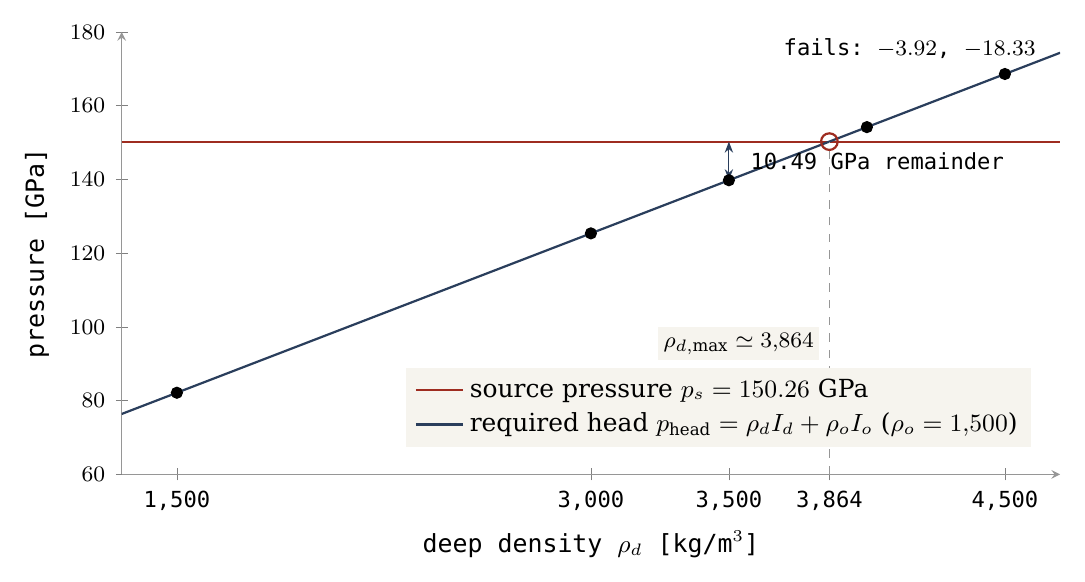
Figure 2 draws the table as two lines. The flat red line is what the source supplies; it does not depend on the melt. The rising navy line is what the column costs; it climbs with the deep density. To the left of their crossing the source wins, and the vertical gap between the lines is the remainder — 10.49 GPa at 3,500 kg/m³, marked by the arrow. To the right of the crossing the column wins and the feed stops. The crossing, 3,864 kg/m³, is the threshold.
What we now have: the parent holds 150.26 GPa at its source, and this is enough to hold a column of melt up to the corotation radius, provided the deep melt is lighter than about 3,864 kg/m³. Holding the column is not yet moving mass along it; the next section asks how fast the mass must move.
A.11How fast must the feed operate?
A surplus of pressure means that melt can flow; it does not say how much. The question here is how much mass the feed must deliver each second to build the Moon in the time available, and what that demands of the passage.
If a fraction of the target mass arrives internally over , the mean rate is:
Equation (15) is the simplest possible account: the mass delivered by the feed, (the internal share of the lunar mass ; the rest comes from the rising shell, Part B), divided by the time over which it arrives.
For , one obtains about over 100 million years, and about over 600 million years. The two windows are those of the environment table: 600 million years is the scenario window, 100 million years the sensitivity case. For a smaller internal share the mean rate falls in direct proportion. These rates describe the average net accumulation of mass in the body; any loss of supplied material requires a larger gross feed rate. Intermittent feed requires a larger rate during activity: if the feed runs only part of the time, it must run faster while it runs to deliver the same total.
For a sensitivity test, a geometrically confined segment can be represented as laminar Newtonian flow in a cylindrical passage of radius , length and a no-slip condition:
The terms need a word each. Laminar flow moves in smooth layers, without turbulence; Newtonian means the resistance of the fluid is described by one number, its viscosity — the material’s resistance to flowing, low for water, very high for cold glass or for the solid mantle creeping over geological time; no-slip means the fluid at the wall of the passage does not move, so the flow is fastest along the axis and slowest at the wall. The first part of equation (16) gives the volume of melt passing each second through a passage of radius and length when a pressure difference drives it. The second part turns the question around: it is the first part solved for the viscosity, with set to the volume rate the construction needs (the mass rate of equation 15 divided by the melt density). The result, , is the most viscous the material in the passage may be while still delivering the lunar mass in time. Any material less viscous than passes; any material stiffer fails.
This is the Poiseuille solution [1], used here as an estimate for a bounded segment; its wall boundary condition cannot be assumed to apply throughout the unconfined outer part.
For , , and :
|
Passage radius |
for 100 million years, Pa·s | for 600 million years, Pa·s |
|---|---|---|
| 100 km | ||
| 500 km | ||
| 1,000 km |
The inputs are a passage 10,000 km long ( m, comparable to the distance from the deep source to the body), the reference melt density of 3,500 kg/m³, and a driving surplus of 10 GPa — close to the 10.49 GPa remainder of §A.10 — with the whole Moon delivered by the feed.
How to read the table. Each cell is the stiffest material that would still build the Moon through a passage of the given radius in the given time. Reading down a column, the ceiling rises steeply with the radius: a wide passage tolerates a far stiffer material than a narrow one. Reading across a row, the ceiling is six times higher for 600 million years than for 100 million, because a longer time requires a slower flow. For scale, the environment table sets the stiff, cold shell at Pa·s; only the widest passage over the longest window approaches that value.
The strong sensitivity is : halving the radius reduces the rate sixteenfold at the same pressure surplus and viscosity. The reason is that a wider passage gains twice: it has more cross-section, and its centre lies farther from the walls that hold the flow back. Between 100 and 500 km the radius grows fivefold and the ceiling grows by , which is the step between the first two rows. The viscosity values in the table are mathematical ceilings for the estimate, not properties measured in magma. A surplus of 10 GPa is a test parameter; if supporting the body consumes the remaining pressure, that pressure is unavailable to drive flow. A long time window may ease the rate requirement, but requires the passage to remain mobile and stable over that time.
What we now have: with a surplus of the size the pressure test leaves, a passage of a few hundred kilometres or more can carry the lunar mass in the scenario window, provided it stays hot and mobile. The width of the passage matters far more than any other input; §A.13 returns to it.
A.12 Energy: what is the source of the work?
Pressure and rate concern how the mass moves; energy concerns what pays for moving it. Lifting the Moon’s mass from the Earth’s surface to the corotation radius is work done against gravity, and the model must say where that work comes from.
An order-of-magnitude check of the gravitational work for the full target mass, in a fixed terrestrial field, from 8,991 km to the release at 16,400 km gives:
Equation (17) is the standard work needed to move a mass outward in the gravity of a mass , from a distance to a distance from its centre. Here km is the distance between centres when a body of the full lunar mass touches the parent’s surface (§A.2), and km is the release distance on the equator. “Fixed terrestrial field” means the Earth’s mass is held constant and the body is treated as a point.
The estimate refers to moving a given mass between two distances; it is not the full work account of a body growing out of the deep source. The full account must include the change in the gravitational energy of the whole system, the rotational energy, the internal energy, the losses and the energy carried in the departing material.
The Earth’s total binding energy cannot automatically be counted as available energy. The binding energy is the energy that would be needed to take the whole Earth apart against its own gravity; it is large, but it is not stored in a form that can be spent. Energy becomes available only when the body changes into a more tightly bound state. A physical evolution that releases energy is required: for example, organisation of density, contraction or a fall in internal energy, together with exchanges of rotational energy. The work is of order J, less than one per cent of the parent’s binding energy; the evolution that releases it — descending iron and a contracting, cooling interior — is the same evolution that drives the upwelling. When iron sinks toward the centre, the parent’s mass is drawn closer together and gravitational energy is set free; the lift of the Moon needs only a small fraction of it. The full energy account of that evolution is a requirement listed in §D.1.
A.13 A joint test in the same state: pressure, flow and load
Sections A.9 to A.11 tested pressure and flow separately, and on the initial parent. A real connection meets all of them at once, and in a later state: a smaller Earth (the Moon’s mass has left it), a slower day, a body far from the equator, and the weight of the body pressing on the end of the passage. The question here is whether a single passage can pass all the tests in one and the same state — and, if it cannot pass them as a thin tube, what shape it must have.
To test the three quantities together, we choose the last state of the climb, at the latitude of release of Part C: Earth mass , body mass , a 5.77-hour day, latitude 22.5°, and the body’s centre one body radius inside the corotation line, — its far side touching the line (at release, on the line itself, the radial load vanishes and only the lateral load remains, §C.2). The corotation line at 22.5° lies at 17,287 km (Paper 4); a body of radius 1,889.77 km whose far side touches it has its centre at 15,397 km. It is the last state of the climb before release: the body is at its farthest before its centre reaches the line, and its weight on the passage has not yet fallen to zero. For an analytical pressure section only, a terrestrial volumetric radius of 6,517 km and a homogeneous-density approximation are kept. These are section approximations, not the full equilibrium shape of the connected body.
Define an axis from the Earth’s centre toward the body. The body’s equivalent radius at density 2,600 is 1,889.77 km, so the near end of the feed passage lies at . The column therefore runs from the Earth’s centre () to the near side of the body (); there the body sits on it. The potential along the axis includes the body’s attraction and the acceleration of the origin of the terrestrial frame:
Equation (25) lists every effect that pulls on a piece of the column at distance , written as a potential energy per kilogram. The first term, , is the Earth’s gravity. The second is the body’s own gravity, which pulls the column toward the body and so helps the feed near its upper end. The third term corrects for the fact that the Earth itself is not at rest: the body pulls the Earth’s centre toward it, so a frame fixed to the Earth’s centre is accelerating, and everything in that frame feels a uniform apparent pull the other way. The fourth term is the centrifugal effect of the spin; at latitude a point at distance lies only from the spin axis, which is why appears.
For the homogeneous terrestrial sphere:
Equation (26) is the potential of a uniform sphere: inside, it deepens toward the centre as a parabola, corresponding to gravity growing in proportion to the distance from the centre as in §A.9; outside, it is the familiar point-mass form.
The linear term in equation (25) cancels the uniform acceleration of the Earth’s centre due to the body. One obtains and . These are the same two potential steps as equations (11) and (12), now evaluated in the later state: the deep step is almost unchanged, and the outer step is somewhat smaller, mainly because the column ends at the body’s near side rather than at the corotation radius and the body’s own attraction helps. The source pressure along the section is , where here , according to the Earth’s mass after the division of mass. As in §A.9, the source pressure is the head of a column of the parent’s own mean density, now that of the Earth without the Moon.
For the resistance test we choose a cylindrical passage of radius , deep density 3,500, outer density 1,500 kg/m³ and an adopted uniform viscosity . The mass rate is the reference mean for 600 million years, ; this is a state test, not a proof that the state lasts 600 million years. Applying the confined-flow estimate to the two segments gives:
Equation (27) is the Poiseuille relation of equation (16) applied to the two segments in turn and added up: the pressure spent on friction to push the mass rate through a deep segment of length filled with melt of density , and an outer segment of length filled with material of density . Dividing the mass rate by the density turns it into a volume rate; the lighter outer material must flow faster for the same mass rate, and so costs more per kilometre.
The radial load at the end is written as a mean stress , and the lateral component as . Here is the force with which the body presses along the axis onto the end of the passage — its weight in the rotating frame, the inward pull of gravity less the outward centrifugal part along the axis — and is the sideways force. The sideways force exists because the body is not on the equator: the centrifugal effect points away from the spin axis, not along the line from the Earth’s centre, and at latitude 22.5° part of it pushes the body sideways, toward the equatorial plane. Dividing each force by the cross-section of the passage, , turns it into a stress that the end of the passage must carry. These expressions close the averaged model over a section perpendicular to the axis; they do not solve for the pressure distribution across a finite connection. The radial pressure remainder is:
Equation (28) is the full budget of equation (13), now with every bill priced in one state: the source pressure, minus the head of the two segments, minus the body’s weight on the end, minus the friction of the flow. As in §A.10, a positive remainder means the push is enough.
|
Passage radius, km |
Radial load, GPa | Flow loss, GPa | Radial remainder, GPa | Required lateral stress, GPa | Mass of the outer segment in lunar masses |
|---|---|---|---|---|---|
| 500 | 46.18 | 0.01032 | −35.03 | 46.04 | 0.112 |
| 1,000 | 11.54 | 0.000645 | −0.39 | 11.51 | 0.448 |
| 1,500 | 5.131 | 0.000127 | 6.024 | 5.116 | 1.008 |
How to read the table. Each row is a passage of a different radius in the same state. Before the load and the friction are paid, the source and the head leave about 11 GPa: 148.46 GPa minus the head of the two segments (in any row, the remainder plus the radial load and the flow loss). The table then shows what the remaining bills take from it. The radial load is the body’s weight spread over the passage’s cross-section; it falls as , from 46.18 GPa at 500 km to 5.131 GPa at 1,500 km, because the same weight rests on a larger area. The flow loss is tiny in every row — at most about a hundredth of a gigapascal — so friction is not the limit in this state. The radial remainder is what is left; it is strongly negative for a 500-km passage, just below zero at 1,000 km, and positive at 1,500 km. The lateral stress is the sideways push the end of the passage must resist; it is almost as large as the radial load in every row, because at 22.5° and so close to the line the sideways and radial parts of the body’s effective weight are of similar size. The last column is the mass of material standing in the outer segment of the passage itself, in units of the Moon’s mass; it grows as , from about a tenth of a Moon at 500 km to a full Moon at 1,500 km.
The mass of the outer segment is estimated in the same geometry:
Equation (29) is the volume of a cylinder of radius and length , the part of the passage that stands above the Earth’s surface, multiplied by the density of the material filling it.
Result of the test: with these inputs, the radial pressure balance passes from a radius of about 1,017 km. But already at this threshold the mass of the outer segment is about 0.46 of the lunar mass. The assumption of a connection of negligible mass is therefore not consistent in the range that passes the radial test. This mass must be reassigned among the reservoirs in equation (1), and its gravitational field and momentum included; it must not be added to the two given masses without changing the state. Put plainly: a thin tube fails because the body’s weight, concentrated on a small end, crushes the remainder below zero; a tube wide enough to spread that weight is so wide that it holds nearly half a Moon of material itself. The connection cannot be both narrow and massless.
In addition, a static fluid transmitting pressure only through the radial section does not supply the lateral stress. A liquid at rest can push but cannot hold a sideways force — that is what makes it a liquid. A column of melt can carry the body’s weight along the axis, but it cannot by itself stop the body from being pushed toward the equator. A possible solution would need to define a connection shape, viscous stresses or the strength of a load-bearing material, and momentum transferred in the flow. Heating eases the passage; the lateral load is carried by the shape of the connection, which is the broad base of the dome of Part B.
The sensitivity to density remains decisive: raising the outer density to 2,000 kg/m³, the remainder at a radius of 1,000 km becomes about , with the other inputs unchanged. A modest increase in the density of the outer segment thus moves the threshold radius well beyond 1,000 km, for the same reason as in §A.10: every kilogram per cubic metre in the column costs head. Shortening the feed time to 100 million years multiplies the flow loss sixfold in the estimate, but does not remove the lateral-stress requirement or the mass of the connection. Even sixfold, the flow loss remains well below a gigapascal in all three rows, so the conclusion does not depend on the time window.
This is a quantitative limit of the cylindrical approximation: passing the pressure test is not yet passing the full construction test. The result tells the model what its connection must look like: broad enough to pass the radial balance (above about 1,000 km), and therefore massive enough that its own mass and lateral stresses enter the account. That connection is the base of the dome of Part B — a contact 3,000 km across, half the 6,000-km base in width and a quarter of it in area — and Part C shows how the body begins to separate at the corotation line and is released just beyond it. A contact 3,000 km across has a radius of 1,500 km, the last row of the table, where the radial remainder is positive; its sideways load is carried not by fluid pressure but by its shape, a broad hot base standing on a wider pear.
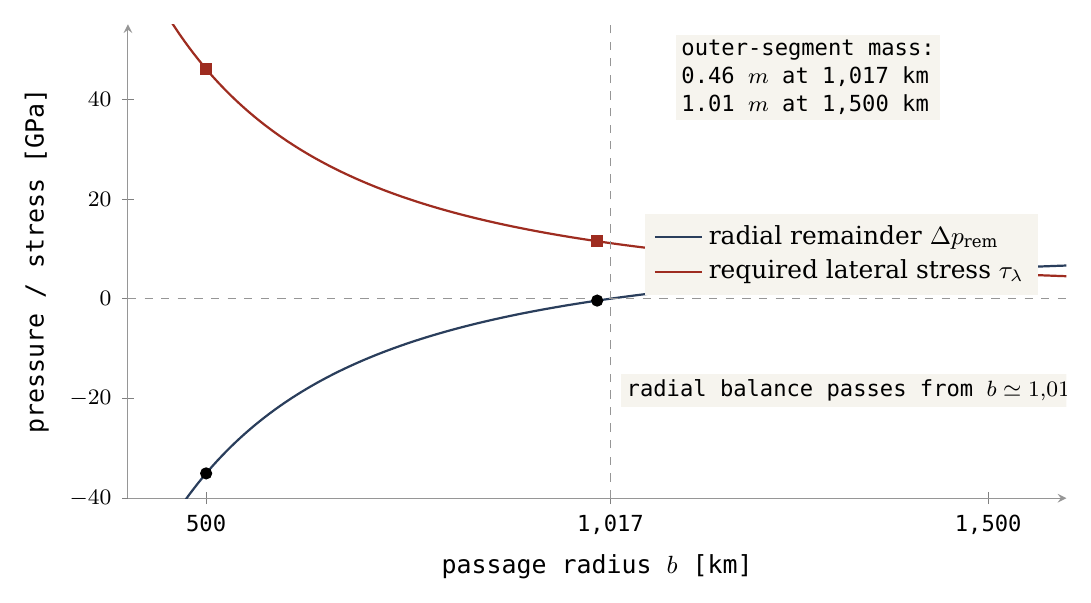
Figure 3 shows the two quantities that decide the test as the passage widens. The navy curve, the radial remainder, rises from deep below zero and crosses it at about 1,017 km; to the right of the dashed line the radial balance passes. The red curve, the lateral stress, falls with width but stays at several gigapascals throughout — a sideways load that pressure alone cannot carry. The box at the top records the price of passing: the outer segment already weighs 0.46 of a Moon at the threshold and a full Moon at 1,500 km.
What we now have: the parent’s pressure suffices to hold a column of light melt up to the corotation radius; a passage of a few hundred kilometres or more can carry the lunar mass in the scenario window; the lift costs of order J, a small part of what the descending iron releases. But the connection that meets all three in one state is not a thin tube. It is broad, hot and massive, and it carries its sideways load by its shape. Part B describes that shape from the outside.
From without: the body on the tip of the pear
the internal feed lifts material; it does not by itself explain where the Moon’s crust came from, why it is thicker on the far side, or why the Moon carries an ancient crater record spread over both hemispheres. The approach: the outer shell is treated as the surface of the same body that Part A feeds. We follow it through four stages, fix its geometry at each, and derive what it becomes.
Part A followed the material that rises inside the body: the deep source, the pressure that drives it, and the rate and energy of the feed. This Part looks at the same body from outside. Its question is simple to state: what happens to the Earth’s outer skin over the construction region while the body is being built beneath and above it, and where does each piece of that skin end up on the Moon we see today? The answer is the geometric core of the model. It is built here in four steps, one per stage, and the picture at each step is fixed by numbers before the next step is taken.
The whole Part rests on one picture, and it helps to hold it from the start. The Earth’s outer shell does not stay behind while the body rises; it rises with the body as the skin of its upper dome. The body itself is not a ball floating free but a squashed ball resting on the tip of the pear: two domes, one on the other — a lower dome that hugs the rounded tip from above, and an upper dome that stands high over it. As the body later rounds outward into a ball, each part of its surface keeps its share of the whole, and so each part can be followed onto today’s Moon.
The four stages, and how they fit the series. This paper numbers its own stages: stage 1, the flat stage (§B.1); stage 2, the body on the tip of the pear (§B.2); stage 3, the outward rounding (§B.4); stage 4, the flattening, the inward rounding and the release (§§B.6, C.4–C.8). The series as a whole numbers the history of the Moon in stages 0–8: 0 before the bulge, 1 the bulge, 2 the dome, 3 the pear, 4 the rounding (outward, then flattening, then inward), 5 the release, 6 the pear’s fate, 7 the recession, 8 today. The two numberings correspond as follows. Stage 1 of this paper is series stage 0 and the beginning of the bulge, while the shell still lies flat over the feed. Stage 2 is the bulge, the dome and the pear (series stages 1–3) seen at the moment the body sits as a dome on the tip of the pear. Stage 3 is the first part of series stage 4, the outward rounding. Stage 4 is the rest of series stage 4 — the flattening and the inward rounding — together with series stage 5, the release. Series stage 6, the fate of the pear, is Part E of this paper; stage 7, the recession, is Paper 4, The Orbit; stage 8, today’s Moon, is where §§B.4–B.7 place each region of the surface.
B.1 Stage 1 — the flat stage and the gathered shell
Before the body rises, the parent’s outer sialic layer over the construction region lies flat, over an active feed. “Sialic” refers to sial, the light upper layer of the Earth’s crust, rich in silicon and aluminium; beneath it lies sima, the denser layer rich in silicon and magnesium. Deep material reaches the sial through openings and is ejected through them; part of the ejecta returns and lands on the exposed shell, making craters (Paper 6, The Craters). The shell at this stage is the source of the Moon’s crust and of its earliest crater record. This matters because it means the Moon’s oldest surface did not form on the Moon: it formed here, on the Earth, before the body existed, and was later carried up.
The initial area of the shell that will form the dome differs from the surface area of the resulting dome. The Pacific basin of the author’s reconstruction (Figure 4) — about m² with its marginal seas, about m² without — is 1.4 to 2.4 times the surface of the upper dome at stage 2 ( m², below). In this picture the shell over the region was drawn inward by a factor of up to about two in area as the dome formed, as a cloth laid flat on a table gathers inward when its middle is lifted. The basin therefore marks the source area of the gathered material, rather than the footprint of the dome itself. This is a reading of a present feature, and the paper states its difficulty as Paper 2 did: the present floor of the basin is younger than 180 Myr, and the reading refers to a hemispheric asymmetry of the lithosphere beneath it — the rigid outer layer of the Earth, crust and uppermost mantle, which is older and deeper-rooted than the sea floor that now covers it.
The base of the pear and the back of it. The region marked on Figure 4 is the pear seen from above as it leaned, not its foot. The base of the pear lay to the east, toward America, and across its whole width it held openings — into the pear and, through it, on to the Moon: in the author’s reconstruction its centre lies near Kiritimati, in the Line Islands of Kiribati — by the villages of London, Paris and Poland — at about 1.9°N, 157.5°W — about 4,800 km east-south-east of the earlier reading.
The pear did not stand upright, and the reason is the Earth’s spin. As it was drawn out, its outer part, carried away from the axis, lagged behind the Earth’s turn, as the arms of a skater lag when she spreads them, and the whole pear leaned back, westward, its tip and the Moon on it trailing (§C.8). It leaned north as well: from a base near the equator its tip reached about 22.5°N, the latitude of release of Paper 4. The rotation does not give that northward lean — at any latitude its sideways push is toward the equator — it comes from the feed: the deep source, the concentrated feed region of §A.4, lies north of the equator, and the feed rose obliquely from it, northward of the base, carrying the pear north with it (§D.1).
The western side of the pear, under which Japan lies today, is its back, which was gathered back into the Earth after release; the front of the pear, stretched under tension as it leaned, was gathered back into the stripes of Paper 9, The Stripes. Paper 9 also locates the imprint of the tip itself: between two bends of the stripes, a region 3,360 km wide centred at 9.3°N, 169.3°E, about 3,760 km west of the base by the coordinates (an earlier version gave 3,770 km) — the direction in which the leaning pear carried its tip — while the back, gathered in, lies in the arcs of the western Pacific. The 22.5°N of the tip at release and the 9.3°N of this footprint are different quantities: the first is the direction of the Moon’s centre from the Earth’s centre at release, the second the footprint of the gathered-in tip on today’s surface, about 15° north of the equator of the stripe system; they are measured in different frames, and relating the two frames — the axes — is future work. The pear never left the Earth’s mass. It was not lost at release; after release the sorting gathered it back into the Earth, gradually, over tens to hundreds of millions of years — its heavy part deep into the Earth beneath the base of the pear (Part E), its leading side into the stripes of the North Pacific, and its back into the arcs of the western Pacific. The mass moved from high outside the Earth to deep inside it. The base lies above the Pacific large low-velocity province at the bottom of the mantle — a broad region, seen in seismic images, through which earthquake waves travel more slowly than in the surrounding mantle — in published maps of that province, which reaches from near Hawaii southward; the measured distance from the base to the province’s centre and edge is given in §E.4. The nature of the deep provinces is left open.
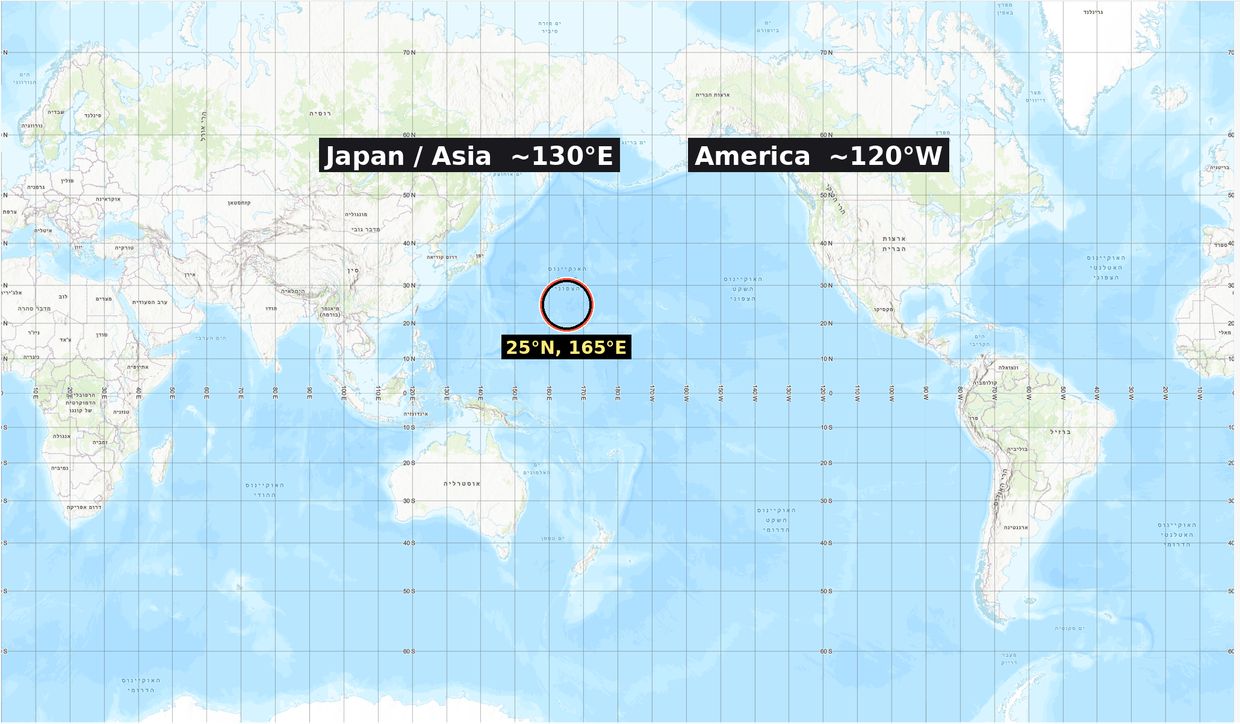
Figure 4 should be read as a view from above of a leaning object. The marked area in the north-central Pacific is where the body of the pear lay over the Earth as it leaned back to the west; the foot of the pear, where it rose from the Earth, lay to the east of it, near Kiritimati, close to the equator. The two margins named in the caption bound the source region on the Asian and the American sides.
What we now have: a flat sial shell over an active feed, already carrying craters from returning material, gathered inward from a Pacific-sized region, and the place where the pear later stood and leaned.
B.2 Stage 2 — the body on the tip of the pear
The question of this section is the shape of the body at the moment it is first a body: how big it is, how its surface divides, and how dense it must be. At the intermediate stage the body sits on the tip of the pear of §C.7, and the tip is wide: the contact is 6,000 km across. The body is a squashed ball seated on the rounded tip of the pear. Its lower dome lies on the curved tip and follows it — the tip, of curvature about 4,000 km, enters the body some 1,350 km under the middle of the contact — and its upper dome rises above it: two domes, one on the other, the lower one hugging the tip. The number 1,350 km follows from the geometry: a curved surface of radius about 4,000 km, spanning a chord of 6,000 km, rises about 1,350 km at its middle above the line of its rim. So the body’s underside is not flat; it is pushed up from below by the tip, as a cap pulled down over a head. Its geometry, for the full lunar mass:
| Quantity | On the tip of the pear | Sphere at release, 1,890 km | The Moon today, 1,737 km |
|---|---|---|---|
| Upper dome | m² (67%) | — | — |
| Lower dome, on the tip | m² (33%) | — | — |
| Whole surface | m² | ||
| Volume | m³ | ||
| Density for the lunar mass | 1,300 kg/m³ | 2,600 | 3,344 |
| Upper dome above the rim of the contact | 3,650 km | — | — |
The table compares the same mass — the full mass of the Moon — in three states. Read it from left to right: the body grows smaller and denser. On the tip of the pear it is large and light, its volume about two and a half times today’s; as a sphere at release its radius is 1,890 km and its density 2,600 kg/m³; today its radius is 1,737 km and its density 3,344 kg/m³. Read the first column from top to bottom: two-thirds of the surface on the tip of the pear is the upper dome, one-third is the lower dome that rests on the tip. These two shares are the starting point of the translation rule of §B.4.
The height of the upper dome is set by the density, because the mass is fixed: the taller the dome over the same contact, the larger the volume, and the lower the density. The same mass over the same contact has a density of about 2,000 kg/m³ if its upper dome is as high as a hemisphere, 3,000 km, and today’s 3,344 if it is 2,450 km, the lowest possible (Figure 7) — lowest, because a body of the lunar mass cannot be denser than the Moon is now. We adopt the tall dome: 1,300 kg/m³ is the foamed launch state that Part A’s pressure test requires — against the 1,500 adopted there — and it is the density at which the flattening of Paper 7, The Poles, begins. “Foamed” means a melt full of gas bubbles, as a rising dough is lighter than the flour and water it is made of; a light column is what the source pressure of Part A can lift to the corotation line. The body is foamed, and its upper dome stands high.
The lower dome is the contact with the parent: m². At this stage the body’s self-gravity — the pull of its own mass, holding it together — is small against the tidal stretch of the parent, the difference between the Earth’s pull on the near and the far side of the body, which tends to draw it out: the ratio of §C.4 is about 0.11 (taking the body’s size as its full height of about 5,000 km, at a centre about 13,000 km from the Earth’s centre; for the equivalent sphere of 2,381 km the ratio would be about 1), so the body’s own pull is about a ninth of the stretch across its full height. The body is therefore held; it is a dome on the tip, not yet a body of its own.
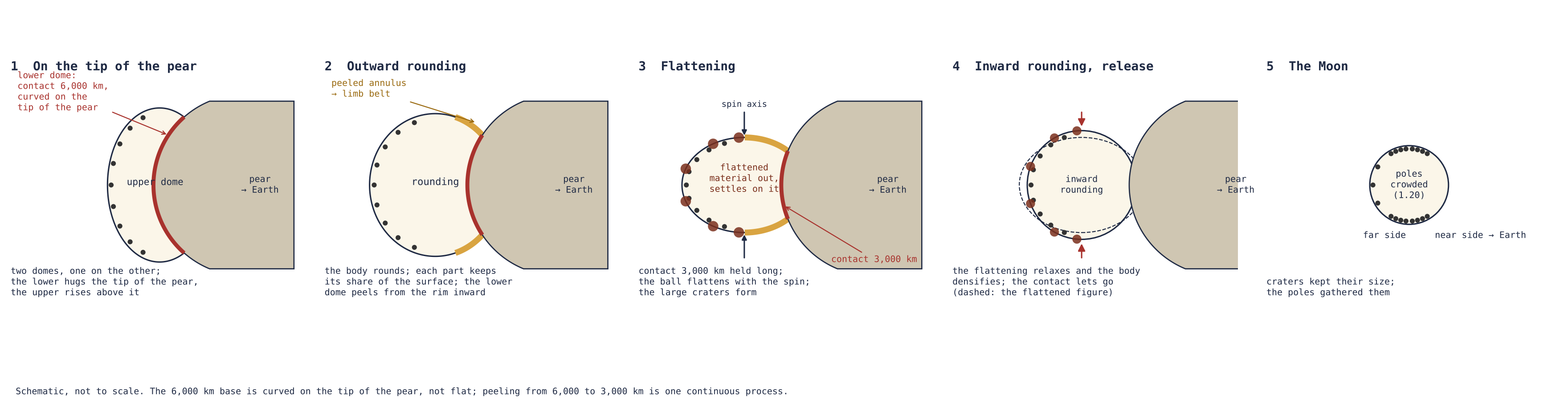
Figure 5 is the story of this Part in five pictures, to be read in their numbered order. Its panels are numbered as pictures, not as stages: panel (1) is stage 2 of this paper, panel (2) is stage 3, panels (3) and (4) are stage 4, and panel (5) is today’s Moon. Look first at the two domes in panel (1) and at the line where the lower dome meets the tip; then follow that line as it shrinks inward in panel (2), and the outline of the body as it flattens in panel (3) and rounds again in panel (4). The inward rounding is complete before the body leaves: by release the body was round, its outer shell rigid (Paper 2, §B.7: axis ratio at most 1.04).
B.3What moves, and what does not
A reader who pictures a crust travelling thousands of kilometres from the Earth to the Moon will ask what force carries a crust that far. The shell does travel, but it is not dragged across the parent: it rises with the body of the pear, and at the same time it slowly separates from the sima beneath it and slides up the pear to its tip, into the body. The forces of the spin drive it, in the direction of outward sorting, and the lubricated layer between sial and sima eases the slide under shear (§C.10). This is why the tip separates as a body of its own. (The inward gathering of §B.1 belongs to stage 1, before the dome.)
What contracts during stage 3 is the annulus of the lower dome — the ring of the body’s underside between the rim of the contact and its centre, the exposed surface of the body, not shell: from the rim at 3,000 km radius to the contact at 1,500 km, about 1,500 km of inward motion over the whole of stage 3, on the same weak interface. The dome requires a layered rheological structure — “rheological” meaning how each layer flows under load: a stiff, cold shell ( Pa s, the value that keeps a 100-km crater from relaxing in yr at ), over a mobile interior, with the weakest layer at their interface. Here is the viscosity, the resistance of a material to flow — honey has a higher viscosity than water, and a cold shell a vastly higher one than either; a shell of Pa s holds the shape of a crater 100 km wide for ten million years without sagging. The peeling of the contact from 6,000 to 3,000 km and the rounding of the body took millions of years: slow at the start, over hundreds of millions of years, and faster toward the end, over tens of millions; the timing of the shell is the timing of the rise.
The gravity of the developing body holds the shell against its surface. At the top of the upper dome the body’s own gravity is about 0.9 m/s² (for the equivalent sphere, 2,381 km at 1,300 kg/m³ — the sphere of the same volume), rising to 1.37 m/s² on the closed body at 1,890 km. On a surface centred on the body’s centre of mass this gravity is normal to the surface — it points straight down into the body — and holds the shell; it is not counted as a tangential drive; the slide of the sial toward the tip is driven by the forces of the spin.
B.4 Stage 3 — the outward rounding, the contact, and the translation rule
This section answers the central question of Part B: when the squashed body becomes a ball, where does each part of its surface go? The body is the load on the tip of the pear of §C.7, and stages 3 and 4 are the same tip drawn out while the body on it rounds and is released. As its self-gravity grows the body rounds outward (§C.4): the squashed body becomes a ball, at constant volume and without expansion. The contact narrows from 6,000 to 3,000 km and stays attached; the rest of the lower dome, the annulus between the two, detaches slowly, peeling from the rim inward with the sial it sat on (§C.4a) — as a soft, half-deflated ball pressed onto the top of a rounded support peels away from it from the edge inward when it is inflated. The process is continuous and takes time. At its end the body is supported over a disc wide enough that the connection is a layer rather than a neck (§C.5).
What the body’s surface becomes on the sphere is fixed by one rule: in the outward rounding each part keeps its share of the surface.
The rule says that a part covering 7% of the squashed body’s surface covers 7% of the ball’s surface, and so on for every part. On a sphere, a share of the surface measured from one point is a fixed angle from that point: a cap covering 7% of a sphere reaches about from its centre, and a cap covering 33% reaches about . The point from which the angles are measured is the centre of the contact — the tip of the pear, at about 22–24°N. The zones are computed about 24.1°N 335.2°E, the centre of the contact as the author outlined it, 34.0° from the sub-Earth point. The table applies the rule to the three parts of the body:
| Part on the tip | Area | Share | Angle from the contact centre | On the Moon |
|---|---|---|---|---|
| The contact, 3,000 km | m² | 7% | – | a near-side cap about 1,900 km across |
| The peeled annulus | m² | 26% | – | the belt |
| The upper dome | m² | 67% | – | the far side and the outer belt |
The colours of the table run from the Earth outward: red for the contact, the part that touched the Earth to the end; orange for the annulus, peeled away during the rounding; blue for the upper dome, exposed to space from the start. Read each row from left to right: the part, its area on the tip of the pear, its share of the whole, and the angles it occupies on the ball. The contact and the annulus together make the 33% of the lower dome; the upper dome is the remaining 67%. A cap of on today’s Moon is about 1,900 km across.
The ball has a smaller surface than the squashed body of the same volume — m² against , a factor 0.68 in area and 0.83 in length — and since every part keeps its share, the change is the same everywhere: it moves no zone and no crater relative to another. A ball always has the least surface for its volume; rounding outward therefore shrinks the surface, but evenly, as a photograph reduced in size keeps every figure in its place. The exposure sequence of the construction is written on the Moon as three concentric zones about the contact centre:
The cap of about was the contact; it was not wholly covered until release: Serenitatis peeled away from it first, and Imbrium was detached last.
The belt from to was the peeled annulus — the sial on which the body sat, peeled from the parent as the contact shrank from the rim to the disc — exposed during the outward rounding.
The far side, beyond , was the upper dome: shell throughout, exposed from the flat stage, its craters carried up.
The angles hold through the later stages, for what follows the outward rounding — the flattening and the inward rounding (Paper 7) — changes the poles against the equator, not the near side against the far side. In the flattening the spin widens the body at its equator and lowers it at its poles, and in the inward rounding this is undone; both act symmetrically about the spin axis and leave the division between near and far side where it was. The paper hands the zones to Paper 11, The Requirements, as a requirement to be tested against the basins; the identification of the cap with the Procellarum region is Paper 11’s, not this paper’s.
The two regions on the Moon today. The base of the hill and the last contact can both be drawn on today’s near side, from their outlines on the LROC map (the map of the Lunar Reconnaissance Orbiter Camera):
| Region | Width at construction | Centre today | Near-side maria inside |
|---|---|---|---|
| The hill — the base of the bulge | 6,000 km | 16.6°N 13.1°E | 99% |
| The contact — the last 3,000 km | 3,000 km | 24.1°N 335.2°E | 66% |
| Mare Imbrium — the last feed opening | — | 37.6°N 340.0°E | inside the contact |
The table nests three regions, each inside the one above it. The hill, the base of the bulge on which the body sat at stage 2, contains 99% of the near-side maria — the dark plains of the near side; the contact, the last 3,000 km that stayed attached, contains two-thirds of them; and Mare Imbrium lies inside the contact.
Both regions lie on the near side, the contact inside the hill, and Mare Imbrium inside the contact: the pressure and the feed rising from the Earth’s interior entered the body through Imbrium and Serenitatis; Serenitatis peeled away first, and Imbrium stayed connected until detachment, the last link. Imbrium lies inside the contact, not necessarily at its centre. The rule’s angles are measured about the contact centre, 24.1°N 335.2°E; the rule fixes the size of the zones, the outlines fix where they lie today. The two kinds of information are kept apart on purpose: the rule is a calculation of shares, and needs no map; the outlines are a reading of the map, and say where the calculated zones sit.
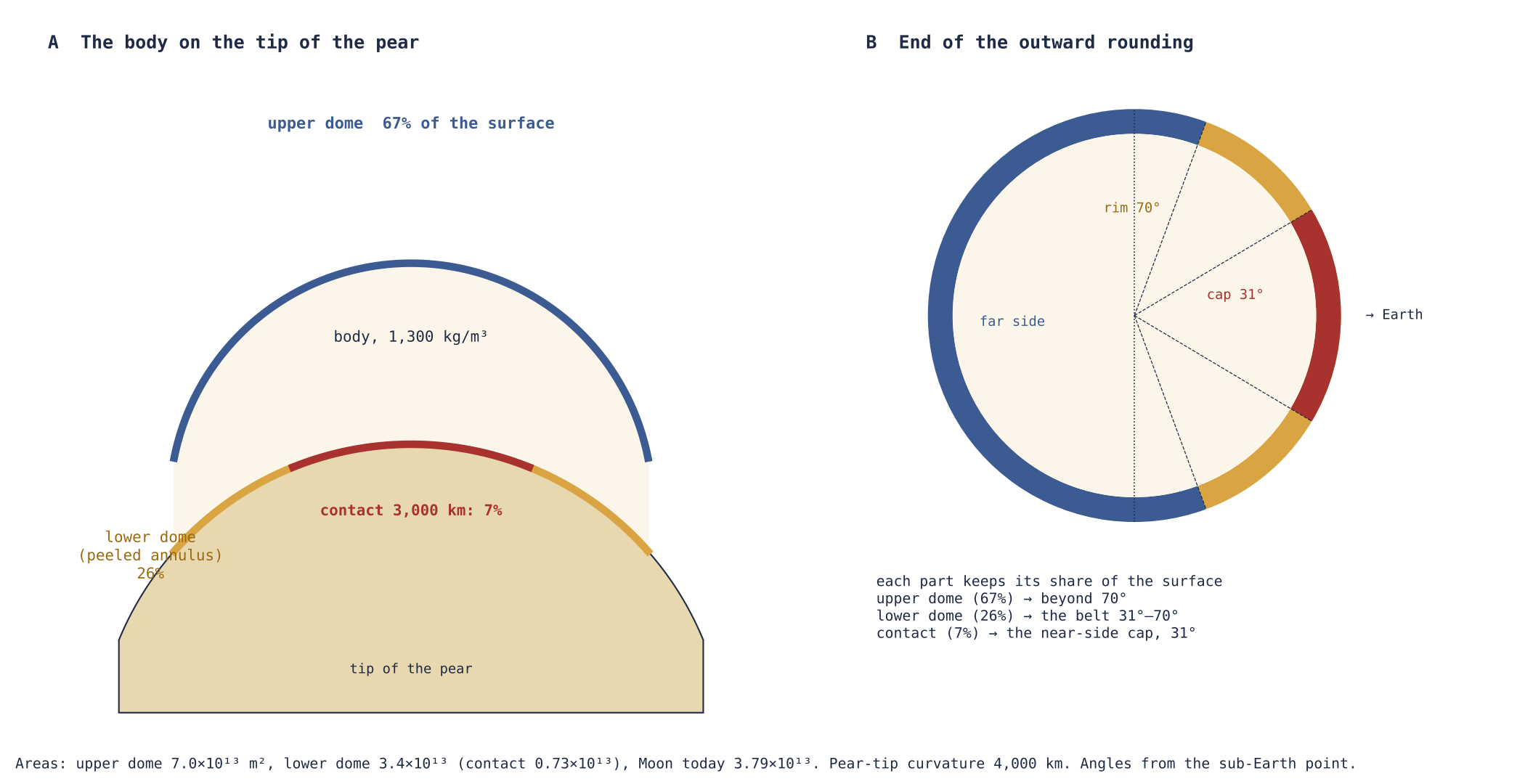
Figure 6 is the table of the translation rule drawn. In panel A, pick out each of the three parts of the squashed body; in panel B, find the same part on the ball. The point to see is that nothing changes its order: the contact, at the centre of the underside, becomes the cap at the centre of the near side; the ring around it becomes the ring around the cap; and the upper dome wraps the rest of the ball.
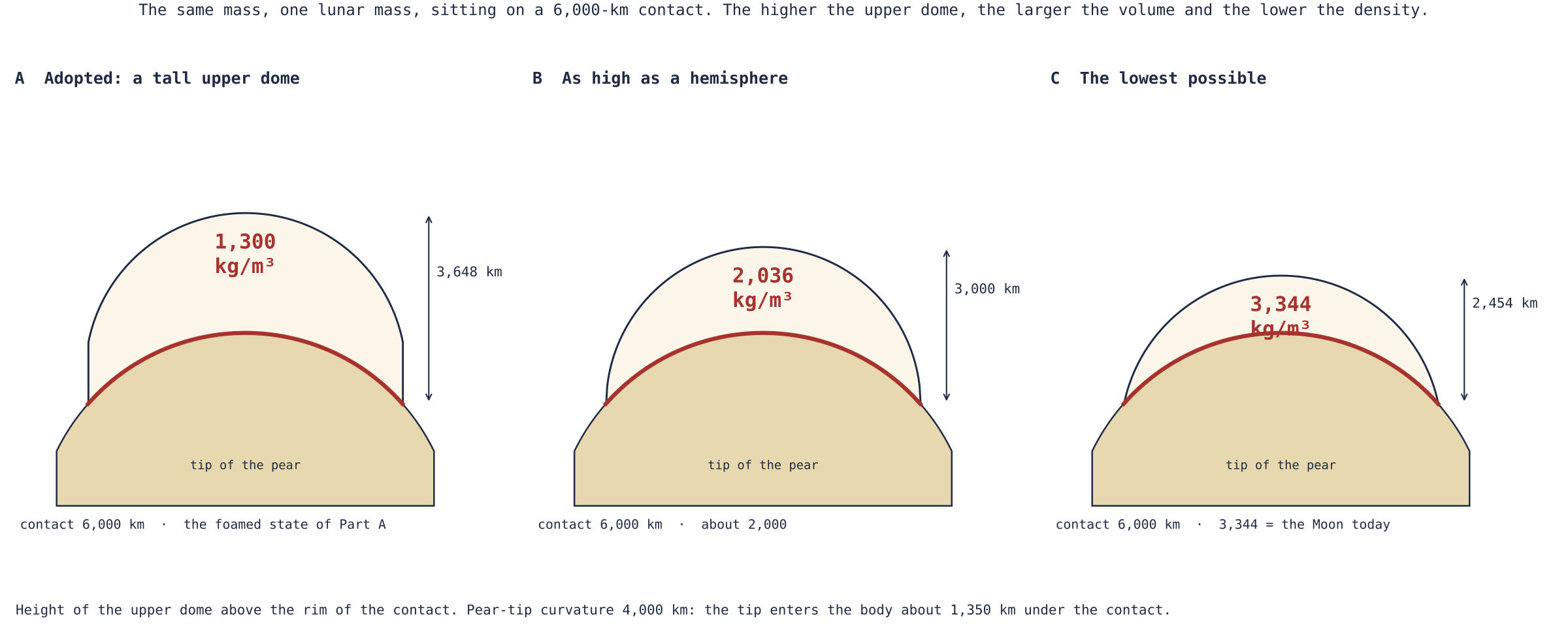
Figure 7 shows the relation used in §B.2 between the height of the upper dome and the density of the body. Look at the three cases named in the caption. The higher the dome, the lower the density; the adopted dome stands at the light end, where the body has the foamed density that Part A requires.
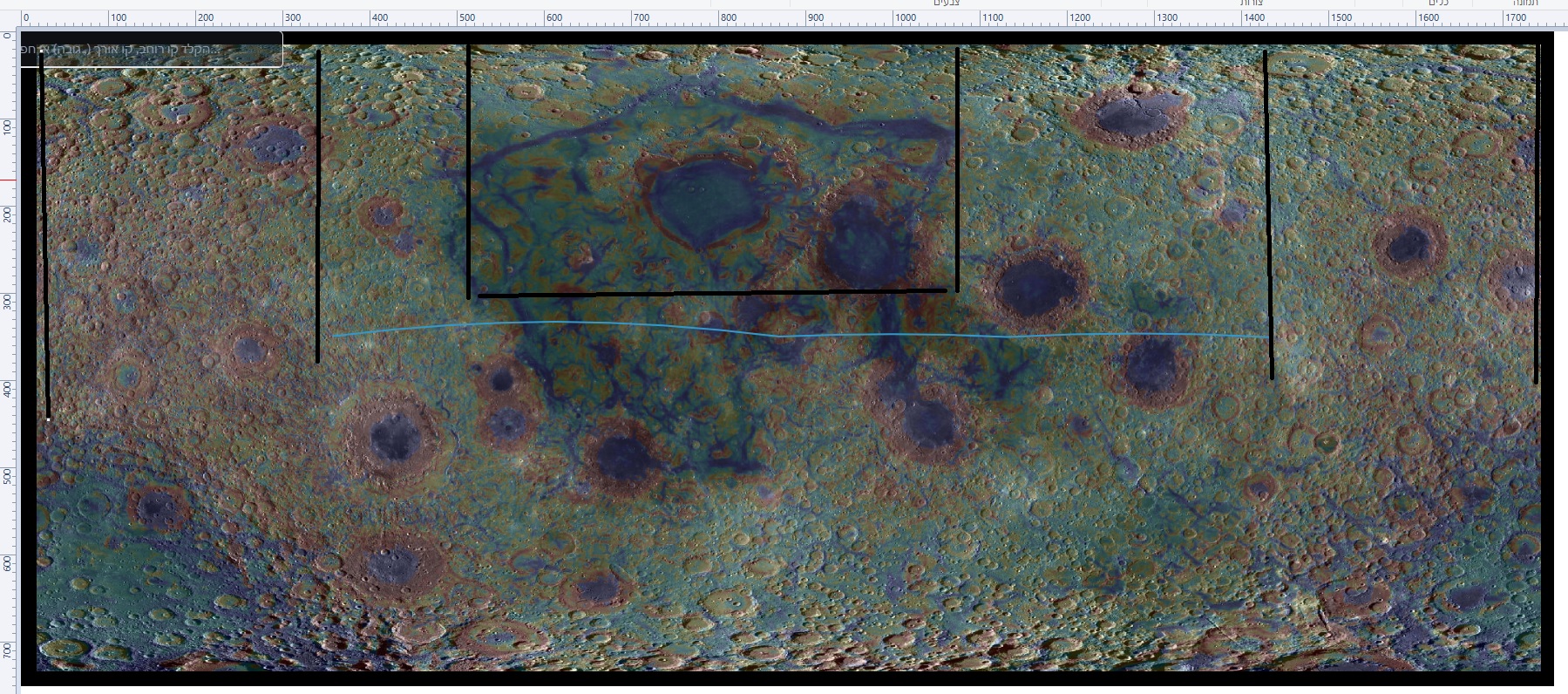
Figure 8 carries the rule onto the real Moon. GRAIL, the twin-spacecraft gravity mission, mapped the Moon’s gravity field and, through it, the thickness of its crust. The blue line marks where the base of the stage-2 body — the rim of the lower dome — lies today; the black line marks the last contact. Look at the dark maria: almost all of them fall inside the blue line, and most inside the black.
What we now have: a rule that turns the geometry of the body on the tip of the pear into a map of the Moon — a near-side cap, a belt around it, and a far side — with each zone exposed at a different time.
B.5The openings
The shell is not continuous. The feed of Part A reaches the dome through openings, and material is ejected through them; at stage 1 they are the maria of the flat shell, at stage 2 those on the upper dome are exposed as it rises, and those under the lower dome remain covered until release. The openings therefore differ by when they were exposed and by what passed through them. The openings on the crown and flank were active while exposed, and material was ejected through them outward. The openings under the lower dome — the near-side maria — were internal passages: while covered, they carried the Earth’s pressure through the pear into the maria we see and from there into the Moon, and material passed through them as through a pipe.
Serenitatis was exposed before Imbrium, and when it was exposed it was still slightly active: splashes are seen in the ring around it, but no giant craters. Large craters are made by large material, driven out by pressure; the small craters in the rings around the maria come from bubbling and splashes, most of which return into the mare, while a small part lands at its margin and leaves its mark there. Imbrium was exposed last. Once it was exposed, the Moon’s internal pressure stopped — not at once, but quickly — and with it the popping of the lunar maria. The Earth went on with its own activity and went on throwing material in all directions, most of it small; part of it returned to the Earth, and part landed on the Moon. This is why small craters cover the whole Moon, the near side included (§C.11).
The observational form of this picture — which basins are which, and what signature each should carry — is a matter of the lunar record and is examined in Paper 11; here the openings enter only as the places where Part A’s feed meets Part B’s shell.
B.6The record carried on the body
A crater made in the shell by returning material while the shell lay exposed at stage 1, or on the upper dome at stage 2, travels with the shell as the body rounds. This is stratigraphy — the reading of order from what lies on what — not new physics: for the segment concerned. In words: a crater formed before its piece of surface was covered or carried is carried with it. The record survives if the shell keeps its shape, which is the requirement that makes it a shell: a viscosity of order Pa s or more at the surface over the yr of the rise. The shell stiffened early, in the first part of the magmatic storm; a stiff shell neither stretched as the body grew nor was squeezed as it rounded, and the craters on it kept their size.
The record is written in three stages:
In the outward rounding the craters already present change with the surface, alike everywhere, and new ones keep arriving; the poles are formed.
In the flattening that follows most of the craters form, and the largest: the differentiation has advanced, the ejected material is rich in water, and the poles, already formed, receive more.
In the inward rounding, as the flattening relaxes and the whole body densifies, the craters keep their size and the surface between them closes, most at the poles, which gather them (Paper 7) — as the spaces between buttons sewn on a cloth close when the cloth is gathered, while the buttons stay the same size.
The belt and the cap lay under the lower dome and received no craters before their exposure; their oldest populations are younger than the far side’s. A far side whose oldest population is the densest, a belt less so, and a cap least, is what the rule predicts, and it is stated in Part D with its test. This is the test that the translation rule hands to the Moon: the order in which the zones were exposed must be read in the order of their oldest craters.
Behind the scenes. An earlier version of this part had the far side close onto a third of its area, its craters shrinking by 0.58 and their density rising threefold. The craters were asked directly, by measures that a change of scale would move — the diameter of the transition from simple to complex craters, the largest craters in an equal area, the old against the fresh (Paper 7, §D.5). Small craters are simple bowls; above a certain diameter they develop terraced walls and central peaks, and that transition diameter would have changed if the surface carrying them had been squeezed. Between the far-side and the near-side highlands they find no difference of scale: the transition lies at 16.5–17.1 km on the far side and 14.3–15.1 km on the near. The geometry of §§B.2–B.4 follows from that.
B.7The mass and thickness balance
The last question of Part B is whether the crust that the Moon actually has can be made in this way, both in its mass and in its uneven thickness. As measured today, the far-side crust — about 55 km thick by GRAIL, at 2,550 kg/m³ over the far hemisphere — is about kg, 3.5% of the Moon (an earlier version gave kg and 3.6%; recomputed in Paper 11, §B.3). These are observations of the crust as it is today, not the thickness of a model shell. In the model the far-side crust is many layers of compacted sial. Two supplies built it, layer upon layer, on the upper dome: the sial of the parent, which slid up the pear over the sima and gathered at its tip (§C.10), and the material ejected through the openings, which returned again and again on the far part of the body.
The ejection never stopped, and the differentiation — the separation of the deep material by density, heavy iron sinking and light, volatile-rich material rising — advanced with time. As it advanced, the material that came out was ever lighter and richer in fluids: in the flattening the outflows were of relatively light terrestrial material, full of water. Each layer laid down earlier came out less sorted, and so carries more iron than the layers above it. The far-side crust is therefore layered by age and by sorting, and its iron content rises with depth: the deeper the layer, the earlier it formed, and the richer it is in iron — and the denser. That is a prediction, read from the composition of crater central peaks against their depth of origin (§D.1).
The near side carries a crust of 30–35 km — the peeled sial of the annulus and, over the contact, a crust smoothed by heat and gravity — about kg more at the same density (an earlier version gave kg, which would bring the total to 6.3%); together they are the 4–6% of the lunar mass that GRAIL models give for the whole crust [4]. The remaining 94–96% of the lunar mass is the deep material of Part A — a split estimated from the earlier shell picture, to be recomputed for the layered crust — and the metal the interior must carry for a 1.4% core is a requirement on Part A’s feed, not on the crust (Paper 11, R2). The balance therefore indicates that the crust the two supplies build on the outside is a small fraction of the Moon, and the bulk of the mass is what Part A lifts from within.
The far side is thicker than the near side (Figure 9) because the two were built differently: the upper dome, exposed throughout, gathered sial and returning material layer upon layer; the lower dome carried only the sial it sat on, and at its centre lost even that to the heat of the contact. The near side is thinnest where it is opened: the maria are the openings of §B.5, and the crust beneath them is thin because they are openings. The far-side crust is the older and the thicker; the boundary between the two lies at the rim of the lower dome (§B.4).
Figure 9 is a map of the whole Moon unrolled flat, the near side in the middle and the far side split between the two edges; LOLA is the laser altimeter that measured the heights of the surface. Look at the colours from the centre outward: blue under the near-side maria, at the centre of the map, where the contact and the openings lay; red and white toward both edges, on the far side, where the upper dome gathered its layers. The map is the translation rule seen in the thickness of the crust.
What Part B has given: the Moon’s crust and its oldest craters came from the Earth’s outer shell, which rose as the skin of the upper dome; the body sat as two domes on the tip of the pear; when it rounded outward each part kept its share of the surface, so that the contact became a near-side cap, the peeled annulus a belt, and the upper dome the far side. Part C now turns to the connection beneath the body — what it carries, and how the body is released.
The connection and the release
after testing the feed, we must know what carries the body and when the connection ceases to hold. We use the coupled calculations of mass, spin and latitude, and distinguish force, stress and change of shape.
Part A showed that the pressure can feed the body, and Part B followed the body’s surface from the flat stage to the outward rounding. This Part asks the mechanical question that both leave open: what holds the body to the Earth while it rises, and how it is released. The answer is built in steps. Sections C.1–C.3 compute the load the connection must carry at release and show why a narrow neck cannot carry it. Sections C.4–C.5 show how a broad, hot contact carries it, and how the body begins to separate at the line and is released about 210 km beyond it, the contact resisting only a little; §C.5a gives the release-distance search. Section C.6 hands the release state to Paper 4 (The Orbit). Sections C.7–C.9 describe the structure beneath the contact — one bulge of the Earth drawn into a pear, a part of the Earth held by the Earth’s gravity — with its width, length and mass. Sections C.10–C.11 close with what the body took with it and what the Earth went on doing after release.
Three words are kept apart throughout. A force is the total pull or push, in newtons. A stress is that force divided by the area that carries it, in pascals (one gigapascal, GPa, is about ten thousand times the air pressure at sea level). A change of shape is what a material does when the stress on it is not balanced. A connection may carry a large force with a small stress if it is wide, and the same force may tear a narrow one.
C.1 The cap does not carry the whole source pressure
The question of this section is a simple one that is easily answered wrongly: does the full pressure of the deep source push on the outer cap of the body? It does not. In hydrostatic balance — the state in which, at every depth, the pressure of a fluid just carries the weight of what lies above it — the pressure varies along the path. It is highest at the deep source and falls along the way up, because at each step it has carried the weight of the column above. The deep source pressure (about 150 GPa, Part A) must therefore not be inserted as a uniform pressure difference across the outer cap.
A useful scale is the pressure that the body produces by its own weight. For a homogeneous spherical body of lunar mass and density 2,600 kg/m³ one obtains a radius of about 1,890 km and a central pressure due to its own gravity:
Here is the gravitational constant, the lunar mass and the body’s radius. The formula is the standard result for a uniform ball: each layer is pressed by the weight of the layers above it, and the sum reaches its largest value at the centre. In words, the body’s own gravity alone compresses its centre to about 3.37 GPa — some forty times less than the deep source holds. The pressure that reaches the body has therefore already been spent, for the greater part, on lifting the column beneath it.
The hydrostatic pressure decreases toward the boundary. However, an envelope of finite thickness, inflow, tides and non-spherical geometry can impose loads on that boundary. The pressure difference and the local stresses must therefore be computed; they must not be assumed automatically to be zero. This is the reason the following sections compute the load of the connection directly, from the motion of the body, rather than from the source pressure.
C.2 What does the connection require at non-zero latitude?
The body is attached to the Earth and turns with it. To keep turning with the Earth at a fixed place, it must be given at every moment exactly the acceleration that this circular motion requires; whatever gravity and the rotation do not supply, the connection must supply. This section computes that remainder at the moment of release.
Define as the distance between the centres, and . is the Earth’s mass; measures the joint gravity of the pair; and is the reduced mass, the single mass that stands for the two bodies when their mutual motion is treated as the motion of one (it is slightly less than , because the Earth also moves a little about the common centre). For attached motion in corotation — the body turning with the Earth’s spin, at the same angular rate — at a constant latitude and at a constant rate at the moment examined, the required support accelerations are:
The first is positive outward, and the second is toward the pole in the northern hemisphere. In words: is the radial support, the Earth’s pull less the part of the outward fling of the rotation that points straight away from the Earth’s centre. is the lateral support. Away from the equator the outward fling of the rotation, , points away from the spin axis, not away from the Earth’s centre; part of it therefore runs along the ground toward the equator, as a bead threaded on a spinning hoop is pushed toward the hoop’s widest part. To hold the body at its latitude, the connection must pull it toward the pole with an acceleration equal to that sideways part. The total force required of the connection in the two-body approximation is:
This is the reduced mass times the combined acceleration, the two components added at right angles.
In the state of release adopted in the series — latitude , an Earth day of 5.77 h, and the Moon’s centre of mass on the corotation line at that latitude, (Papers 2 and 4) — one obtains:
The corotation line is the set of points at which a body turning with the Earth already moves at the speed of a free circular orbit; on the equator it lies at , 16,399 km at the 5.77-hour day, and at latitude it lies farther out, at , 17,287 km at 22.5°. On that line the radial requirement vanishes exactly, : gravity and the rotation balance along the radius, and the connection need neither push nor pull outward. The lateral requirement does not vanish. It is 0.559 m s, about two-fifths of the body’s own surface gravity at release (1.37 m/s², §B.3), and applied to the reduced mass it gives a force of N. That is the load the connection must carry at release, and it is wholly sideways.
A force says little about a connection until it is divided by the area that carries it. Over a circular section of radius , the equivalent mean stress is:
| Connection radius | Equivalent mean stress |
|---|---|
| 1,000 km | 12.92 GPa |
| 1,500 km | 5.74 GPa |
| 2,000 km | 3.23 GPa |
The table is read from top to bottom: the stress falls as the square of the radius, so that doubling the width of the connection divides the stress by four. At a radius of 1,500 km, a section perpendicular to the radial direction requires no normal component — on the line the radial balance is met — but a lateral component of about 5.74 GPa. That lateral component is a shear: it tries to slide one face of the section past the other. An isotropic pressure on such a section — a pressure that pushes equally in all directions, as in a still fluid — does not by itself supply the lateral component. A different connection shape may change the distribution of stresses, but it must be computed. When the mass of the connection is significant, it and the flow momentum must also be included; the table is a load estimate for two bodies, not a solution for a massive connection.
Why a narrow neck cannot do the job. The table shows the difficulty of a narrow connection. A neck 1,000 km in radius would have to carry 12.92 GPa of shear, and the joint test of §A.13 gives 46.04 GPa for a passage 500 km in radius. A neck that carries the feed is hot and partly molten, and a molten material carries no lasting shear at all: under a steady sideways load it flows. A narrow neck therefore cannot hold the body at 22.5°; it would bend and flow toward the equator. The way out is not a stronger neck but a wider structure: a part of the Earth itself, held by the Earth’s gravity, that carries the sideways load as the Earth carries its mountains. That structure is the broad base of the dome and the pear beneath it (§C.4, §C.7). Figure 10 shows the load to be carried.
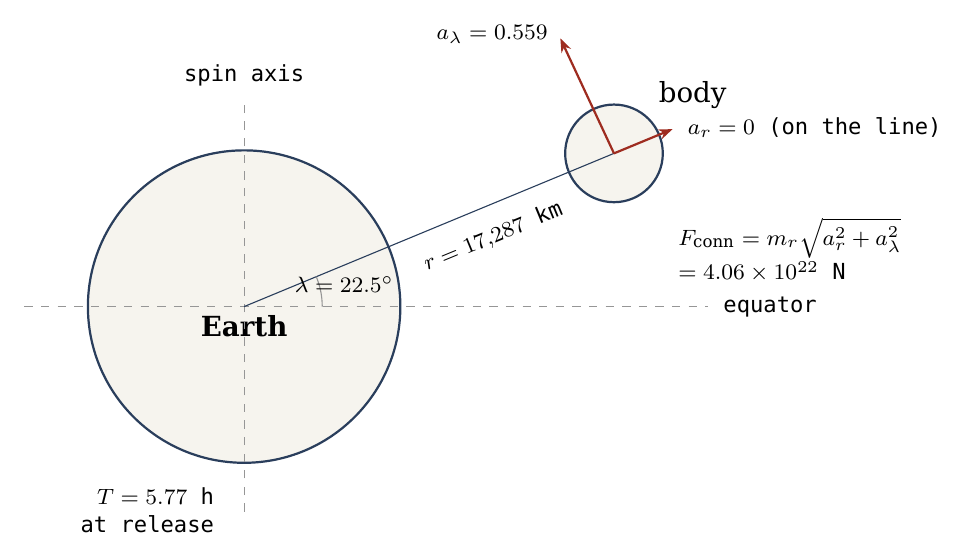
The figure is read from the body: the short red arrow along the radius is the radial requirement, which is zero on the line; the long red arrow toward the pole is the lateral requirement that remains. The connection must supply the second.
C.3How corotation detaches the body
Corotation is what detaches the body, but not as a switch thrown at a single point. This section explains what happens at the line. In the equatorial plane, and in the point-body approximation, the change of sign of changes the direction of the required support: inside the line the connection must hold the body up against the Earth’s pull, beyond it it must hold the body down against the outward fling. At the line itself the requirement passes through zero. At non-zero latitude, even when , remains. In the state of release this point is the line itself, 17,287 km at 22.5°, and the connection load there is still newtons.
The corotation line is therefore the place where the direction of the radial requirement turns over; it is also where the body begins to separate. The connection gives way a little beyond it, once it can no longer transmit the required force, torque and momentum flux. High temperature and melting may reduce its resistance to deformation; pressure can contribute to the push; rounding changes the contact shape and the stress path. Heating, pressure and rounding act together in the same system. The sections that follow show how these act together at the line: the line sets where the net radial pull turns outward, and beyond it the body, the contact resisting only a little, is pulled outward and released about 210 km past the line (§C.5–C.5a).
C.4 The outward rounding and a broad connection
Rounding is a response of the shape to self-gravity, tides, spin and rheology (the way a material flows under load). A body held together by its own gravity tends to become a ball; the Earth’s tide pulls it into an elongated shape along the line joining the two; the spin flattens it; and its viscosity sets how fast it can follow these pulls. The comparison:
gives a local estimate of the competition between self-gravity and tidal stretching. The left side is the body’s own gravity at its surface, which holds it together. The right side is the tidal stretch across the body: the Earth pulls the near side harder than the centre and the centre harder than the far side, and the difference over one body radius is . When the left side wins, the body holds itself; when the right side wins, the body is held only by what it rests on. At stage 2, on the wide tip, the ratio of the two is about 0.11 (§B.2): the body is still a dome on the tip, not yet a body of its own. Survival in orbit and the tearing of the connection are the two conditions Paper 2 places on the released body, and this comparison is where they enter.
The broad connection may stretch and separate while flowing and deforming, without first narrowing into a neck. This is the central difference from a pinch: a drop leaving a syringe thins to a thread and snaps, but a wide, soft layer pulled apart opens across its whole width at once (§C.5).
The order of the shape changes is fixed. The body completed its outward rounding long before release, while it still turned with the Earth; it then flattened with the spin, and the flattening and the inward rounding that relaxed it both happened while the body was attached. In the inward rounding the axis ratio fell from 1.69 at the peak of the flattening to late in the attached stage (Paper 7, The Poles). By release the body was round, its outer shell rigid (Paper 2, §B.7: an axis ratio of at most 1.04). The detailed stresses and the evolution of the geometry remain to be solved. The contact in this picture is the 3,000-km disc that remains of the body’s lower dome at stage 3 (Part B.4); its width, 1,500 km in radius, is the of the release calculation in §C.5.
Why the broad base can do the job. Two things change when the connection is the broad base of the body rather than a neck. The load is spread over a disc 1,500 km in radius, so the mean stress falls to the 5.74 GPa of the table in §C.2 instead of rising as the radius shrinks. And beneath the disc the support is not a thread but a wide part of the Earth itself, the pear of §C.7, a part of the Earth held up by the Earth’s gravity. The contact only has to pass the load into the pear, over a short distance; the pear carries it down to the Earth.
C.4a Peeling: the body leaves with the sial it sat on
This section describes what happens over the parts of the lower dome that are not the final contact. The body sat from the start on the parent’s sialic layer — the light outer layer, rich in silicon and aluminium (§C.10) — it grew on it, and it left with it. The picture is a deflated football or basketball pressed onto the rounded top of a stand and inflated while it is still on the stand: as it swells and rounds, the wall that touches the stand peels away from it, from the edge inward, and rounds with the rest of the ball. Here the stand is the tip of the pear.
Over the 6,000-km base the separation is a peeling. As the body rounded outward (§C.4) the contact shrank from the rim of the lower dome, 6,000 km across, to the 3,000-km disc (§B.4); the peeling is slow, and the disc stays attached to the end. Across that annulus — the ring between the 6,000-km rim and the 3,000-km disc — the body did not tear from the parent: the sial beneath it peeled from the sima below (the denser, magnesium-rich layer beneath the sial), along the lubricated boundary between the two layers (§C.10), and went with the body. That peeled sial is today’s belt between and from the contact centre (§B.4).
The 3,000-km contact is a hot mechanism. At the centre of the lower dome the body stood on the top of the pear, and there the heat was extreme: it melted the sial layer and removed it. The last separation there may not have been clean, but the heat and the gravity of the body smoothed the whole region. Where the crust of the near side is thinnest it is opened: the maria are the openings of §B.5, and the crust beneath them is thin because they are openings.
And the release itself. When the Moon’s centre of mass reaches the corotation line, the body begins to separate; the corotation forces pull it outward with force, and the last of the contact, resisting only a little, gives way about 210 km beyond the line (§C.5, C.5a, C.8). The body then leaves with its sial: the shell over the dome, the peeled sial over the annulus, and over the contact a surface already smoothed by heat.
The body thus separates in two ways at once: a slow peeling over the ring, where the sial goes with it, and a pull over the central disc, where the hot contact resists only a little. The second is estimated next.
C.5 How the body is released beyond the corotation line
Paper 2 places the release where the Moon’s centre of mass reaches the corotation line: beyond it the corotation forces pull the body outward. The Moon begins to separate as its centre of mass reaches the line and is released about 210 km beyond it, when a little more than half of it has crossed (§C.5a). The contact between the pear and the body resists only a little; the body is pulled outward with force, and this pull drew up the spatula ridges. This section estimates how much the contact resisted.
Why the centre of mass, and why the line. A body that moves as one piece responds to the sum of the forces on it, and that sum acts as if all its mass were at its centre of mass. Inside the corotation line the Earth’s pull on the body is larger than what its circular motion needs, so the body as a whole presses toward the Earth and the contact is in compression: it is pushed, not pulled, and it holds. The far side of the body reaches the line first (the table of the tip in §C.7), but as long as the centre lies inside, the parts within the line outweigh the parts beyond it and the body still presses inward. When the centre crosses the line the sum reverses: the outward fling exceeds the pull, and the body begins to pull on the contact. From then on the contact is in tension, and the question becomes how a hot, viscous layer behaves when it is pulled.
What Stefan release means. Two flat glass plates with a thin film of water between them are easy to slide but hard to pull straight apart. To open the gap, liquid must flow in from the edges toward the centre, and the thinner the gap, the harder it flows. Pulled slowly, the plates come apart slowly at first; once the gap has widened a little, the liquid flows in easily and they part at once. The resistance is not a strength that breaks; it is a resistance to the rate of opening, set by the viscosity of the film — its resistance to flow — by the size of the plates and by the width of the gap. This is Stefan’s problem, and the contact is such a film on a very large scale.
Model the contact at stage 3 as a Newtonian layer of thickness , radius km (the 3,000-km disc of §B.4) and viscosity . A Newtonian layer is one whose resistance to flow is proportional to how fast it is made to flow, as for water or honey. Such a layer carries no tension; it resists the rate at which the two bodies separate. For two discs separating at rate the resistance is Stefan’s,
Here is the gap at a given moment and the rate at which it opens. The equation says three things. The resistance grows with the viscosity and with the speed of opening: a slow pull meets little resistance. It grows very steeply with the size of the disc, as : a disc twice as wide resists sixteen times as much. And it falls very steeply as the gap opens, as : a gap twice as wide resists eight times less.
The force driving the separation, once the body’s centre of mass has crossed the corotation radius by , is the net outward force in the rotating frame, , with at the 5.77-hour day of release (Paper 2). The factor is how fast the net outward acceleration grows with distance past the line: the outward fling grows outward while the pull falls, and at the line the two together change by for each metre of distance. At the line the driving force is zero; a small step beyond it gives a small outward force, a larger step a larger one. Taking all the extension into the layer, :
Equation (31) sets the driving force equal to the resistance and solves for the rate of opening. It contains both effects that speed the release: the driving force grows with , and the resistance falls with .
The solution runs away: the resistance falls as as the gap opens, so the small resistance of the contact soon gives way; release is defined here as the gap reaching , where the resistance has fallen by a factor of 27 and the solution runs away. The margin at release is set by the layer’s thickness alone, (an earlier version gave –); the viscosity and the contact radius set only the time. The reason is that the gap must open by a fixed multiple of the initial thickness before the resistance collapses, whatever the viscosity; a stiffer layer only makes the same opening take longer. The table gives four cases; the time column changes with the viscosity and the thickness, the margin column only with the thickness:
|
[Pa s] |
[km] | [km] | Time to | |
|---|---|---|---|---|
| 20 | 1,500 | about 250 yr | about 40 km | |
| 20 | 1,500 | about 25,300 yr | about 40 km | |
| 50 | 1,500 | about 1,620 yr | about 100 km | |
| 20 | 1,500 | about yr | about 40 km |
The times are obtained by integrating equation (31) from the seed gap to the release gap with the lunar mass; they scale as . An earlier version of this table gave about 4,800, 320 and years for the last three rows; those values did not follow from equation (31), which gives the times now shown and agrees with the curves of Figure 11. A later version gave about 240, 25,700, 1,640 and years; the times now shown are the integral itself, and the four rows scale with one another as . The margin column is unchanged.
A contact layer 20–50 km thick gives 40–100 km, and the adopted release of about 210 km (§C.5a) corresponds to a layer about 105 km thick — in every case a small margin against a release distance of 16,400–17,300 km, under one and a half per cent of it. The body therefore leaves practically on the line, as Paper 2 requires, and the orbit it enters is set by the line, not by the details of the layer. In the account of §C.7–C.8 this is the last opening of the contact, once the Moon’s centre has reached the line and the corotation forces and the internal pressure act together. The release at the line is therefore carried out by the connection this paper finds, without a narrow neck and without a new assumption: the contact, hot and soft (§A.5, §B.4), resists only a little, and for a layer about 105 km thick the body is released about 210 km beyond the line (an earlier version took a layer 50 km thick and a release about 100 km beyond the line).
The times in the table, from a few hundred years to a few million years (an earlier version said “to some hundred thousand years”), are short against the duration of the construction. They estimate the small resistance of the contact; the body itself is pulled outward with force, and this pull drew up the spatula ridges.
The rotational coupling. A second question is whether the same contact can keep the body turning with the Earth while it rises. As the body moves outward, it must be given more sideways speed to keep pace with the rotation, and that requires a torque — a turning force. The same layer answers the question of rotational coupling: the torque needed to keep the body corotating as it rises 1 km/yr is N m; the sideways force it implies at the body, N, spread over the contact is a shear stress of about 0.2 kPa (an earlier version gave 7 kPa) — negligible for any viscosity in the table. A fifth of a kilopascal is about a five-hundredth of the air pressure at sea level; a layer of any of the viscosities above carries it at a negligible rate of shear. The broad contact maintains rotational coupling: it holds the body sideways while it rises, and along the radius it resists only a little once the centre has passed the line.
Figure 11 shows the opening of the gap in time for two of the cases. Both curves stay almost flat for most of the time and then rise sharply: the resistance gives way once the gap has opened a little. The thicker layer releases sooner, but in both cases the gap at release has opened to three times the initial thickness, so that the margin beyond the line, , is twice the layer’s thickness — 40 km for the 20-km layer and 100 km for the 50-km layer, as in the table (an earlier version of this sentence called the margin three times the thickness).
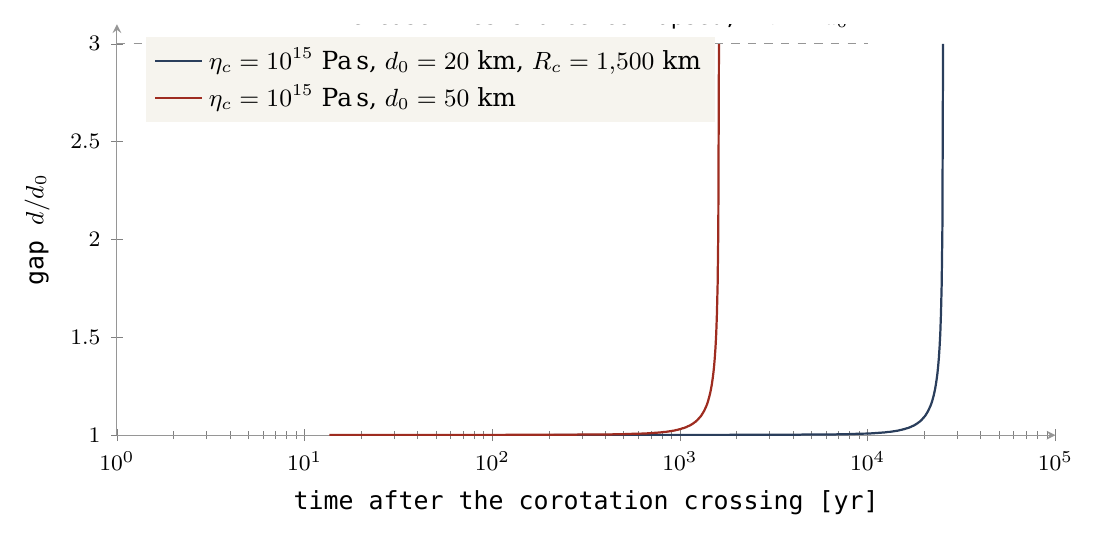
The order is fixed: the body rounded outward and flattened during the attached stage, and its inward rounding was completed before release — the axis ratio of 1.2 belongs to the late attached stage, and at release the body was round, its shell rigid (Paper 7; Paper 2, §B.7). The separation is a stretching of the layer, not a pinch, and the body it releases carries a shell.
Why the body did not slide to the equator. A body resting on a parent that turns once in 5.5 hours feels a centrifugal force — the outward fling of the rotation. At the equator that force is wholly radial; at latitude it has a tangential component, , directed toward the equator. This is the same component as of equation (19), seen from the other side: there it is what the connection must supply, here it is what would move the body if nothing supplied it. On a fluid parent a body at 22.5° would slide to the equator and separate from there, with zero inclination. What prevented it?
On the wide tip — anchoring. The body rests on a base 6,000 km wide, within an opening in the rigid sialic shell. That is the shell the model requires in any case, at a viscosity of Pa s or more, for the crater record to survive on it (§B.6). A shell that holds craters holds position: a base anchored over such an area does not migrate. A shell stiff enough that a 100-km crater does not relax in ten million years (§B.3) is far too stiff to let a base 6,000 km wide slide across it.
In the outward rounding — the pear. The contact shrinks to 3,000 km, but the body still rests on the tip of the pear, a part of the Earth held by the Earth’s gravity, which carries the sideways load down to the Earth (§C.4, §C.7). The body does not drift toward the equator.
Conclusion. The body is released at the latitude at which it was carried, the latitude of release of Paper 4, 22.5°. The inclination is the tilt of the Moon’s orbit against the Earth’s equator; a body released at a latitude starts on an orbit tilted by that latitude. The base of the pear stood roughly on the equator of that time; whether that equator is today’s is left to the axes, which are future work.
C.5a How far beyond the line: the release distance
Section C.5 found that the body is released a short distance beyond the corotation line. This section asks how far, what that distance does to the orbit, and within what range the reduced laws of the series place it. The answer is the release the series adopts: about 210 km beyond the line, when a little more than half the Moon had crossed it. The question matters because the distance is small against the radius — less than one per cent of it — but it is not small for the shape of the orbit. A body released exactly on the line moves at the speed of a circular orbit and enters a circle. A body released beyond the line carries a little more speed than a circle needs: the release point becomes the nearest point of the orbit, the perigee, and the orbit is a slightly stretched ellipse. Its eccentricity — zero for a circle, growing as the ellipse stretches — grows with the distance beyond the line. That eccentricity, and the somewhat larger orbit that comes with it, are carried into the two numbers that today’s Moon can be checked against: the tilt of its orbit and the stretch of its orbit.
The setting. Each row places the Moon’s centre of mass at the stated offset beyond the corotation line at the moment of full detachment, with the Earth day of release, 5.77 h, and the radius of the body at release, 1,890 km; “crossed” is the share of the Moon’s volume that lies beyond the line at that moment. The initial orbit follows from the formulas of Paper 4, Appendix A (the speed ratio , , , release point at perigee), and the final angle from the reduced tan-law of Paper 4, Part D, . The eccentricity is carried from release to the present distance of 384,400 km with the constant-time-lag tide [21] — the tide raised on the Earth plus the tide raised in a synchronous Moon whose strength relative to the Earth’s is — with the Earth’s spin following from the conservation of angular momentum; the Sun and the evection resonance are not included.
The tilt. The first table releases the body at the latitude of the series, 22.5°, where the corotation line lies at 17,287 km. Read it from top to bottom: the offset grows, and with it the share of the body that has crossed the line, the eccentricity at release, the size of the orbit and the final angle at the present distance. The navy tint deepens with the final angle. The row in green and bold is the one whose final angle equals the observed 5.145°; it is the adopted release.
| Offset (km) | Crossed | (km) | Apogee (km) | Final angle | |
|---|---|---|---|---|---|
| 0 | 50% | 17,287 | 0 | 17,287 | 5.020° |
| 50 | 52% | 17,489 | 0.009 | 17,641 | 5.049° |
| 100 | 54% | 17,696 | 0.017 | 18,005 | 5.079° |
| 150 | 56% | 17,907 | 0.026 | 18,377 | 5.109° |
| 210 (adopted) | 58% | 18,163 | 0.037 | 18,831 | 5.145° (observed) |
| 300 | 62% | 18,571 | 0.053 | 19,554 | 5.202° |
| 400 | 66% | 19,040 | 0.071 | 20,392 | 5.267° |
| 500 | 69% | 19,531 | 0.089 | 21,275 | 5.334° |
| 650 | 75% | 20,316 | 0.117 | 22,695 | 5.440° |
| 1,000 | 86% | 22,404 | 0.184 | 26,521 | 5.711° |
Table C.5a.1. Release at 22.5° (corotation line 17,287 km): the initial orbit and the final angle under the reduced law, as functions of the offset beyond the line. The navy deepens with the final angle; green marks the observed 5.145°, which is the adopted release.
The final angle rises slowly and steadily with the offset: about three-hundredths of a degree for every 50 km. Release on the line gives 5.020°, release 100 km beyond it 5.079°, and the observed 5.145° is reached at about 210 km, when 58% of the Moon’s volume had crossed. The angle is, however, more sensitive to the latitude of the tip than to the offset. The author places the tip between 22° and 24°; the offset that returns 5.145° moves across that range as follows:
| Latitude of the tip | Offset that returns 5.145° |
|---|---|
| 22° | about 420 km |
| 22.5° | about 210 km |
| 23° | about 0 km — on the line |
| 24° | none: the angle exceeds 5.145° already on the line |
Table C.5a.2. Sensitivity to the latitude of the tip. The navy deepens with the latitude; green marks the latitude of the series.
Half a degree of latitude moves the offset by about 200 km. The tilt alone therefore places the release within a range, not at a point; the second test narrows it.
The stretch. The second table makes the same search for the eccentricity. It is made in the plane, with release on the equator of that time (corotation line 16,399 km), where the tide equations above are written; at a given offset the eccentricity at release is nearly the same as at 22.5° (compare the two tables). The last three columns give the eccentricity at the present distance for three values of . The number says how strongly the young Moon absorbed tidal energy relative to the Earth: a cold, stiff Moon has a small , a hot, soft Moon a large one. The tide in the Earth stretches the orbit as it grows; the tide in the Moon rounds it. The navy tint deepens with ; the green cell lies next to today’s value, 0.0549.
| Offset (km) | Crossed | Perigee (km) | Apogee (km) | today, | |||
|---|---|---|---|---|---|---|---|
| 0 | 50% | 0 | 16,399 | 16,399 | 0 | 0 | 0 |
| 100 | 54% | 0.018 | 16,499 | 17,117 | 0.76 | 0.49 | 0.013 |
| 200 | 58% | 0.037 | 16,599 | 17,875 | 0.82 | 0.63 | 0.048 |
| 300 | 62% | 0.056 | 16,699 | 18,676 | 0.85 | 0.70 | 0.11 |
| 500 | 69% | 0.094 | 16,899 | 20,417 | 0.88 | 0.78 | 0.30 |
Table C.5a.3. Release on the equator of that time (corotation line 16,399 km): the initial orbit and the eccentricity at the present distance for three strengths of the tide in the Moon. The navy deepens with ; green marks the value nearest today’s 0.0549.
The first row is the decisive one. A body released exactly on the line enters a circle, and the tide carries a circle outward as a circle: whatever the value of , the eccentricity stays zero all the way to 384,400 km. Every eccentricity the Moon has today must therefore begin as a small at release. With little dissipation in the Moon ( or 1) the tide in the Earth stretches even a small into a long ellipse; with a hot young Moon the tide in the Moon holds the stretch back, and for the present 0.0549 lies between the 200- and 300-km rows. The offset that returns today’s eccentricity depends on : about 120 km for , about 210 km for , about 330 km for and about 460 km for .
Release exactly on the line gives a circular orbit, which the tide cannot make eccentric. A release slightly after the centre of mass crosses the line is therefore required, not only allowed.
Two independent reduced tests — the present inclination (Table C.5a.1, at 22.5°) and the present eccentricity (Table C.5a.3, with a hot young Moon, ) — meet near the same offset, about 200–210 km beyond the line, when a little more than half the Moon (about 58%) had crossed. This is “slightly after the centre of mass”, as the model holds, and it is the release the series adopts. The tables show the range within which the reduced laws place it.
Neither table decides alone: the angle depends on the latitude of the tip, the eccentricity on the dissipation in the Moon. The full coupled integration from the release state (Paper 4, Further work) decides.
In the terms of §C.5, where the margin at release is , the adopted offset of about 210 km corresponds to a contact layer about 105 km thick, twice the 50-km layer of the last row but one of the table in §C.5; the resistance remains the small resistance of a hot, soft contact, and the offset remains less than one and a half per cent of the release distance.
Behind the scenes. An earlier version of this paper adopted a release about 100 km beyond the line, the author’s estimate for a contact layer about 50 km thick. The release-distance search above showed that the two reduced tests meet a little farther out, and the series now adopts the computed value; the estimate lay within the same range and close to it.
What we now have: the load at release is known (§C.2), it is carried by a broad, hot contact rather than a neck (§C.4), and the body begins to separate at the line and is released about 210 km beyond it, pulled outward with force against a contact that resists only a little (§C.5); the tilt and the stretch of today’s orbit meet near that distance under the reduced laws (§C.5a). The next section states this result in the form Paper 4 needs.
C.6 The hand-off conditions for the orbital paper
The orbit of the Moon after release is the subject of Paper 4 (The Orbit). It needs from this paper only the state at the moment of release: where the Moon was, how fast the Earth turned, and what the connection was still doing. The state handed to Paper 4 is that of Paper 2, with the offset of the lengthening pear and the centralising core taken into account. The lengthening pear carries mass outward and so slows the Earth’s spin; the iron sinking toward the centre — the centralising core — speeds it up, as a skater spins faster when she draws in her arms; the two together give the 5.77-hour day (Paper 2, §A.4):
| Latitude of release | Earth day | Moon’s centre at release | Orbit at release | Connection load |
|---|---|---|---|---|
| (equator) | 5.77 h | about 16,610 km (line 16,399 km) | nearly circular, | radial balance met; only the small resistance of the contact |
| (Paper 4) | 5.77 h | 17,496 km (line 17,287 km) | nearly circular, | N, lateral |
The two rows differ only in latitude. On the equator the line lies at 16,399 km and the connection has no load left at release but the small resistance of the contact; at 22.5° the line lies farther out, at 17,287 km, and the lateral load of §C.2 remains. In both cases the Moon leaves on a nearly circular orbit: on the line the speed it carries with the rotation is the speed of a circular orbit, and about 210 km beyond it a little more, so the release point is the perigee (§C.5a, §C.8). (An earlier version handed over release on the line, on a circular orbit.)
Behind the scenes. An earlier version of this section handed over a later release, 20,595 km at a 6.59-hour day, beyond the fluid Roche limit of a body of 2,600 kg/m³. That branch took account of the lengthening pear alone; with the centralising core the day at release is 5.77 h and the line lies at about 16,400 km (Paper 2, §A.4). The body released there is inside the fluid Roche limit and far outside the rigid one (10,314 km at 2,600 kg/m³): it is held by its rigid, rounded shell, not by fluid equilibrium (Paper 7, §C.5). The Roche limit is the distance from the Earth inside which the tidal stretch exceeds a body’s own gravity: a fluid body inside it is pulled apart, while a body with a rigid shell survives much closer, down to the rigid limit. The Moon at release lies between the two, which is why the rigid shell matters.
C.7 One bulge: the Earth drawn into a pear whose tip becomes the Moon
This section describes the structure that carries the body from beneath: what it is, why it has the shape of a pear, how wide and long it is, and how much mass it holds.
At release the body’s centre lies on the corotation line, about 16,400 km from the Earth’s centre on the equator, and its near surface about 14,500 km — the centre less the body’s radius of 1,890 km. Between the Earth’s surface — 6,701 km from the centre on the equator of the flattened parent at a 5.77-hour day — and that surface lie some 7,800 km. Something attached must fill them, because a body that left the Earth’s surface with the rotation alone would carry less than half the speed of an orbit and fall back (§C.8). We propose that the Earth itself fills them, with one bulge: the pressure that raised the hill went on raising it, and the bulge was drawn out into a pear of the Earth’s own material, whose tip — the dome of Part B — rounded and became the Moon. The spin, the sorting of the Earth’s interior and the internal pressure that draw out the pear act as one mechanism; its three faces are set out below, under The pear before this paper.
Why a strand cannot, and a pear can. A liquid strand between two bodies cannot carry the body: the joint gravity of the Earth and the body does pull displaced material back toward the line between them — in every direction and at every height — but for a strand 3,000–4,200 km wide that restoring pull holds only a tenth to a fiftieth of the pressure needed near its base, 35–81 GPa. The pear is not a strand. It is a wide part of the Earth itself, and it is held by the Earth’s gravity like any other part of the Earth, as the Earth holds its mountains. It is not thrown out, because its speed is not a throwing speed and it lies wholly inside the corotation line. Near the Earth it is broad, and it narrows in one arc toward its tip, which carries the contact at about 15,400 km from the centre — the Moon’s centre at 17,287 km less its radius of 1,890 km (an earlier version gave 16,100 km and 9,500 km for the top of the tip). The pear at the start, when the body sat on the wide tip (§B.2), and at release:
| Start: body centre 13,000 km, 5.5 h | Release: Moon centre 17,287 km, 5.77 h | |
|---|---|---|
| The tip of the pear (the contact) | 6,000 km | 3,000 km |
| Length, Earth’s surface to the contact | about 4,000 km | about 8,700 km |
The two columns describe the pear growing. Between the start and release it roughly doubled in length, from about 4,000 to about 8,700 km, and its tip narrowed by half, from 6,000 to 3,000 km, as the body on it rounded outward.
The width of the base. The base of the pear is taken as 9,000–11,000 km wide. An upper bound comes from the energy: a wider base holds more mass, and lifting more mass costs more work. Widening the base at the same shape, the pear at release holds 8.8 lunar masses with a base of 9,000 km, 10.4 at 10,000 km and 12.1 at 11,000 km, and lifting it costs , and J — the last of the order of the energy released by the formation of the Earth’s core. We take the base as 9,000–11,000 km. As the body rose the tip narrowed from 6,000 to 3,000 km, while the base widened.
The mass of the pear. The pear therefore holds 8.8–12.1 lunar masses for bases of 9,000–11,000 km. The figure “about nine lunar masses” used in this paper (§C.9) is the 9,000-km case, the narrow end of the range; in words, the pear holds about nine to twelve lunar masses. For comparison, the 9,000-km pear holds about 11% of the Earth’s mass (§C.9) — a large bulge, but one region of the planet, not the planet.
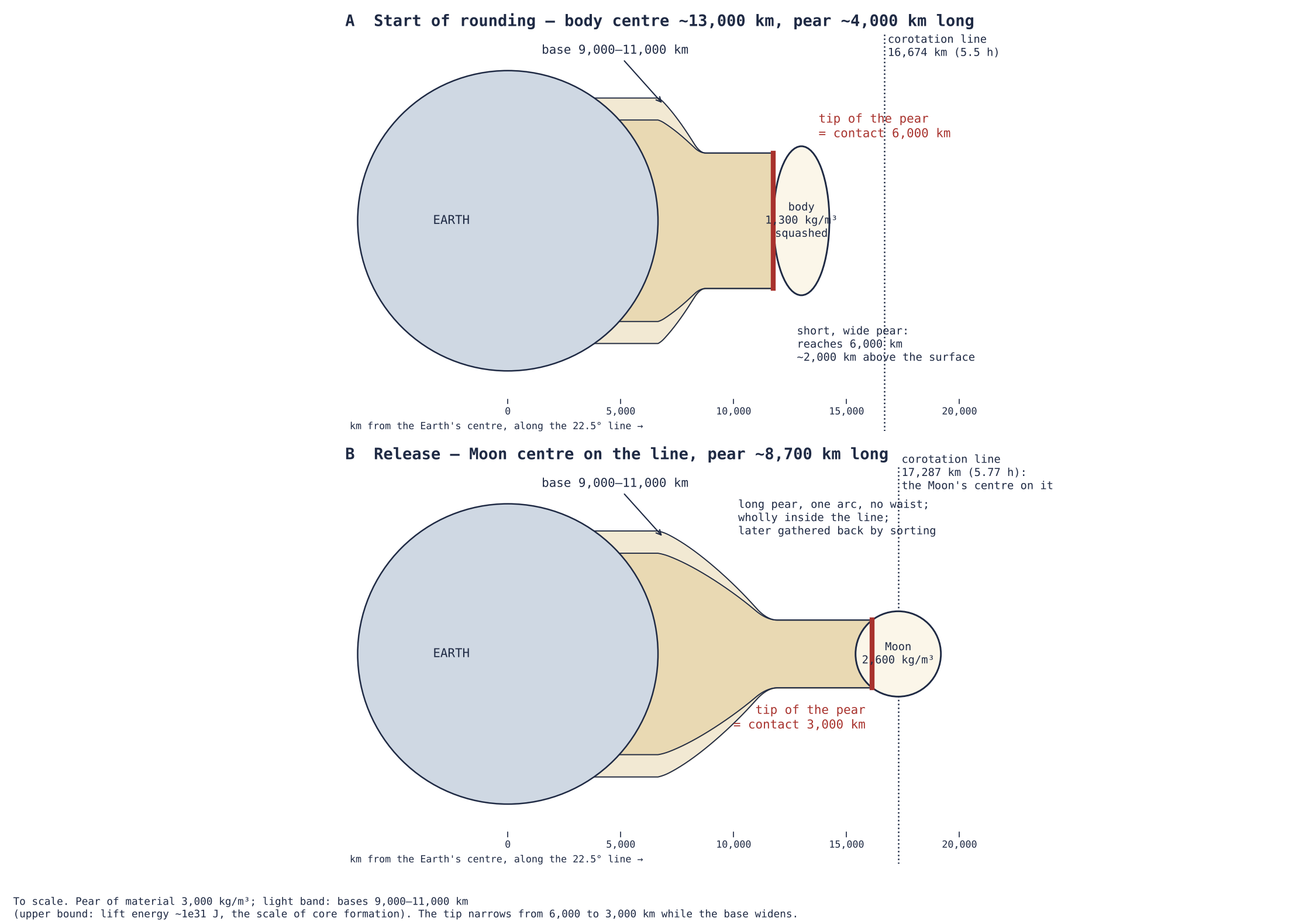
Figure 12 draws the two columns of the table. The point to look at is the outline of panel (B): it narrows steadily from the base to the tip, in one arc, with no waist where it could pinch, and it ends before the corotation line.
The tip along the climb. The tip of the pear carries the body of Part B, and the body densifies as it rises; its spin is the Earth’s. The stages, with the figure of a spinning body of that density and spin (Paper 7, §C.1). The axis ratio is the ratio of the body’s longest to its shortest axis: 1.00 for a sphere, larger for a flattened body. A light body spinning with the Earth flattens strongly, because its own gravity is weak against the spin; as it densifies, its gravity grows and it rounds inward. The table is read from top to bottom, with the density rising and the ratio falling toward 1:
| Stage | Density (kg/m³) | Earth day | Axis ratio | State |
|---|---|---|---|---|
| On the tip of the pear (stage 2) | 1,300 | 5.5 h | — | held by the lower dome |
| Peak of flattening, start of inward rounding, 13,000 km | 1,300 | 5.5 h | 1.69 | holds itself; flattest |
| On the pear, rising | 1,600 | 5.55 h | 1.44 | densifying |
| On the pear, densifying | 2,000 | 5.62 h | 1.30 | |
| Far side reaches the line | 2,300 | 5.70 h | 1.24 | |
| Late attached stage, approaching the line | 2,600 | 5.77 h | 1.20 | inward rounding ending |
| Centre on the line — release | 2,600 | 5.77 h | 1.04, round | rigid shell |
| Today | 3,344 | — | 1.00 | compacted |
The flattening and the inward rounding both took place while the body was attached: the ratio fell from 1.69 at the peak of the flattening to 1.20 late in the attached stage. By release the inward rounding was complete; the body was round, its outer shell rigid (Paper 2, §B.7: an axis ratio of at most 1.04), and it has since compacted to today’s density of 3,344 kg/m³.
Three results. Three results follow. The pear is part of the Earth and is held by the Earth’s gravity, so the lateral question of the connection is answered by the Earth’s own gravity: the sideways load of §C.2 that no neck could carry is carried by a wide body of the Earth’s own material. In its upper part the pear is set by the contact it carries, 6,000 km at the start and 3,000 at release. And the whole pear lies inside the corotation line, so that the effective gravity along it points toward the Earth everywhere: it is compressed along its length, it has no waist to pinch, and nothing of it can stay in orbit; after release the sorting gathers it back whole into the Earth over tens to hundreds of millions of years.
What became of the pear. The pear was not lost at release. After release the sorting gathered it back into the Earth, gradually, over tens to hundreds of millions of years. Its heavy part sank deep into the Earth beneath the base of the pear (Part E); its leading side was gathered into the stripes of the North Pacific, and its back into the arcs of the western Pacific (Paper 9, The Stripes). The mass did not leave the Earth; it moved from high outside to deep inside, and it left wrinkles on the surface where it entered.
Behind the scenes. We first looked for a narrow strand between the Earth and the body; it cannot carry the load. We then drew the pear with a long neck reaching beyond the corotation line, released when the tip crossed it. When the release was placed where the Moon’s centre of mass reaches the line (Paper 2), the neck lost its role: the pear is a single arc from the Earth’s surface to the contact, wholly inside the line.
The pear before this paper. The shape is not new to physics. Poincaré [8] found in 1885 that the sequence of rotating fluid equilibria passes from the Maclaurin spheroid to the Jacobi ellipsoid and branches there into a pear-shaped, or piriform, figure, and he suggested that a pear might divide into two unequal bodies. A Maclaurin spheroid is the flattened, round-in-plan shape of a uniform fluid body that spins slowly; a Jacobi ellipsoid is the elongated shape, with three unequal axes, that such a body takes when it spins faster; the pear branches from the Jacobi shape at faster spin still. Darwin carried the idea to the Earth and the Moon, and the Poincaré–Darwin fission theory followed [9]. In that theory the pear is stretched by rotation alone, and so requires a spin close to break-up — the angular-momentum objection that ended it; and Cartan later showed that dynamical instability sets in where the pear branches from the Jacobi sequence [10], interrupting the slow evolution the theory assumed. The pear proposed here differs in its cause. Its cause is one mechanism with three faces. The spin creates centrifugal pressure. The Earth’s sorting (differentiation) tends to concentrate the heavy material, and in doing so presses everything else outward: this is the internal pressure. And the spin drives the sorting. Together they make the anomaly that is the pear. The pear forms at a 5.5-hour spin whose rotation parameter, for the homogeneous parent (an earlier version gave 0.093), is far below the point at which the Jacobi branch begins. The rotation parameter compares the spin with the body’s own gravity; the comparison must be made on one scale. On the scale used here, the Jacobi branch begins at 0.374 (Paper 2, §A.6.5), so the parent’s 0.092 is about a quarter of it; the value 0.187, often quoted for the same branch point, is the same point on the scale , and is not to be compared with 0.092 directly. The 5.5-hour parent is therefore far from the spin at which rotation alone would make it a pear. The pear here grows from one region rather than from the whole body; only its tip leaves, once the tip’s centre of mass reaches the corotation line, and the rest is gathered back into the Earth by sorting. An equilibrium that is unstable is no obstacle to a figure that is driven and then released. A pear cannot form in a body that is already sorted and slow, as the Earth is today: such a body has settled, and nothing can leave it. At the time of the pear the spin was fast, the viscosity low and the sorting only beginning; under these conditions pears form, and from them moons.
Closer to the present account, several authors have proposed that the Moon left a more slowly rotating Earth with help from inside. De Meijer and colleagues [13] invoked a nuclear explosion near the core–mantle boundary of a proto-Earth turning in about 5.8 hours; Edwards [14] proposed that heat and volatiles accumulated above the proto-large low-velocity provinces until an explosion launched that material, with the mantle above it, into a low orbit, where it coalesced into the Moon. Lock and Stewart [15] showed that a hot, expanded Earth reaches its corotation limit and forms an extended structure beyond it; and Denton and colleagues [16] found that Charon, attached to Pluto after a collision, had its centre of mass beyond Pluto’s corotation radius before the two separated. The account here shares a driver with the first two and a boundary with the last two, and differs from all of them in its course: no explosion and no cloud of debris, but one connected body, raised gradually by the pressure, whose tip begins to separate when its centre of mass reaches the corotation line and is released just beyond it.
Figure 13 sets the two pears side by side. On the left the classical figure: the whole body stretched by rotation. On the right the pear of this section, drawn to scale: a spinning Earth of ordinary shape, from one region of which the pressure has drawn a pear, with the Moon at its tip and its centre on the line.
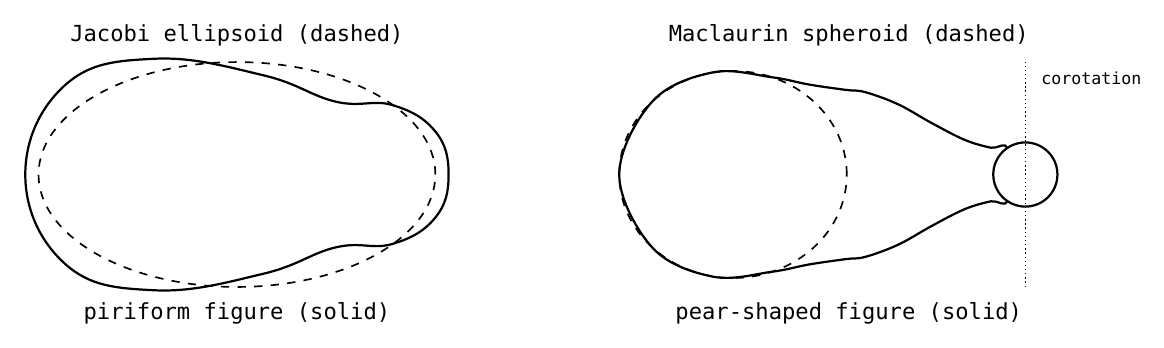
What drives the pear outward: a flow, then a trapped pressure. The pear grows in two phases, set by the openings on the far side of the body. While those openings are open, the pressure escapes through them, but not without effect: it sets up a stream that runs the whole length of the structure, from the deep source through the pear and the body, to the far-side exits. That stream builds the far side and its crater record (Paper 6, The Craters), carries material to the outer end of the pear, and keeps the narrow part hot. The far-side openings then seal. We propose that two causes acted together: the openings were exposed to the cold of space, and, as the pear grew, the far part of the body moved away from the Earth’s focus and received less of the Earth’s heat. The result is a chain reaction: less heat, the far maria seal, fewer exits remain, the pressure rises, and the pear lengthens. Most of the far-side maria sealed in this way and formed a kind of closed cap, which the pressure pushes from within. From then on the pressure is trapped, and with the weight of the rising material falling toward zero at the corotation line, the pear accelerates outward. The reason is the same as in §C.5: near the line, gravity and the outward fling nearly balance, so the material there weighs almost nothing and a trapped pressure that no longer escapes can push it out easily. The near-side base faces the hot Earth and does not seal while the body is attached. At detachment the Earth’s pressure stopped reaching the Moon, and with it the Moon’s internal pressure and the ejections. The large near-side maria were then hot and of low viscosity, which is why their surfaces are smooth, like a frozen lake; they froze afterwards, slowly and from the outside inward, over hundreds of millions of years to one or two billion — Serenitatis first, very close to the Earth, and Imbrium after detachment. The craters on them are mostly small: after release, small and medium drops thrown by the Earth were drawn to the Moon and made them (§C.11). The old openings of the far side had sealed before release. One far-side mare is an exception: Moscoviense stayed active long after the others had sealed. The author proposes that it was fed from Serenitatis, while Serenitatis was still internal, along a straight passage through the interior between the two, and that this is why it remained active for so long.
The stream does not stretch the narrow upper part of the pear by drag. It stretches it by what it carries and by the heat it brings. The following table tests both effects. For the feed rates of Part A, the narrow upper part of the pear — 3,000 km across and some 6,000 km long — and a melt of 3,000 kg/m:
| Quantity | 100-Myr feed ( kg/s) | 600-Myr feed ( kg/s) |
|---|---|---|
| Mean speed of the stream | 3.5 cm/yr | 0.6 cm/yr |
| Péclet number along the narrow part | about 6,600 | about 1,100 |
| Heat carried | W | W |
| Frozen skin the heat can sustain | about 7 km | about 44 km |
| Viscous pull on the walls, Pa s | N | N |
| That pull against the connection load ( N) | 0.004% | 0.0007% |
The two columns are the two durations of the feed of Part A (in the last row an earlier version gave 0.0006% for the 600-Myr feed): the whole lunar mass delivered in 100 million years or in 600 million years. The Péclet number compares how fast the stream carries heat along the pear with how fast heat leaks away by conduction; a value of thousands means that the stream brings heat in far faster than it can leak out. The frozen skin is the cold outer crust that can form on the narrow part while the stream keeps its inside hot: the more heat the stream brings, the thinner the skin. The last two rows give the drag of the stream on the walls and compare it with the load of §C.2.
The drag is negligible; the heat is not. The pull of the stream on the walls is less than a hundredth of a per cent of the connection load. Advection — the carrying of heat by the moving material — outruns conduction by three orders of magnitude, and a skin of only some kilometres to some tens of kilometres freezes over a narrow part 1,500 km in radius: it stays molten and soft while the pear is drawn out, and it is at the hot, uncovered contact that the body begins to separate when its centre reaches the line and is pulled free just beyond it (§C.8). This is the hot, soft contact of §C.5, which resists only a little.
C.8 Where the body leaves: its centre reaches the line
This section states where the release happens and why the body leaves on an orbit rather than falling back. The body begins to separate when its centre of mass reaches the corotation line and is released about 210 km beyond it (§C.5a; Paper 2, §B.8): there the speed it carries with the rotation is the speed of a circular orbit, and beyond it the corotation forces pull it outward; the internal pressure beneath it assists. At latitude the line lies at , with km at the 5.77-hour day. The line moves outward away from the equator because at a latitude the body is closer to the spin axis than its distance from the centre, and turns on a smaller circle; it must be farther out before the speed of the turn matches the orbit:
| Latitude of the Moon’s centre | Its distance at release (on the line) |
|---|---|
| 0° | 16,399 km |
| 5° | 16,441 km |
| 10° | 16,567 km |
| 15° | 16,782 km |
| 22.5° (Paper 4) | 17,287 km |
| 25° | 17,511 km |
The distance grows slowly with latitude: by 888 km between the equator and 22.5°, about 5%. The adopted release, 17,287 km at 22.5°, is in bold.
The body there lies far beyond the rigid Roche limit, 10,314 km at 2,600 kg/m³, and is held by its rigid, rounded shell (Paper 7, §C.5). The contact is also the weakest point of the whole structure: the one place the body’s skin did not cover, and the place where the hot pear meets it.
What the pear does to the Moon: it lifts it, and it carries it round. The pear acts on the Moon in two directions at once. Radially, it lifts it: the pressure that draws the pear out raises the body at its tip from the Earth’s surface to the corotation line, at a gravitational cost of about J (§A.12). Sideways, it carries it round: because the Moon is attached, the pear turns it with the Earth, and every kilometre the Moon rises it must be given the sideways speed of the rotation at its new distance. The picture is a child walking outward on a turning roundabout: the farther out she goes, the faster she must move sideways to stay with it, and the roundabout must push her to give her that speed. The pear supplies that speed through the contact, and at the line the speed it has given is exactly the speed of a circular orbit there:
| Release | Moon’s centre | Sideways speed given, | Circular orbital speed | Angular momentum given |
|---|---|---|---|---|
| Equator | 16,399 km | 4.96 km/s | 4.96 km/s | kg m/s |
| 22.5° | 17,287 km | 4.83 km/s | — (Paper 4) | kg m/s |
On the equator the two speeds are equal, 4.96 km/s: this is what “on the line” means. At 22.5° the sideways speed is , because the Moon turns on a circle of radius about the spin axis; the orbit that follows from it is computed in Paper 4. Angular momentum — mass times sideways speed times distance from the axis, the “quantity of rotation” that is conserved when no outside torque acts — is given in the last column. It is computed here with the Moon’s mass about the Earth’s spin axis; Papers 2 and 4 give for the orbit at release, the same quantity on the equator written for the two-body orbit with the reduced mass , which is 1.2% smaller than .
The angular momentum the pear passes to the Moon, about a sixth of the system’s, is taken from the Earth’s spin — the slowing that the centralising core offsets (Paper 2, §A.4). The lift brings the Moon to the line; the carrying gives it, when it arrives, the speed to stay in orbit. A body thrown from the Earth has the first and lacks the second:
Why the body must be carried, not thrown. The rotation gives a body the speed , which grows outward, while an orbit needs , which falls; the two meet only at the corotation radius. A body released below the line falls back whatever outward push it receives, because an outward push adds height but not the sideways speed of an orbit. The table follows such bodies on a 5.5-hour Earth. “Highest point” and “lowest point” are the farthest and nearest distances of the orbit from the Earth’s centre; a lowest point below the Earth’s radius means the body returns to the Earth:
| Released from (5.5 h) | Outward push | Highest point | Lowest point of the orbit |
|---|---|---|---|
| 8,991 km | none | 8,991 km | 909 km — into the Earth |
| 8,991 km | 6 km/s | 17,037 km | 867 km — into the Earth |
| 8,991 km | 7 km/s | 24,433 km | 854 km — into the Earth |
| 15,500 km | 1.4 km/s | 20,241 km | 11,396 km |
| 15,800 km | 0.35 km/s | 16,904 km | 14,733 km |
The first three rows start from 8,991 km, the top of a body sitting low on the Earth: whatever the outward push, even 7 km/s, the orbit still dips to about 900 km from the centre, deep inside the Earth. A push raises the highest point but hardly moves the lowest one, because it gives no sideways speed. Only the last two rows, released close to the line at 15,800 km (the line lies at 15,818 km for the 5.5-hour day), stay clear of the Earth, and there a small push is enough. On the line itself, none is needed.
The attached rise is what gives the body the sideways speed of an orbit. The pear keeps pace with the rotation while it grows: material carried outward must gain angular momentum, and the pear supplies it, but at the feed rates of Part A the shear this asks of the narrow upper part of the pear is of order 0.03 Pa — negligible for a molten, viscous connection — so the lag is not a tear but a tilt: the outer part of the pear, carried away from the axis, trails the Earth’s turn, and the whole pear leans back, westward, with the Moon at its tip (§B.1). The angular momentum the Moon still needs reaches it through the contact. On the line the body carries the speed of a circular orbit; released about 210 km beyond it, it carries a little more and leaves on a nearly circular orbit whose perigee is the release point (§C.5a; Paper 4). Gravity holds it on that orbit, and the tide raised on the faster-turning Earth draws it forward and outward over the following millions of years.
C.9What the pear requires
The pear is a large structure, and the model must account for what it costs. This section collects its requirements; each is a condition the mechanism places on itself.
Mass. For the widths of §C.7 at 3,000 kg/m³, from the Earth’s surface to the contact, the pear holds about 11% of the Earth’s mass, about nine lunar masses — the 9,000-km base of §C.7; for bases of 9,000–11,000 km it holds about nine to twelve. Lying wholly inside the corotation line, it leaves no residue of the connection in orbit; after release the sorting gathers it back into the Earth over tens to hundreds of millions of years, and the Earth becomes round again: its heavy part deep into the Earth beneath the base of the pear (Part E), its front and back into the stripes and arcs of the Pacific (Paper 9; §C.7).
Energy. Lifting that pear in the rotating field costs about J — more than five times (about 5.4 times) the lift of the Moon itself (an earlier version said about six times) (§A.12). The evolution that releases it — the descent of the iron into the core, which frees of order J — is the same that drives the upwelling; the full account is a requirement (§D.1). As the iron sinks, the gravitational energy it gives up is enough, in order of magnitude, to lift the pear.
Angular momentum and heat. The lengthening pear slows the Earth’s spin and the centralising core speeds it up; Paper 2 (§A.4) takes both into account. The returning pear releases its potential energy as heat, which enters the thermal history of the parent.
Pressure. The source must lift and hold the pear as well as the body; the pressure test of §A.9–A.13 is to be repeated with the pear’s mass.
The parent’s flattening. The pressure test uses a spherical field. The flattened parent () increases the inward pull by about 3% at 9,000 km from the centre on the equator and 1.4% at 25°N, and by 5.4% at the equatorial surface itself, where the column leaves the parent (an earlier version said “at most 3% near the surface”); along the outer column the cost rises by about 3%, and even if the whole cost of the lift rose by 3%, about 4 GPa, the margin of 10.49 GPa would carry it. The corotation line on the equator moves outward by about 50 km. ( is the standard measure of a planet’s equatorial bulge in its gravity field; the value here is that of the spinning parent.)
The shape itself. The widths and masses above come from round cross-sections of uniform density, without flow; the equilibrium figure of a rotating, internally pressurised Earth with a body at its tip is the calculation that remains.
C.9aNo ring around the young Earth
A fast, volatile-rich young planet that vents steam through its fissures can surround itself with a ring: the steam rises, condenses higher up into ice and dust, and circles the planet at orbital speed. Around the young Earth of this model no such ring could form, for four reasons.
The pear swept the place. The pear turned with the Earth once a day, out to the corotation line. Inside the line, ring material would orbit faster than the pear turned; it would overtake the pear and strike it. Whatever condensed in the band of the pear was gathered onto it and became material of the body on its tip.
The volatiles had a road. The broad, hot connection carried the volatile-rich melt up into the body (Part A). What a venting planet loses to space, the Earth fed into the Moon.
Too hot, too close to the Sun. The young Earth was hot and wrapped in a rock-vapour atmosphere (Paper 6, §J.3); at the heights where a ring would stand, water did not condense to ice.
The Moon clears the rest. After release the Moon, massive and about 7,200 km beyond the rigid Roche limit (§C.5a), would remove any remnant by its tides and resonances.
The Moon carries the record of this absence. A body that passes through a ring is ground: its hollows are worn shallow, its rims rounded, its small craters erased, and the body itself reduced — smooth Deimos is one example of such a surface. The lunar highlands keep a saturated crater record, and the Moon kept its mass: it never passed through a ring (Paper 6, §L.8).
C.10 What the body is made of: three layers from one pear
The pear does not only carry the body; it decides what the body is made of. This section follows each of the three layers of the Moon — crust, mantle and core — back to where it came from in the pear.
The pear sorts what it carries. Over the construction region the parent’s outer layer is sialic — light and rich in silicon and aluminium — and it lies on the denser, magnesium-rich sima beneath. The sial was not dry: the boundary between the two layers was lubricated, and as the pear was drawn out the sial slid up the pear over the sima, along its flanks, to the tip — the direction of outward sorting, driven by the forces of the spin — and the lubricated boundary eased the slide under shear. When the tip was released, the sial went with it and became its skin — over the upper dome as the shell and over the annulus of the lower dome as the sial the body sat on, peeled away with it (§C.4a); only at the contact was it melted away by the heat. The far side carries the thick crust because many layers of compacted sial gathered there, with the material that returned again and again (§B.7). Part of the sial did not stay on the surface; it entered the Moon’s interior.
Beneath the skin, the body is the feed: the Earth’s own mantle, lifted by the pressure and carried along the pear. All the Moon’s metal is terrestrial. Much iron entered the pear, and less of it toward its tip. Along the whole pear, which lies inside the corotation line, the effective gravity points toward the Earth, so the heavy material sank back down the pear while the light material rose to the tip — and the pressure lifts only material lighter than about 3,864 kg/m in the first place (§A.10). The pear worked as a settling column: heavy grains sink and light ones rise, as sand settles below water in a shaken jar. Most of the iron that entered the pear therefore returned to the Earth with the rest of it after release; the Moon kept only what had reached the tip. At detachment the heavy core material was in the last third of the body; it did not cross the corotation line, and it went back down the pear. This is why the Moon’s core is small: it is terrestrial iron that reached the tip, while most of the core material in the pear returned to the Earth. The stream that ran along the pear carried heat and iron-rich material into the body through Mare Imbrium and Mare Serenitatis — Serenitatis until it peeled, Imbrium until detachment — the openings that joined the feed from the Earth’s interior to the inside of the Moon (§B.4).
The table sets each layer of the model beside what is measured on the Moon:
| Layer | In the model | What is measured |
|---|---|---|
| Crust | The sial that drained to the tip and was released with it; part of it carried into the interior | An aluminium-rich anorthositic crust, thick on the far side and thin on the near side |
| Mantle | The Earth’s mantle, lifted by the pressure and carried along the pear | Olivine and pyroxene; oxygen isotopes indistinguishable from the Earth’s |
| Core | Terrestrial iron that reached the tip; most of the core material in the pear returned to the Earth | A core about 330 km in radius [5], one to two per cent of the Moon’s mass, against a third for the Earth |
Each row matches: an aluminium-rich crust from an aluminium-rich layer, a mantle with the Earth’s oxygen isotopes from the Earth’s mantle, and a small core because most of the iron returned down the pear.
The budget allows it. Sial 30 km thick over a region the size of the Pacific basin holds about kg at the shell’s 2,800 kg/m (an earlier version gave ), some four times the lunar crust; up to a tenth of the Moon’s mass of sial carried inside would lower its mean density by about 65 kg/m and raise its aluminium by about 1.5 per cent, within the uncertainty of current models. One test follows. The anorthosite of the crust is poor in potassium and thorium where the Earth’s sial is rich in them; a crust made of the Earth’s sial must have lost them in the melting and refining of the skin, and the composition of the most primitive lunar anorthosites is the place to test it.
C.11 After release: the Earth goes on throwing
Release did not end the Earth’s activity. Its openings went on throwing material; most of it fell back to the Earth, and part of it reached the Moon, then a separate body receding from a few Earth radii. To reach the Moon the material had to leave the Earth faster as the Moon receded. All of it was very hot: the large pieces came out first, and as the magma storm calmed, small, still hot pieces were ejected, so that the pieces reaching the Moon grew smaller with time. The Moon kept the record, in three measurements:
| What is measured | Result | Where |
|---|---|---|
| The last small craters, on the land, every mare removed | 1.19 times more fresh craters of 1–2 km on the near side (1.12–1.27) | Paper 6, Study 9 |
| The floors of the maria | Ordered by when they froze: the contact maria, which froze last, the cleanest | Paper 5, Studies 7 and 12 |
| The state of the craters on the maria | Large and melted, middle and smeared, small and sharp: large pieces early, small ones late, all hot | Papers 5 and 6, shared part |
The first row is the direct measurement, shaded green: on the highlands alone, with every mare excluded on both sides so that the comparison is like for like, the near side carries 1.19 times as many fresh craters of 1–2 km as the far side. The second and third rows read the same history in the maria: the floors froze in order, and the craters on them grade from large and melted to small and sharp.
The near side, facing the Earth, lost its old craters early, to the heat of the contact and to its own maria, and gathered more of the last ones. The last scatterer of craters on the Moon was the Earth. The record closes the account of the connection: the body that was released was not cut from a quiet parent, but from an Earth whose openings were still active, and whose activity waned as the Moon receded. A flux of bodies from outside, as the literature reads the small craters, predicts no near-side excess, only a small one on the leading side.
Predictions, tests and conclusions
The reader must know which results can be tested, and how. We collect the requirements rather than count qualitative matches as independent proofs.
Parts A–C built the mechanism: Part A priced the feed from within, Part B followed the shell that rose from without, and Part C joined the two through the pear and its release. This Part turns the same results into tests. The reason for collecting them in one place is simple: a model can always find features that look like it, and counting such matches one by one proves little. What decides is whether each requirement can be stated with a number or a geometry, and whether there is a measurement or a calculation that checks it. Each row of the table below therefore gives a claim, the quantitative requirement behind it, and the test that checks it.
D.1Tests of the mechanism
The table is read row by row. The first six rows are requirements on the machinery itself (pressure, rate, energy, stability, cooling, release); the next four are predictions about the Moon’s surface and crust that follow from the share rule of Part B; the last three concern the release point and the fate of the pear.
|
Claim |
Assumptions and quantitative requirement | Test |
|---|---|---|
| Feed under pressure | along the path | Equation of state and pressure solution on the same mass profile |
| Construction rate | The integral of the net feed supplies in the available time | Flow dependent on viscosity, aperture and time |
| Energy | The evolution of the system supplies the work and the losses while conserving energy | Account of gravity, spin, heat and departing material |
| Stable attached body | Stress balance in all directions and continuous passage of material | Three-dimensional solution with a free boundary |
| Strengthening exterior and mobile base | A shared domain of external cooling and internal mobility | Coupled thermal and rheological balance |
| Connection and release | Carrying the load to a suitable release state, followed by failure | Evolution of stresses, shape and flow in the connection |
| Order of stages | Outward rounding, then flattening, then inward rounding, well advanced before detachment; ejection continues throughout, the large outflows in the flattening | A shared timing model for Parts A and B |
| The share rule | In the outward rounding each part keeps its share of the surface (§B.4) | Three concentric zones about the contact centre (24.1°N 335.2°E): the contact a cap of about , the peeled annulus a belt to , the upper dome beyond, plotted against basin classes and crustal thickness (Paper 11) |
| Carried record | Craters formed on the exposed shell travel with it and keep their size; the poles gather them in the inward rounding | Oldest population densest on the far side, less in the belt, least in the cap; no difference of scale between far and near; crater statistics by zone and size tests (Paper 7, §D.5) |
| Layered far-side crust | The far-side crust, many layers of compacted sial, built from sial that migrated to the tip and from material that returned again and again; the sorting advances with time, the later outflows lighter and richer in fluids (§B.7) | Iron content of the far-side crust rising with depth, each earlier layer richer in iron; more so than the near side; read from central-peak composition against depth of origin, far side against near |
| Release on the line | The Moon begins to separate as its centre of mass reaches the corotation line and is released about 210 km beyond it; the contact resists only a little, and the body is pulled outward with force (§C.5, C.8) | Margin , about 210 km, a contact about 105 km thick (§C.5a; an earlier version gave about 100 km, 40–100 km for a contact 20–50 km thick) |
| The pear leans north | From a base near 1.9°N the tip reaches about 22.5°N; the rotation pushes toward the equator, and the lean comes from the feed, rising obliquely from a deep source north of the equator (§A.4, B.1) | The geometry of the deep source and of the feed path, against the position of the base (Part E) |
| The pear is gathered back whole | The pear lies wholly inside the corotation line (§C.7, C.9); the sorting gathers it back into the Earth over tens to hundreds of millions of years after release, its heavy part sinking deep into the Earth beneath the base of the pear (Part E) | No orbiting residue of the connection; the base of the pear over the deep region beneath the Pacific (Part E) |
How to read the rows. The first row is the pressure budget of Part A in one line: the source pressure must exceed the sum of the hydrostatic head (the weight of the column of material to be lifted, from the source to the corotation line), the load of the body standing on the connection, and the losses of viscous flow along the path. Part A finds that remainder positive for any deep melt lighter than about 3,864 kg/m³. The second row asks whether the feed is fast enough: the net flow, added up over time, must deliver the internal mass within the available time. In the scenario that time is about 600 million years from the start of the bulge to release at 3.873 Ga — roughly 400 Myr for the bulge and the pear, about 100 Myr for the flattening and about 100 Myr more to release — with 100 million years kept as a sensitivity case (Part A). The test is the flow over the whole permitted range of viscosity and aperture: it must be fast enough, and the passage must stay open until the body is complete.
The third to sixth rows ask whether the energy is there, whether the attached body is stable in three dimensions, whether its exterior can stiffen while its base stays mobile, and whether the connection carries the load until the right moment and then gives way. Each is checked by a calculation over the whole permitted domain: energy that the evolving Earth releases, a body that holds together while its mass is gathered, cooling and mobility that overlap in time, and a connection that neither fails too early (the body would fall back or break up) nor holds for ever. The seventh row fixes the order of events: the body first rounds outward, then flattens, then rounds inward, and this sequence is well advanced before detachment. It is checked by one timing model shared by the feed, the cooling and the failure of the connection.
The next four rows are predictions written on the Moon itself. The share rule says that, as the squashed body rounded outward, each part of its surface kept its fraction of the whole: the contact became a near-side cap of about around the contact centre, the peeled annulus a belt out to , and the upper dome the rest, the far side. It is tested by plotting basin classes and crustal thickness against angular distance from the contact centre, 24.1°N 335.2°E (Paper 11). The carried record says that craters formed on the exposed shell travelled with it and kept their size, and that the poles gathered them during the inward rounding: the oldest crater population should be densest on the far side, less dense in the belt and least dense in the cap, with no difference of scale between far and near. It is checked by crater statistics by zone and by size tests (Paper 7, §D.5). The layered far-side crust says that the far side was built layer upon layer, the later layers lighter and richer in fluids, so that iron content rises with depth, more on the far side than on the near. Central peaks of craters bring up material from a known depth, so their composition against depth of origin measures the profile.
The last three rows concern the release and what followed. Release on the line: the Moon begins to separate as its centre of mass reaches the corotation line and is released about 210 km beyond it (, a contact about 105 km thick; the release-distance search of §C.5a); the contact resists only a little, and the body is pulled outward with force — the pull that drew up the spatula ridges. This is the release that the orbit of Papers 2 and 4 requires. The pear leans north: the base stood near 1.9°N while the tip reached about 22.5°N. Rotation alone pushes material toward the equator, so the northward lean must come from the feed, which rose obliquely from a deep source north of the equator; it is checked against the geometry of the deep source and of the feed path, and against the position of the base (Part E). The pear is gathered back whole: because the pear lay wholly inside the corotation line, where the Earth’s gravity outweighs the outward pull of the rotation, nothing of it could remain in orbit. It is part of the Earth, and after release the sorting gathered it back into the Earth over tens to hundreds of millions of years (Part E).
A single density example speaks for that example, not for every scenario of connected feed; and passing one pressure test does not by itself settle stability, energy or the connection. A single set of parameters must satisfy all the requirements. This is the standard the paper sets itself: the thirteen rows are not thirteen independent votes in favour of the model, but thirteen conditions that the same Earth, the same feed and the same body must meet at once.
D.2 Results that can be looked for on the Moon
The question of this section is which features of today’s Moon the mechanism bears on directly, and how far each can be used as a test.
If one side received more prolonged feed and heating and the opposite side cooled earlier, a thermal and structural asymmetry is expected. In the model the near side sat on the contact, over the feed, and stayed hot longer, while the far side was the upper dome, exposed and cooling. Its sign and strength also depend on the external material, on mixing and on later evolution. GRAIL — a pair of spacecraft that mapped the Moon’s gravity field in detail — data provide constraints on the density and thickness of the crust [4]; the full comparison between observations and the model’s requirements belongs to Paper 11.
A centre-of-mass offset depends on the full density distribution. The Moon’s centre of mass need not coincide with the centre of its outer figure; the distance between them is given by Here is the Moon’s mass, its volume, the position of a small volume measured from the centre of the figure, and the departure of the density at that point from the mean. In words: every place denser than average pulls the centre of mass toward itself, every place lighter than average pushes it away, each weighted by its distance from the centre.
It therefore cannot be inferred from cap thickness alone without choosing a density contrast and compensation. A thick crust on one side moves the centre of mass away from that side only by as much as the crust is lighter than what lies beneath it, and only to the extent that the deeper layers have not adjusted to balance it (compensation). The presence of a metallic component in the Moon, examined seismologically [5], also requires in the model an appropriate transfer and separation mechanism; it does not prove that the metal arrived specifically through the concentrated feed region north of the equator proposed in Part A.
The discriminating observational prediction must be a defined combination of direction, geometry, composition and age. A number derived by fitting an observation is not an independent prediction of it: if a parameter was chosen so that the model reproduces a measured value, that agreement cannot then be counted as a success. The crater record carried on the dome is stated in §B.6 and tested in Papers 11 and 6.
D.3 Novelty and the scope of the conclusion
The work examines the internal construction of an attached body through a single system of requirements of pressure, rate, mass and stress, within the rotational framework of LEF. The particular result of Part A is that widening the passage eases the radial support and the flow, but increases the mass of the connection and does not remove the lateral load. A wider pipe is easier to push material through and holds its column up more easily, but the wider it is the more it weighs, and the sideways pull of the rotating system on it remains. The particular result of Part B is that a body of the lunar mass seated on a 6,000-km contact, its upper dome about 3,650 km above the rim, encloses a volume of m³ — twice the m³ of the sphere at release — and so has the foamed density Part A requires, 1,300 kg/m³ — the low density of a melt filled with gas bubbles — and the far-side crust and the exposure zones follow from the same geometry: the far side built layer upon layer, the near side peeled. Part C joins the two: the broad contact that Part A demands is the base of Part B’s dome, and at the corotation line the body begins to separate, to be released about 210 km beyond it.
The equations of gravity, pressure and flow are standard physics. The LEF architecture and the application of the joint test are the contribution of this work. No historical priority is claimed here for every component of the model without a dedicated literature review; the map of sources and classification appears in Appendix A.
The paper ends with a feasibility analysis, one sharp negative result — a massless cylindrical passage transmitting pressure alone cannot build the Moon — and one geometric result that answers it: the broad, hot, massive connection the negative result demands is the wide tip of the pear, a part of the Earth held by the Earth’s gravity, carrying a body of the Moon’s mass at the foamed density. The negative result closes the simplest picture, a thin pipe through which pressure alone pushes the Moon out; the geometric result shows that the connection the physics does demand is not an extra assumption but the shape the Earth itself takes. The deep equation of state, the energy release and the three-dimensional structure are the three requirements it hands on, each stated with its test in §D.1.
D.4 Conclusions
The conclusions follow the order of the paper: the test system (1), the pressure (2), the passage (3), the cooling (4), the lateral load (5), the pear and the release (6), the body on the tip (7), and the crust and the requirements handed on (8).
Internal feed of an attached body can be formulated through balances of mass, pressure, momentum and energy. The paper defines a quantitative test system for the mechanism.
In the defined spherical pressure test, a deep density of 3,500 kg/m³ leaves 10.49 GPa before load and losses; 4,000 kg/m³ fails. The zero threshold is about 3,864 kg/m³ under the stated assumptions: a deep melt lighter than this can be lifted to the corotation line by the source pressure, a heavier one cannot.
In the joint test of the non-equatorial state, a passage radius of about 1,000 km is the threshold of the radial balance for the inputs chosen. Already at this threshold the mass of the outer segment is about 0.46 of the lunar mass, so it cannot be neglected in the system account: a passage wide enough to carry the feed weighs nearly half a Moon itself.
A thermal gradient provides a basis for examining how the exterior can strengthen while the interior remains mobile. Final thickness and preservation of structures require a coupled thermal and rheological solution.
The lateral-stress test rules out support by pressure only through a radial section in the state chosen. The non-equatorial calculation places connection requirements of order newtons in the examples tested. A zero radial component does not eliminate the total load and does not by itself determine detachment.
Rounding, pressure and spin take part together in the separation from a broad connection; the bulge is drawn into a pear, part of the Earth, whose tip becomes the body; the body begins to separate when its centre of mass reaches the corotation line — about 16,400 km on the equator, 17,287 km at 22.5° — and is released about 210 km beyond it, with the internal pressure assisting (§C.7–C.8). The pear lifts the Moon radially and, because the Moon is attached, gives it the sideways speed of an orbit. After release the sorting gathers the pear back whole into the Earth over tens to hundreds of millions of years: its heavy part sinks deep into the Earth beneath the base of the pear, its leading side is gathered into the stripes of the North Pacific and its back into the arcs of the western Pacific (Paper 9, The Stripes; Part E). The mass does not leave the Earth; it moves from high outside to deep inside.
The body sits on the wide tip of the pear, a squashed body over a 6,000-km contact whose upper dome stands about 3,650 km high at the foamed 1,300 kg/m³. It rounds outward with each part keeping its share of the surface: the contact becomes a near-side cap of about , the peeled annulus a belt to , the upper dome the far side. It then flattens and rounds inward.
The far-side crust is the Earth’s sial — the light outer shell, rich in silica and aluminium — and the material that returned again and again, many layers of compacted sial, a small fraction of the lunar mass, and the near-side crust is the sial of the lower dome peeled away with the body, smoothed by heat over the contact and thinnest under the maria, the openings; the remaining 94–96% is the deep material of Part A (an estimate from the earlier shell picture, to be recomputed). The exposure sequence is written on the Moon as three concentric zones; the craters keep their size and the poles gather them; the far-side crust grows denser and richer in iron with depth — predictions handed to Papers 11, 6 and 7 with their tests. The time of failure, the three-dimensional stability, the deep equation of state and the energy balance are the four requirements the mechanism places on itself; each is stated in §D.1 with its test.
What we now have is a mechanism stated as a set of conditions, each with its test. Part E follows the one part of the system that did not leave: the pear.
What the pear left in the Earth
The pear was gathered back into the Earth, carrying most of the iron that had risen into it. Where did the pear stand relative to the deep Earth seen today, and what did it do to the Earth’s interior while it stood?
The Moon left; the pear stayed. Lying wholly inside the corotation line, it could not follow the Moon into orbit. The pear did not leave with the Moon; after release the sorting gathered it back into the half of the Earth that had carried it, over tens to hundreds of millions of years. Its mass did not leave the Earth; it moved from high outside to deep inside. So large a mass — nine to twelve lunar masses of the Earth’s own material, iron-rich at depth — was gathered into the region beneath the Pacific where the pear stood. This Part records where the base of the pear lies relative to what seismic images show today at the bottom of that region, and what the pear did to the Earth’s interior while it stood. The nature of the deep provinces is left open.
E.1Two provinces at the base of the mantle
The deep Earth is imaged by seismic tomography. Earthquakes send waves through the whole planet; recorded at thousands of stations, their travel times reveal where the waves moved faster or slower than average, much as a medical CT scan builds an image of the body from many X-ray paths. Shear waves (S waves), which shake the material sideways, are especially sensitive to temperature and composition: they slow down where the material is hotter, softer or of a different make-up.
Seismic imaging finds two continent-sized provinces of low shear-wave velocity at the base of the Earth’s mantle, one beneath Africa and one beneath the Pacific, each extending thousands of kilometres laterally and up to about 1,000 km above the core–mantle boundary [11]. These are the large low-velocity provinces (LLVPs): large regions of the lowermost mantle, just above the core, where shear waves travel slowly. Most observations favour a thermochemical nature — material that differs in composition from the mantle around it, not only in temperature — and both provinces stand beneath the plumes and hotspots of the plates above them: they press on the upper mantle today. A plume is a column of hot material rising from deep in the mantle; where it reaches the surface it feeds a hotspot, such as the volcanoes of Hawai‘i.
They are not alike. The African province rises higher than the Pacific one, the Pacific one is lower and broader, and iron-rich ultralow-velocity material lies at its margin beneath Hawai‘i. Ultra-low-velocity zones (ULVZs) are thin patches on the core–mantle boundary in which seismic waves slow far more strongly than in the provinces themselves; a high iron content is one of the readings proposed for them.
The nature of the provinces is still debated. They may, for example, be material related to the core that did not finish sorting, or material that is still sorting very slowly. This paper does not propose a reading of them; it uses them only as a map of the region beneath the Pacific where the pear stood.
E.2 Where the pear stood
The pear stood over the region beneath the Pacific. After release the sorting gathered it back into the Earth: its heavy part — about nine lunar masses of sima carrying most of the iron that had risen into it (§C.10) — sank deep into the Earth beneath the base of the pear; its leading side was gathered into the stripes of the North Pacific, and its back into the arcs of the western Pacific (Paper 9, The Stripes). Sima is the denser material, rich in silica and magnesium, that lies beneath the light sial; the iron it carried made it denser still. Whether any of the deep structure seen today beneath the Pacific is related to the pear is not addressed here: the paper records only where the base of the pear lies relative to that structure (§E.4).
E.3Other readings of the provinces
The provinces have recently been proposed as remnants of the mantle of Theia, the body whose impact formed the Moon in the accepted account: its iron-rich mantle would have sunk to the base of the Earth’s mantle and survived there [12]. The author of that proposal has noted that a different origin of the Moon, one without Theia, would require the origin of the provinces to be reconsidered. Edwards [14] has connected the Moon to the provinces from another direction, with an explosion above the proto-Pacific province that launched its material into orbit. The present paper does not offer a reading of its own. It notes only that in this model the pear was the Earth’s own material, and nothing foreign entered the Earth’s mantle.
E.4The position of the base
One measurement relates the pear to the deep Earth: the position of its base.
Position — measured. The model places the base of the pear near Kiritimati (about 1.9°N, 157.5°W, §B.1). That point lies over the Pacific province, inside its boundary in the published lowermost-mantle models, in every model tested (table and Figure 14): all five tomographic models of the cluster analysis of Cottaar & Lekic [17] vote the point slow, and it lies well inside the contour of both SMEAN [18] and SMEAN2 [19] at 2,800 km, more than 1,200 km from the nearest edge. The base stands over the northern part of the province, some 1,500 km north of its centre; the large ultra-low-velocity zone near Hawaii [20] lies about 1,100 km from the point, measured at the core–mantle boundary.
The three measures used in the test need a word each. Different research groups build different tomographic models from different data and methods, and they do not agree in every detail. Vote maps turn this disagreement into a count: Cottaar & Lekic [17] sorted each point of the lowermost mantle, in each of five models, into slow, neutral or fast, and the vote is the number of models that call the point slow; five of five means that every model places it inside a slow province. SMEAN and SMEAN2 are averages of several shear-wave models; is the departure of the shear-wave speed from the average at that depth, so means that waves there travel 2.25% slower than average. The contour is the usual outline of the province, and a point well inside it, with the edge more than a thousand kilometres away, is not a marginal case.
The longitude 202.5°E in the table is the same as 157.5°W, written on a scale that runs eastward from 0 to 360°. The base is the eastern end of the pear’s footprint. The earlier reading of the source region, centred near 25°N, 165°E, is the back of the pear, which leaned westward and north (§B.1). Paper 9 (The Stripes) locates the imprint of the tip between two bends of the stripes of the North Pacific, 3,360 km wide and centred at 9.3°N, 169.3°E, about 3,760 km west of the base (an earlier version gave 3,770 km), and the back of the pear in the arcs of the western Pacific. This section concerns the base, beneath which the heavy part sank.
| Measure at 1.9°N, 202.5°E | Model, depth | Result |
|---|---|---|
| Slow votes | Cottaar & Lekic, 2,550–2,850 km | 5 of 5 slow |
| Inside the contour | SMEAN, 2,800 km | inside; ; edge 1,584 km away |
| Inside the contour | SMEAN2, 2,800 km | inside; ; edge 1,229 km away |
| Centre of the slow region | three models | 11.1–11.8°S, 195.7–200.0°E; 1,476–1,657 km to the south-south-west |
| Hawaiian ULVZ, centre | Cottaar & Romanowicz, base of the mantle | 17.5°N, 192.5°E; 2,050 km at the surface, 1,120 km at the core–mantle boundary |
The green rows are the three measures that place the point inside the province; the last two rows place it within the province. The point lies in the northern part of the province, 1,476–1,657 km north-north-east of its centre, which the three models agree in placing south of the equator. The Hawaiian ULVZ is 2,050 km away at the surface but only 1,120 km at the core–mantle boundary: the same angle between two points spans a shorter distance on the core–mantle boundary, whose radius is only about half the Earth’s.
Figure 14 shows the measurement on the maps themselves: the point near Kiritimati falls inside the dashed contour of both averaged models and on the darkest shade of the vote map, where all five models agree.
Isotopes in plume basalts. In this model the pear was the Earth’s own material, and nothing foreign entered the mantle; plumes rising from either province are therefore expected to carry the Earth’s own isotopic signature, with no component foreign to the Earth. Isotopes are versions of an element that differ slightly in mass; their ratios differ from body to body in the solar system and so act as a fingerprint of origin.
E.5The Earth’s core during the pear
The pear also acted on the Earth while it stood. The question of this section is what so large an attached mass did to the deep interior of the Earth, and whether a record of it could survive.
At that early stage the Earth had almost no core. It was a forming Earth: its layers were not yet defined, only the first signs of layering had appeared, and at its centre lay a broad pre-core — material that would later become the core, not yet separated from what lay around it. As this body turned and began to draw out the pear, the broad pre-core took the same shape: an extended inner pear, reaching toward the outer one.
While the pear stood, seven to twelve lunar masses of the Earth’s own material stood on one side of the Earth, between its surface and some 15,400 km from its centre (an earlier version gave 16,000 km) (§C.7 gives 8.8–12.1 lunar masses at release for bases of 9,000–11,000 km). Their gravity reaches the centre. The pre-core is denser than the material around it, and in a field that acts on the whole interior it is pulled toward the pear, as a weight in a liquid is, until the pull of the material it displaces holds it. Because the pear is part of the Earth and not a separate body, the Earth as a whole does not move toward it; its field acts on the interior as a steady field.
The table gives the fields at the Earth’s centre at the start of the pear and at release, for the narrowest and the widest base. The net field is the pull of the pear plus the small pull of the Moon, less the centrifugal term: the Earth, the pear and the Moon turn together about their common centre of mass, which lies off the Earth’s centre toward the pear, and this turning gives the Earth’s centre an acceleration directed away from that side. The colour deepens down the table as the pear grows and its pull grows with it.
| Stage, base of the pear | Field of the pear (m/s²) | Field of the Moon | Centrifugal, about the barycentre | Net field |
|---|---|---|---|---|
| Start, 9,000 km | 0.430 | 0.029 | 0.378 | |
| Start, 11,000 km | 0.496 | 0.029 | 0.434 | |
| Release, 9,000 km | 0.466 | 0.016 | 0.393 | |
| Release, 11,000 km | 0.613 | 0.016 | 0.517 |
A displacement in kilometres is not given, and cannot be. It would require a defined core, a defined mantle around it and a stiffness between them, and at that stage none of these existed. The table gives only the pull and its direction. We propose that the inner pre-core extended toward the pear for as long as the pear stood — a large part of the roughly 600 million years from the start of the bulge to release at 3.873 Ga. The direction rests on one assumption: that the deficit left at the deep source was filled and spread by the surrounding material as the feed rose; a deficit left in place beside the centre would push the other way.
After release the sorting gathered the pear back into the Earth, gradually, over tens to hundreds of millions of years, and its material spread over the half of the Earth to which it had been attached. As an uncompensated layer it would go on pulling the interior toward that half — the field of such a layer at the centre, , is 0.53–0.73 m/s². Here is the mass of the layer and the Earth’s radius; the expression is the pull, at the centre of a sphere, of a thin layer covering one half of its surface. But a light layer laid on a fluid mantle does not stay uncompensated: the mantle beneath it adjusts, and the far field of a compensated load is small. Compensation is the process by which the mantle flows away from beneath an added surface load until the column below each point weighs the same again, as a raft settles in water until it displaces its own weight; the added mass is then balanced by a deficit beneath it, and seen from the centre the two nearly cancel. The inner pre-core then relaxes back toward the centre. In short: while the pear stood the pre-core extended toward it, and after the pear was gathered back it relaxed.
The test is stated as a requirement and an opening for research (Paper 12): a hemispherical structure of the core aligned with the side of the pear, of which the east–west asymmetry of the inner core is the first candidate. Seismic waves crossing the solid inner core travel at different speeds in its eastern and western halves; if the pre-core extended toward the pear while the core was forming, the growing core may have recorded the side. The test is weak if the inner core is much younger than the Moon, for a later inner core would not carry the record.
What we now have is the full fate of the pear: after release the sorting gathered it back into the Earth, its heavy part sinking beneath its base, over a region whose deep provinces are seen today and whose nature is left open; the base lies inside the Pacific province in every model examined; while the pear stood the broad pre-core extended toward it, and after it was gathered back the pre-core relaxed.
Further work — openings for research
Parts A–C define the inputs for calculations that remain to be performed. The following list identifies work that other research groups are equipped to undertake. Each item names a calculation that this paper sets up but does not perform, and the section whose result it would replace or test.
A three-dimensional simulation of the connected body. The initial state — a body of the lunar mass at 1,300 kg/m³ seated on a 6,000-km tip, on a parent of 6,517 km volumetric radius spinning in 5.5 hours, fed through a base contact at a source pressure of 150 GPa — is fully specified. A smoothed-particle or finite-element run would test the stability of the dome, the rounding sequence of §C.4 and the release margin of §C.5 together. Both methods divide the body into many small elements and follow the forces between them step by step, which is what a free, changing shape of this kind requires.
The equation of state of the deep melt. The feed requires a melt lighter than 3,864 kg/m³ along the ascent (§A.10). Experiments on hydrous and carbonated silicate liquids at 50–150 GPa, and first-principles molecular dynamics of the same compositions, decide whether the requirement is met and at what volatile content. The equation of state is the relation between pressure, temperature and density of a material; water and carbon dioxide dissolved in a melt lower its density.
The energy release of the parent. The lift costs of order J (§A.12). A thermal-evolution model of an Earth with descending iron, contracting and cooling under a steam atmosphere, would give the rate at which that energy becomes available and hence the duration of the feed.
Stefan adhesion of a hot silicate layer. The release margin (§C.5) uses a Newtonian layer. Laboratory and numerical work on the separation of two bodies joined by a partially molten layer — cavitation, necking, the transition from viscous to brittle failure — would fix the margin’s range and the release time. Stefan adhesion is the resistance of a thin viscous film to the separation of the two surfaces it joins, the force felt in pulling apart two plates with honey between them; a Newtonian layer is one whose resistance is simply proportional to the rate at which it is deformed.
The layered far-side crust. The far side was built in layers of increasingly sorted material (§B.7). The composition of central peaks against their depth of origin, separately for the far and the near side, would measure the gradient, and a model of the build would predict its steps.
The Earth’s core during the pear. A three-dimensional hydrostatic model of the young, not yet layered Earth, with the pear standing and after it was gathered back, and with the source deficit followed, would show how the broad pre-core extended toward the pear (§E.5) and how it relaxed afterwards; the inner core’s hemispherical structure is the first record to compare.
The near-side crust. The sial of the annulus of the lower dome peeled with the body; over the contact it was melted away and the surface smoothed by heat and gravity (§C.4a). A thermal model of the contact gives the depth of that melting, and hence the thickness of the crust over the contact against that of the belt.
Mare classification by exposure zone. The openings did not all behave alike (§B.5). Imbrium did not eject material, and Serenitatis did not either, apart perhaps from slight popping. Most of the other openings, of the author’s 34–36, did eject material: the far-side ones early, until they sealed, and the limb ones over a long time. The difference between the non-ejecting contact maria and the ejecting ones is testable in the composition, the secondary-crater fields and the crustal thickness beneath each basin (Paper 11, R8).
Code availability
All numerical results of this paper are reproduced by the scripts of the LEF reproduction package (Python 3, numpy, scipy), which prints the values of each section from the inputs stated in the text. The package is attached to this preprint as supplementary material (LEF_code_and_data.zip). An earlier version of the series and of the package is deposited at doi:10.5281/zenodo.22743615.
References
[1] Batchelor, G. K. (1967). An Introduction to Fluid Dynamics. Cambridge University Press. Source for the momentum-balance equations, fluid stresses and viscous flow; the numerical estimates and their application to LEF are derived in this paper.
[2] Hauri, E. H., Weinreich, T., Saal, A. E., Rutherford, M. C., & Van Orman, J. A. (2011). High Pre-Eruptive Water Contents Preserved in Lunar Melt Inclusions. Science, 333, 213–215. https://doi.org/10.1126/science.1204626.
[3] Goldblatt, C., Robinson, T. D., Zahnle, K. J., & Crisp, D. (2013). Low simulated radiation limit for runaway greenhouse climates. Nature Geoscience, 6, 661–667. https://doi.org/10.1038/ngeo1892.
[4] Wieczorek, M. A., et al. (2013). The Crust of the Moon as Seen by GRAIL. Science, 339, 671–675. https://doi.org/10.1126/science.1231530.
[5] Weber, R. C., Lin, P.-Y., Garnero, E. J., Williams, Q., & Lognonné, P. (2011). Seismic Detection of the Lunar Core. Science, 331, 309–312. https://doi.org/10.1126/science.1199375.
[6] Turcotte, D. L., & Schubert, G. (2002). Geodynamics, second edition. Cambridge University Press. Source for the rheological framework, viscous relaxation of topography and thin-film (Stefan) adhesion used in Parts B and C.
[7] Mortimer, N., et al. (2017). Zealandia: Earth’s Hidden Continent. GSA Today, 27(3–4), 27–35. DOI 10.1130/GSATG321A.1. Cited for the caution that the Pacific region is not free of continental crust.
[8] Poincaré, H. (1885). Sur l’équilibre d’une masse fluide animée d’un mouvement de rotation. Acta Mathematica, 7.
[9] Walter, S. A. (2023). The Poincaré pear and Poincaré–Darwin fission theory in astrophysics, 1885–1901. Philosophia Scientiae, 27(3), 159–187. doi:10.4000/philosophiascientiae.4178.
[10] Cartan, É. (1928). Sur la stabilité ordinaire des ellipsoïdes de Jacobi. In J. C. Fields (Ed.), Proceedings of the International Mathematical Congress, Toronto 1924.
[11] Garnero, E. J., McNamara, A. K., & Shim, S.-H. (2016). Continent-sized anomalous zones with low seismic velocity at the base of Earth’s mantle. Nature Geoscience, 9(7), 481–489.
[12] Yuan, Q., Li, M., Desch, S. J., et al. (2023). Moon-forming impactor as a source of Earth’s basal mantle anomalies. Nature, 623, 95–99.
[13] de Meijer, R. J., Anisichkin, V. F., & van Westrenen, W. (2013). Forming the Moon from terrestrial silicate-rich material. Chemical Geology, 345, 40–49. doi:10.1016/j.chemgeo.2012.12.015.
[14] Edwards, M. R. (2026; online 2025). Explosive lunar fission above a large low-velocity province. Acta Geochimica, 45, 15–29. doi:10.1007/s11631-025-00834-2.
[15] Lock, S. J., & Stewart, S. T. (2017). The structure of terrestrial bodies: Impact heating, corotation limits, and synestias. Journal of Geophysical Research: Planets, 122, 950–982. doi:10.1002/2016JE005239.
[16] Denton, C. A., Asphaug, E., Emsenhuber, A., & Melikyan, R. (2025). Capture of an ancient Charon around Pluto. Nature Geoscience, 18, 37–43. doi:10.1038/s41561-024-01612-0.
Internal references within the LEF series — the author’s manuscripts: 1, The Model — the narrative of the model; 2, LEF Mechanism in Principle — corotation, the pear, the offset, the angular-momentum budget and the Roche limits; 4, The Orbit — the orbital evolution after release; 5, The Maria; 6, The Craters — the returning material and the craters; 7, The Poles — the rounding of the attached body; 8, South Pole–Aitken; 9, The Stripes; 10, Mars; 11, The Requirements — the observational tests, including the classification of the basins by exposure zone. References to the manuscripts are not external confirmation of the model’s results.
[17] Cottaar, S., & Lekic, V. (2016). Morphology of seismically slow lower-mantle structures. Geophysical Journal International, 207, 1122–1136. doi:10.1093/gji/ggw324.
[18] Becker, T. W., & Boschi, L. (2002). A comparison of tomographic and geodynamic mantle models. Geochemistry, Geophysics, Geosystems, 3, 1003. doi:10.1029/2001GC000168. (SMEAN.)
[19] Jackson, M. G., Konter, J. G., & Becker, T. W. (2017). Primordial helium entrained by the hottest mantle plumes. Nature, 542, 340–343. doi:10.1038/nature21023. (SMEAN2.)
[20] Cottaar, S., & Romanowicz, B. (2012). An unusually large ULVZ at the base of the mantle near Hawaii. Earth and Planetary Science Letters, 355–356, 213–222; corrected table, 390, 327 (2014).
[21] Hut, P. (1981). Tidal evolution in close binary systems. Astronomy and Astrophysics, 99, 126–140. Source of the constant-time-lag tidal equations used in the release-distance search of §C.5a.
Author, data and methods
Zohar Duran, Independent Researcher, Ramla, Israel. ORCID: 0009-0005-3194-9387.
The paper presents no new quantified observational data set; the source location and the interpretation of shape attributed to the author are geomorphological hypotheses whose reconstruction method has not been presented here. The pressure, flow and cooling estimates can be reproduced from the inputs and equations detailed here. The coupled states in Part C are based on the calculations of Paper 2; their full reproduction also requires the shape solution and the angular-momentum balance detailed there. The observational literature serves as a constraint for testing the model. The number of digits in the results is not an estimate of the physical uncertainty, which is governed mainly by the assumptions on structure and material.
Sources, assumptions and novelty
This appendix sorts the components of the paper by their standing. Some are standard physics taken from textbooks; some are prior observations used as constraints; some are calculations made here; and some are elements of the model that are proposed and must be tested. The table is read row by row: the middle column gives the class of each component, and the right column its source and the role it plays in the argument. The point of the sorting is that a reader can see at once which parts of the paper rest on established physics and which are the model’s own proposals.
|
Component |
Classification | Basis and role |
|---|---|---|
| Newtonian gravity, momentum balance and pressure | Standard physics | The balance equations are derived in the body of the paper; continuum mechanics per [1]. |
| Viscous flow in a cylindrical passage | Standard physics | Poiseuille solution [1]; its application to the passage is an explicit approximation. |
| Cooling and solidification | Heat-balance estimate | Equation (7); the thermal inputs are adopted sensitivity inputs, not measurements of the ancient system. |
| Water in inclusions, lunar crust and core | Prior observations | [2], [4], [5]; they are not a validation of a particular formation path. |
| Radiation limit in a vapour atmosphere | Prior work | [3]; its conditions must not be copied to the whole connected system. |
| Connected feed from a concentrated source region | Model element | A structure to be tested; not derived from a single observation or from differentiation itself. |
| Combination of pressure, flow, load and passage mass | Calculation in this work | Equations (25)–(29) and the radius threshold; indicates the limit of the approximation, and is not a three-dimensional solution. |
| The body on the tip and the share rule | Calculation in this work | Part B: height of the upper dome and density, shares of the surface, zone angles; a geometric rule, not a deformation solution. |
| Resistance of the contact at release | Standard physics applied here | Stefan’s law [6]; a small resistance; release about 210 km beyond the corotation line (; §C.5a), the body pulled outward; a Newtonian thin-layer model. |
| Priority relative to all previous construction models | Not established | The paper does not claim proof of exclusivity or an exhaustive review of prior art. |
Two terms in the table may need a gloss. The Poiseuille solution is the standard result for the steady flow of a viscous fluid through a pipe: the flow rate grows with the fourth power of the pipe’s radius, which is why the width of the passage matters so much in Part A. Stefan’s law gives the force needed to pull apart two surfaces joined by a thin viscous layer; here it estimates how much the contact resisted — a small resistance — with release about 210 km () beyond the corotation line (§C.5).
Constants and limits of reproduction
This appendix states the constants used throughout and what can, and cannot, be reproduced from this paper alone.
In all the numerical calculations here: , a year = 365.25 days and a day = 86,400 seconds. is the gravitational constant, which sets the strength of gravity between two masses. In the flow tables the viscosity, the segment densities, the passage width, the feed duration and the internal share are test inputs: they are chosen to explore the range of the problem, not measured values of the ancient Earth. The values of , and in the cooling equation are numerical assumptions for the estimate; no verified ancient-material range is presented for them. Here is the thermal conductivity, the latent heat released when the melt solidifies, and the temperature difference that drives the cooling.
The tables in Part D follow from the angular-momentum and shape conservation states of Paper 2. Once the masses, the distance, the period and the latitude are given, the force and stresses can be reproduced from equations (19)–(20), and the joint test from equations (25)–(29). Proof of the spin period itself requires the shape solution and angular-momentum balance of Paper 2; it does not follow from the pressure equations of Paper 3. In other words, this paper takes the 5.77-h day and the release distance from Paper 2 as given, and everything it computes from them can be checked here; the day itself is checked in Paper 2.
A high number of digits in a table must not be converted into a small uncertainty of the model. The uncertainty in density, flow boundaries, connection shape and body structure is more significant than the rounding error. A value such as 10.49 GPa is printed with four digits so that the reader can repeat the calculation exactly, not because the margin is known to that precision. The final result of Paper 3 is a feasibility constraint within stated approximations.
Use of AI tools: The author used AI assistants (Claude, Anthropic; ChatGPT, OpenAI; Google’s AI search assistant) to write and run the computation scripts, to analyse the catalogues and maps, to prepare figures and tables, to discuss the scenarios, and for language editing and translation. The model and its conclusions are the author’s. The author checked the content and takes full responsibility for it.